


South Africa’s municipalities have, in fact, achieved a great deal since 1994, even if that word rarely appears in the debate about local government.
In 2022, 82.4% of households had access to piped water inside their yards, up from 73.4% in 2011; 71% had flush toilets, up from 60%; 88.5% lived in formal dwellings, up from 77.6%; and 94.7% had access to electricity, up from 84.7%.
Only 7.9% of households now live in informal dwellings, down from 13.6%, and only 21% lack internet access, down from 64.8% just over a decade ago.
Since 1996, the share of households with no access to piped water has fallen from almost 20% to under 9% and the share with piped water inside the home or yard has risen from around 60% to more than 80%.
These are real gains and any honest account of local government has to start with them.
At the same time, it is important to sketch out in broad terms the overall capacity of municipalities to perform their more than 100 functions.
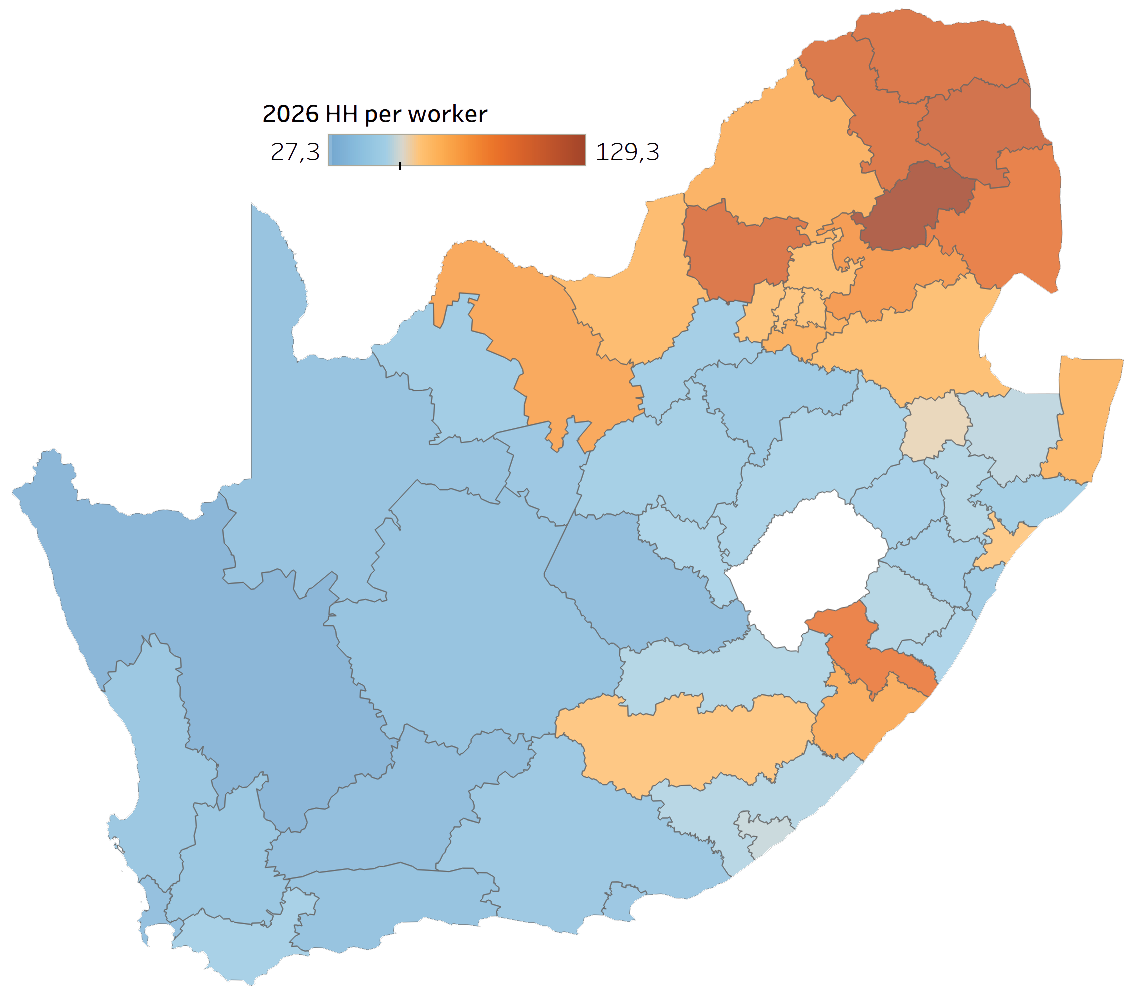
The following figure shows this broad capacity using the ratio of municipal employees per household in the metros and districts/locals combined. The households-per-worker (a proxy for how stretched municipal staff are relative to the population they serve) ranges from 27 (Namakwa, Northern Cape) to 129 (Sekhukhune, Limpopo) among districts with the average for the country is 56 households per worker. The largest districts by household count (Ehlanzeni, Bojanala, Nkangala, Vhembe, Capricorn — all over 400 000 households) are also among the most short-staffed, at 84 to 129 households per worker. Smaller districts tend to be better staffed.
Why municipalities struggle to deliver basic services
The gains made and capacity differences, though, sit alongside a hard truth: much of what has been built is not being kept running.
Our domestic water consumption runs to more than 60 litres per person per day above global benchmarks, driven largely by leaks and losses, though it also points to a need for households with easy access to water to use it more sparingly.
The deeper problem is maintenance. Of the R128 billion municipalities spent on capital projects in 2021/22, around 30%, or R57bn, went to water and sanitation infrastructure. Only 3% of that was spent on repairs and maintenance though. The figure should sit somewhere between 7% and 10%.
This is our first serious problem: we are failing to look after what we have and it shows in every water outage, electricity interruption and sewage spill reported in the news.
The budget numbers tell the same story from another angle.
In 2012/13, municipalities did not spend approximately R35bn; by 2022/23 that had grown to R71.4bn, some 12% of total municipal budgets.
Poor budgeting, weak revenue collection and inefficient management lie at the root of much of this.
Over the same period, the share of municipal expenditure going to capital projects fell from almost 20% to just 12%, meaning steadily less new infrastructure is being built, while operational spending on repairs and maintenance has remained low and in many cases, declined further.
Put together, the trends explain why service delivery is fraying even as the underlying achievements since 1994 remain real.
The importance of professional, merit-based appointments
Fixing this starts with the people running our municipalities.
Our first call to action must go to the institutions mandated to monitor local government, urging them towards real, responsive action.
This does not have to mean the blunt instruments of Section 139 interventions or administrators. It can mean far more targeted steps: stopping performance bonuses where they are not deserved, refusing to allow the appointment of senior managers who lack the requisite experience or professional qualifications, intervening wherever Municipal Staffing Regulations are not being complied with, and insisting on consequences for managers who are responsible or accountable for failures.
Too often, the wrong people end up in critical technical and management posts, not because capable people are unavailable but because appointment processes often take too long and/or bend to political convenience rather than merit.
Restoring a culture in which qualifications, experience and performance determine who runs our water and sanitation departments, electricity departments and finance units is not a technical nicety; it is the single most direct route back to reliable services. Senior management must also be held far more accountable by their own councils when they fail to carry out their duties, rather than being shielded from the consequences of poor performance.
Transparency must become a national priority where all tender and quote outcomes and all building plan/alteration approvals are made available publicly every month. And lack of responsiveness must result in consequence action.
Practical reforms to restore public confidence and institutional capability
Alongside merit-based appointments, two further reforms would go a long way towards rebuilding trust. The first is transparency. Imagine if every municipality published on its website what outsourced service delivery costs, ward by ward, including every call-out to a contractor for repairs.
Imagine too if all building plan/alteration approvals were also made available. Residents would be able to check whether the work was done, and everyone — from councillors to ratepayers — could see whether we are getting value for money.
In the case of building plans, communities could focus on informing the municipalities where buildings are being built without plans being properly passed. The simple steps would allow for far better relationships to emerge between councillors, officials and civil society.
The second is a fairer public conversation about what is working. Municipalities spend more on public infrastructure than provincial or national government does, excluding major state-owned entities, and while some of that spending is undoubtedly wasted, most deliver services and infrastructure that people rely on every day.
Acknowledging genuine accomplishments, achieved within budgets and programmes, alongside honest criticism of the shortcomings, would make it easier to hold municipalities to a standard without writing off the system.
None of this is beyond reach. Lifting repairs and maintenance spending to the recommended 7% to 10% of infrastructure budgets, reversing the decline in capital expenditure, improving revenue collection and budgeting discipline, appointing on merit and publishing what services cost are all practical, achievable reforms.
Taken together, they offer a credible path from the real achievements of the past three decades to the reliable, accountable local government South Africans need.
• Dr Sutcliffe is co-director of City Insight, a firm that provides information and advice on development issues. He’s a former city manager of eThekwini Metro.
• Bannister is co-director of City Insight and a development consultant with experience in urban planning and policy development.
• McGahey has over 20 years’ experience in planning and development and project management.
- Since 1994, South African municipalities have increased access to piped water inside yards from 73.4% in 2011 to 82.4% in 2022, flush toilets from 60% to 71%, formal dwellings from 77.6% to 88.5%, and electricity from 84.7% to 94.7%.
- The average ratio of households per municipal employee is 56 nationally, with larger districts being more understaffed, having between 84 to 129 households per worker.
- In 2021/22, municipalities spent around R57 billion on water and sanitation infrastructure, but only 3% was allocated to repairs and maintenance, below the recommended 7-10%.
- From 2012/13 to 2022/23, unspent municipal budgets increased from approximately R35 billion to R71.4 billion, accounting for about 12% of total municipal budgets.
- Suggested reforms include merit-based appointments, transparency in municipal spending and approvals, increased maintenance budgets, improved revenue collection, and accountability for senior management.


