


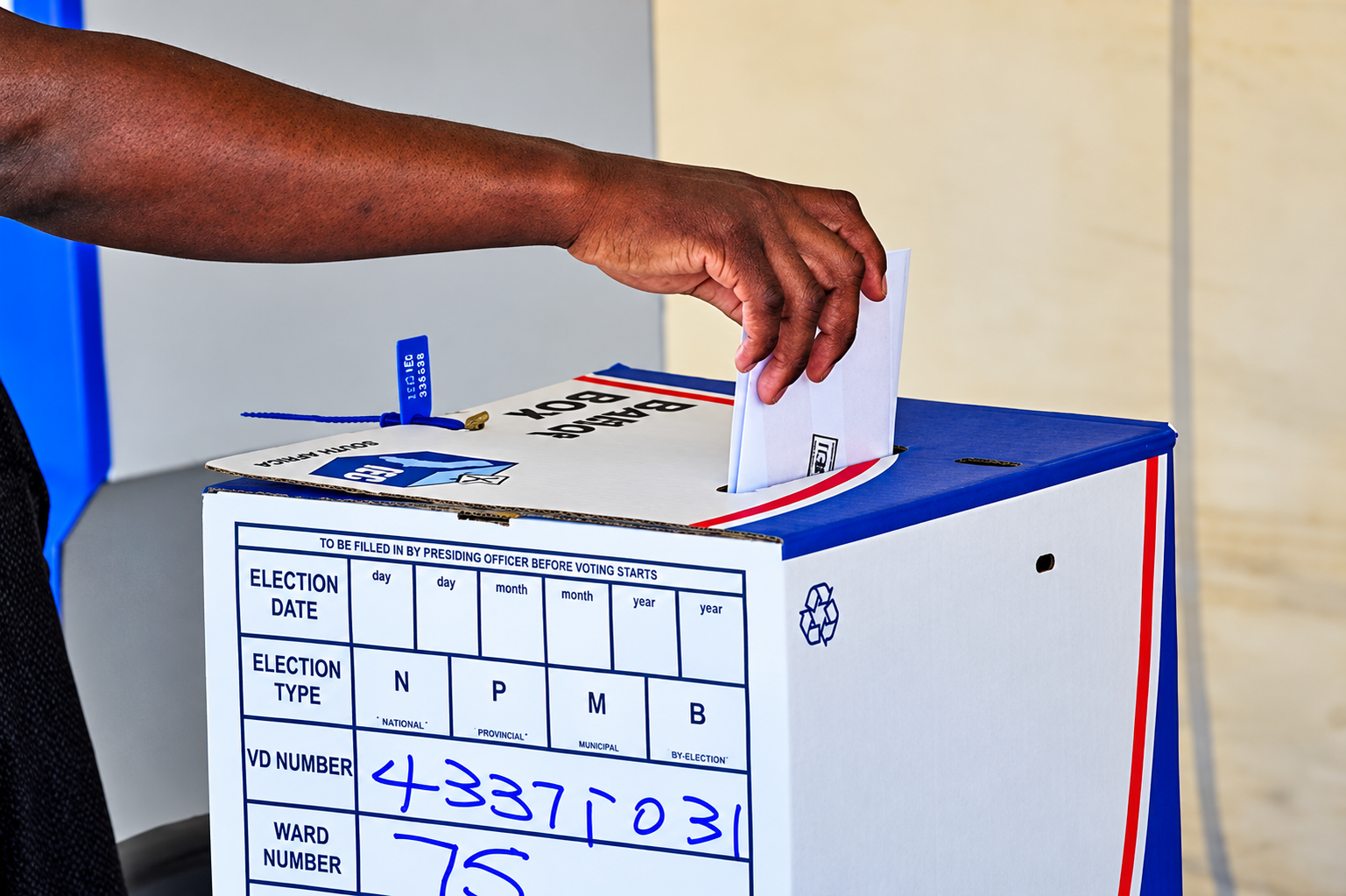
As the 2026 South African local government elections approach, the political class, media, and polling industry are gearing up for the familiar spectacle of a horse race. They will analyse vote shares, coalition possibilities, and the shifting loyalties of the electorate.
Yet, this entire exercise is based on a fundamental misreading of the national reality. The most critical story of 2026 will not be the victory of any single party, but the deafening silence of the majority. The most important data point in the upcoming election according to the Lehohla Ledger is not found on any ballot paper, but in the demographic and spatial audits of the nation.
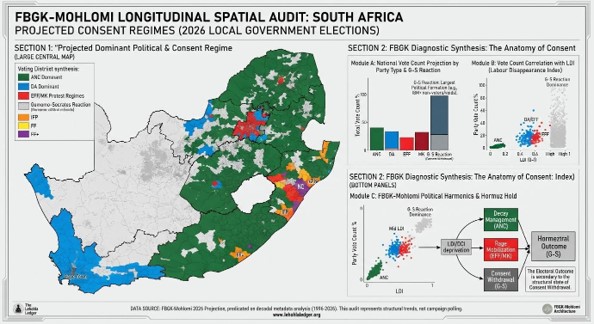
It is the confirmation that the single largest “political formation” in South Africa is not the ruling ANC, the official opposition DA, or the disruptive new challenger, the MK Party. It is the Gomomo-Socrates Reaction – the millions of citizens who have, over decades, actively or passively withdrawn their consent from the transactional electoral market.
To understand why this is happening, we must discard aspatial, national averages and apply the granular diagnostic rigour of the Lehohla Ledger. Standard political analysis obscures the structural invariants of the mesh – population dynamics, the Labour Disappearance Index (LDI), and the Dependency and Capability Index (DCI). When we map the country at the level of its 27,000 voting districts, a stark and troubling picture emerges.
The election is a contest fought over a shrinking pie of political legitimacy. While the ANC (the “Decay Management” regime) and the DA (the “Decay Denialism” regime) fight over the remaining active voters in peri-urban and suburban zones, vast swathes of the deep rural periphery and high-deprivation townships have become inert.
READ: Nozipho Dlamini | Don’t let service delivery frustrations silence your vote
In these areas, the “Hormuz hold” on productive assets has effectively severed the link between the populace and any functional economic future. The spatial kriging models of the Ledger reveal a terminal concentration of poverty and infrastructural failure. When a young person in a hollowed-out rural village, facing a 70% unemployment rate, looks at the state, they see a system that has abandoned them.
Their response is not to vote for the opposition in the hope of change; it is to withdraw. This withdrawal, the Gomomo-Socrates Reaction, is not apathy. It is a political act. It is an unshakeable, data-audited vote of no confidence in the entire system’s ability to provide a daily, lived reality of dignity and function. The election results, regardless of who is declared the winner, will not change this fundamental trajectory. Therefore, how the political parties will “fare” on November 4th is dictated entirely by these spatial realities.
The ANC will hold onto nominal majorities in areas where the state still has a transactional pulse – Lebowakgomo-A or established townships – relying on organizational inertia and the concentration of grant recipients. But this support is soft, brittle, and consumed by structural decay. The EFF and MK Party will consolidate the “rage vote” in high-LDI, high-deprivation informal settlements, capitalising on the rejection of the current order but offering no alternative structural engine.
READ: Elections 2026 | Battleground metros to watch
The winners of the wards will not be parties with mandates, but distinct structural regimes managing the fallout of systemic resource constraints.
- The “Gomomo-Socrates” Wards (The Periphery): The G-S Reaction will be the undisputed winner, signaling terminal delegitimisation
-
The “Transactional” Wards (The Core): The ANC will manage the decay
-
The “Protest” Wards (The Informal Mesh): The EFF/MK will manage the rage. This is a zero-sum equilibrium. The declared winner is not the true sovereign.
The real work of 2026 will begin in spite of this election. The graduating class of 2026 and the emerging generation of leaders cannot afford to wait for distant, insolvent municipalities to be remediated. They must use the granular tools of the Lehohla Ledger – the Fisher-Bayes & Kriging modules – to map their own voting districts, audit their own water grids, and inventory their own productive assets.
The only path forward is to bypass the system that has failed them. The 2026 election will mark the moment when the gap between the political spectacle of a democratic nation and the lived reality of a failed state became too wide to ignore. The future sovereign of South Africa is not the party that secures the highest vote count from a shrinking minority, but the community that successfully transitions from structural dependency into an autonomous, data-driven, and sovereign daily democracy. The silence of the millions on November 4th is not an end; it is the beginning of a new, self-reliant republic.
- The largest "political formation" in South Africa for the 2026 local elections is the Gomomo-Socrates Reaction, representing millions who have withdrawn their consent from the electoral system.
- The elections will reveal three regimes: ANC managing decay in transactional wards, EFF/MK managing rage in protest wards, and the Gomomo-Socrates Reaction dominating in periphery wards.
- Vast rural and high-deprivation township areas show terminal poverty and infrastructural failure, causing residents to disengage politically rather than support opposition parties.
- ANC support persists in peri-urban and suburban zones due to organizational inertia and grant concentration, but this support is fragile and declining.
- The 2026 election highlights a divide between political appearance and lived reality, signaling a shift toward communities seeking autonomous, data-driven local governance.


