



The classical definition of economics states: “Economics is the social science that studies how individuals, businesses, governments and societies allocate scarce resources among competing needs and wants”.
Despite its widespread acceptance and use in economic policy, this definition does not fully capture national well-being or the true wealth of nations. It also overlooks the social foundations of economic prosperity.
Firstly, scarcity is not always inevitable. This narrow definition treats scarcity as inevitable, yet sophisticated marketing, monopolistic behaviour and other market mechanisms that favour the wealthy can also create it.
Secondly, needs and wants exist within a social context. The definition portrays needs and wants as unchecked and insatiable, without acknowledging the role of societal restraint. Lastly, sustainability and the distribution of benefits matter. The definition does not address whether the exploitation of scarce resources is sustainable or how unevenly the resulting benefits are distributed.
Limits of classical economic systems
The free-market promise that wealth would trickle down from the rich to the poor has proved to be a fallacy rooted in greed. Centralised economic control has likewise failed to deliver the intended well-being for citizens. Both capitalist and communist systems have operated as elite-dominated, top-down power structures rather than governing in partnership with citizens.
As global powers are debating a new world order, global inequality continues to worsen across all four dimensions, with these disparities particularly pronounced in South Africa. South Africa is unquestionably the most economically unequal country in the world, with a Gini coefficient ranging between 0.63 and 0.67.
READ MORE: Unemployment rate edges up, highlighting key voter concern
Income inequality refers to differences in earnings and income between individuals, households, and countries. These gaps continue to widen, although rapid economic growth in China, India and other emerging economies has narrowed profound differences remain intractable between countries. Sub-Saharan Africa has experienced slower income convergence, and low-income countries remain dependent on primary commodities.
Substantial gaps in productivity, technological capacity and industrialisation persist between developed and developing countries. In South Africa, the richest 20% of the population controls 70% of the country’s income, while the poorest 20% hold less than 5%.
Wealth inequality concerns the unequal ownership of assets, including property, land, businesses, shares, and financial investments. Wealth has become increasingly concentrated among the richest individuals and households with the richest 10% owning approximately 75% of global wealth, while the poorest 50% own approximately 2%.
In South Africa, the top 10% of the population owns 86% to 95% of total wealth, and the bottom 50% hold zero or negative net wealth (debts exceed assets). Opportunity inequality reflects unequal access to quality education, healthcare, employment, technology, and entrepreneurship.
The digital economy creates new opportunities but also introduces new forms of inequality. Countries and individuals with access to artificial intelligence, digital infrastructure, data, and computing resources have a growing advantage over those without these capabilities. These disparities are particularly pronounced where teaching methods remain outdated. Despite progress in education and labour-force participation, substantial gender disparities persist. In South Africa provinces like Gauteng generate a massive share of the national GDP (about 34.7%) and offer lower unemployment, whereas former homeland regions suffer from scarce job opportunities and lower educational outcomes.
Spatial inequality describes disparities in living standards and economic opportunities between countries and regions, and between urban and rural areas. Climate change disproportionately harms populations that have contributed least to historical greenhouse gas emissions. Black workers living in peripheral townships or former homelands in South Africa face costly transport and long hours of daily commuting. Research by the International Monetary Fund links longer commutes to higher unemployment, lower household incomes and family structures vulnerable to crime and social diminishment.
Beyond GDP: well-being and sustainability
A central question continues to challenge economic debate: if the global economy generates enough wealth and resources to improve living conditions for everyone, why do billions of people still face poverty and limited economic opportunities?
Over recent decades, these concerns have exposed the limitations of economic approaches that fail to account for social realities. Frustration with the slow progress towards more egalitarian societies has encouraged a broader view of economic performance—one that looks beyond GDP to population well-being and environmental sustainability.
Concurrently, successive waves of technology-driven industrial change are reshaping production and the rules of market engagement. As the emphasis shifts from physical to intellectual assets, economic and social systems must be understood together.
This interdependence lies at the heart of the call for a broader approach to economics.
Towards a caring economy
Riane Eisler’s approach to the economic ecosystem is based on the idea that an economy is much broader than markets, businesses, financial institutions, and government. It is an interconnected system of human, social, institutional, and environmental relationships that collectively generate and sustain wealth. She identified a need for a much broader approach to economics: one that considers its larger social and natural context. In her award-winning book Real Wealth of Nations, Eisler argues that economic policy can help reverse this regression by fostering a caring economy.
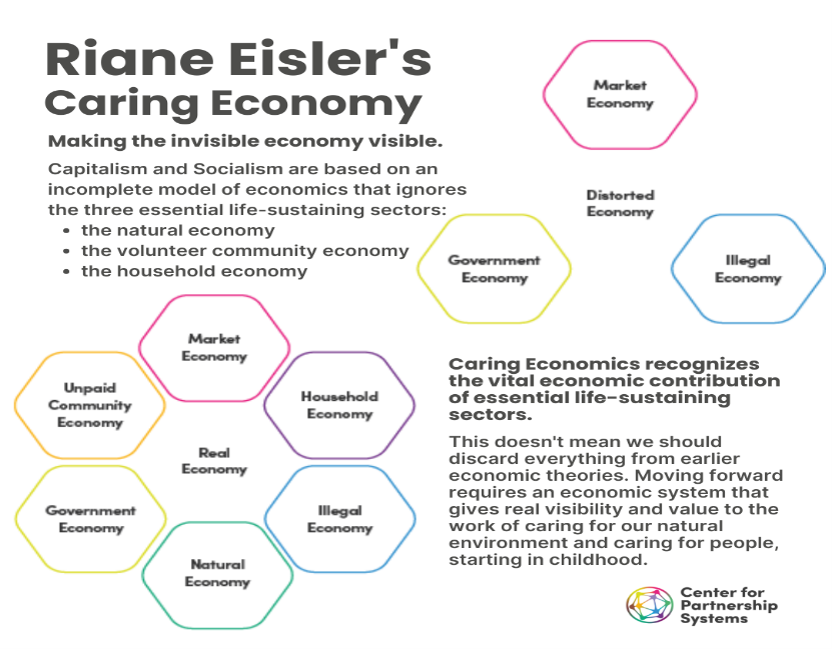
Her suggested approach brings economics into closer dialogue with the social sciences, drawing on evolutionary science, social systems, chaos and complexity theory, and principles developed in quantum physics. Within the expanded ecosystem, Eisler highlights the obscurity of the household economy, despite its centrality in developing human capital. A nation’s economic performance is inextricably linked to the health and well-being of its households and their capacity to nurture a productive population.
Childcare as economic infrastructure
The concept of childcare infrastructure recently emerged prominently in political debate. Worldwide, childcare is increasingly seen as vital economic infrastructure, not just a family responsibility. Accessible childcare helps parents participate in the workforce, boosts workplace productivity and supports economic growth. This further promotes greater economic equality between women and men. Just as roads and electricity supplies underpin society’s physical infrastructure, paid parental leave and universal childcare sustain its social functioning and labour force.
Expanding subsidised childcare is particularly important in “childcare deserts”—areas with limited access to care. Governments can support this expansion through capital grants to private and non-profit operators to build facilities in rural, low-income, and industrially zoned areas.
ROI of investing in childcare infrastructure
Investment in early childcare infrastructure proved to offer one of the highest returns on investment (ROI) among public and private capital projects. These returns extend beyond social benefits: they also support economic growth and can offset the initial investment over time.
Nobel Prize-winning economist James Heckman’s longitudinal research highlights investment in early childhood development as a highly effective approach to supporting long-term economic growth. His research showed that high-quality programmes targeted at disadvantaged or low-income families can generate a return of $7 to $13 for every $1 invested. Benefits stem from lower spending on special education, healthcare, and criminal justice; higher tax revenues from increased adult earnings; and reduced reliance on social welfare.
READ MORE: 1 million children still shut out of early learning, Gwarube warns
Universal or broad-based childcare systems, including the Nordic model and Canada’s national rollout, deliver near-term fiscal returns of $1.50 to $3.50 for every $1 invested. Subsidised childcare enables parents, particularly mothers, to enter or return to the workforce. Public revenue comes from their income and payroll taxes, as well as corporate taxes from the expanding childcare sector.
For employers, investment in on-site childcare, backup care networks or flexible childcare stipends can deliver tangible financial benefits. Businesses can recoup an average of $2.00 for every $1 spent through improved staff retention and recruitment through lower recruitment and retraining costs, less absenteeism caused by disrupted care arrangements, and a stronger ability to attract skilled professionals.
Strengthening South Africa’s household economy
South Africa’s socio-economic indicators point to a highly vulnerable household economy. Economically vulnerable young children receive care in unstructured settings, often reliant on volunteers. Widespread unemployment, rising lawlessness and corruption, and dependence on social welfare grants among 41% of the population deepen this vulnerability.
These mutually reinforcing problems hinder recovery from prolonged economic stagnation and prevent South Africa from realising the benefits of developing childcare infrastructure.
In South Africa, unpaid childcare enables young parents to participate in the labour force, often far from their families. Grandparents and other relatives frequently provide this care in informal settings. These caregivers should be recognised as economic contributors, not merely dependants. Their often-overlooked work forms an important part of South Africa’s informal economy and should be formalised.
South Africa’s social welfare policies should support childcare from birth, rather than focusing solely on preschool. Policies should also enable family members who provide informal care but are classified as unemployed to enter formal employment. This would create dignified jobs and unlock unrealised economic benefits, delivering tangible social and economic returns on investment.
Without early intervention through childcare infrastructure to improve educational outcomes, the gains from economic growth will remain unevenly distributed. Children whose development and learning needs are unmet must compete with peers from better-resourced families.
Sustainable, inclusive growth requires addressing these disparities early so that its benefits are shared more widely.
- The classical definition of economics states: “Economics is the social science that studies how individuals, businesses, governments and societies allocate scarce resources among competing needs and wants”.
- Despite its widespread acceptance and use in economic policy, this definition does not fully capture national well-being or the true wealth of nations.
- It also overlooks the social foundations of economic prosperity.
- Firstly, scarcity is not always inevitable.
- This narrow definition treats scarcity as inevitable, yet sophisticated marketing, monopolistic behaviour and other market mechanisms that favour the wealthy can also create it.


