


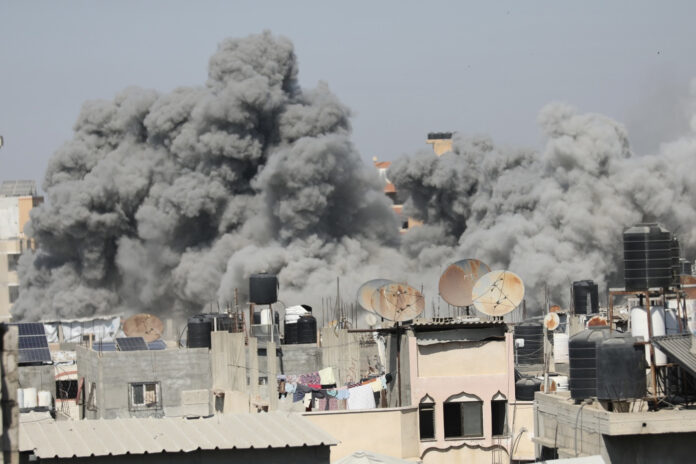
The map of killing and destruction in Gaza is there for all to see, yet some among us claim they cannot see it. How disingenuous of them.
The plight of Palestinians is deafening as Israel’s assault continues, killing and maiming civilians. Follow the map of Gaza from north to south and the scale of destruction becomes clear. Homes, hospitals, universities, mosques and neighbourhoods have been reduced to rubble.
As the rubble is cleared, bodies are found beneath it. Medical workers have testified about children being shot by Israeli drones and quadcopters. A United Nations commission of inquiry documented an incident in which a 10-day-old Palestinian baby was shot in the head by an Israeli military quadcopter.
How sick must things become before the world acts?
The cartography continues underground, through the tunnels discovered by the Israeli military, and into areas where desperate Palestinians gather for food. Reports of civilians being shot near food distribution points have added another layer to the horror.
People are ordered to leave one area for another, told they are moving towards safety, only to find themselves exposed again to bombardment and death.
For months, Palestinians were pushed south towards Rafah on the Egyptian border as Israel expanded its military campaign. The fear has always been that making Gaza unlivable would eventually force Palestinians across the border.
During the Holocaust, Nazi Germany confined Jews and other persecuted groups before carrying out systematic mass murder. The comparison should never be made lightly.
European governments express growing concern about the occupied West Bank, where settler violence, demolitions and displacement continue. They warn that this threatens any future two-state solution. Really?
What two-state solution survives the destruction of Gaza and the steady erosion of Palestinian life in the West Bank?
That is the contradiction European leaders must confront. Concern means little if it is not matched by pressure capable of changing what is happening.
The same applies to grand international peace initiatives. New committees, boards and diplomatic structures mean little if Palestinians continue to die while governments discuss process.
Western media also has questions to answer. For much of this war, arguments over whether hospitals were being targeted, civilians displaced or Israel’s conduct amounted to genocide often overshadowed what Palestinians were experiencing. Where are Gaza’s hospitals? Much of the health system has been destroyed or left unable to function normally. Universities and mosques have been damaged or destroyed. Tens of thousands of Palestinians have been killed.
Yet the argument continues over what to call it. Puzzling.
The evidence is written across Gaza in rubble, graves and displacement.
Some insist Israel is acting in self-defence after the October 7 attacks. Israel says Hamas poses an existential security threat and that its campaign targets Hamas rather than Palestinian civilians.
But self-defence does not remove the obligation to distinguish civilians from combatants. Nor does it make every method of war acceptable.
The deeper question is why so much Palestinian death and destruction can be witnessed without producing the political urgency such suffering demands.
There is also a disturbing hardening of public attitudes inside Israel. Polling and public commentary have shown strong support for continued military action.
I do not pretend to understand the psyche of American and European governments that repeatedly express alarm while pursuing policies that fail to stop it.
Something must give, for the sake of Palestinians and, dare I say, humanity.
We often debate maps because maps shape how we see the world. There has rightly been criticism of maps that visually shrink Africa and distort its true scale.
But what about Gaza? Does it not deserve an honest portrayal of the scale of devastation? The map before us shows neighbourhoods erased, families displaced, hospitals shattered, graves multiplying and a people increasingly confined to smaller pieces of land. That map should not be minimised either.
Only time will tell whether responsible leaders act before more of Gaza disappears. Palestinians do not need symbolic sympathy. They need protection, dignity, political rights and the possibility of sovereignty.
Let us redraw the map of Palestine, but first let us look honestly at the map before us. Stop pretending we cannot see it.
• Dr Van Heerden is a senior research fellow at the Centre for African Diplomacy and Leadership at UJ
- Israel's military assault on Gaza has led to widespread destruction including homes, hospitals, universities, mosques, and neighborhoods reduced to rubble, with many civilian casualties found beneath the debris.
- A United Nations commission documented an incident where a 10-day-old Palestinian baby was shot in the head by an Israeli military quadcopter.
- Palestinians have been pushed southwards towards Rafah on the Egyptian border amid ongoing bombardments, with reports of civilians being shot near food distribution points.
- Tens of thousands of Palestinians have been killed, and much of Gaza’s health system has been destroyed or rendered nonfunctional during the conflict.
- European governments express concern over violence and displacement in the occupied West Bank but have yet to apply sufficient pressure to change the situation, while international peace initiatives have not prevented continued Palestinian suffering.


