


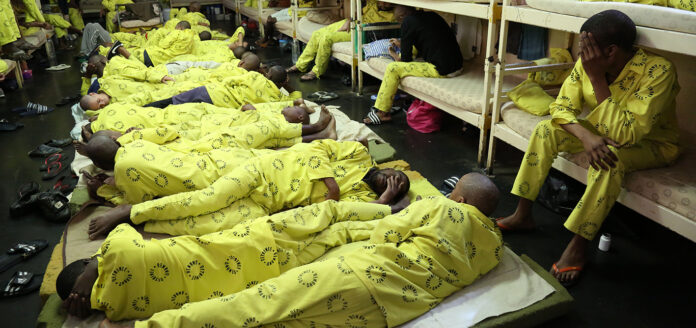
In the wake of recent anti-immigrant protests in South Africa, law enforcement agencies have significantly increased immigration-related arrests.
However, this raises an important question: apart from the hardship and suffering experienced by these detainees, is the mass incarceration of people detained for immigration-related offences an effective response to the country’s immigration challenges? Or does it merely deepen other crises, notably chronic prison overcrowding?
In June, the Department of Correctional Services reported that South Africa’s correctional centres held about 27 880 foreign nationals, comprising 14 614 awaiting-trial detainees and 13 266 sentenced inmates.
The inmates formed 16.4% of an overall prison population of 170 518, despite the country’s correctional system being designed to accommodate 107 054 people, resulting in an overcrowding rate of 159.3%.
Correctional Services also reported to the Judicial Inspectorate for Correctional Services that as of 7 July 2026, 14 877 foreign nationals were detained solely for immigration-related offences, representing about half of all incarcerated foreign nationals. The number exceeds the total approved bed capacity of every province in the country.
If all or even a significant number of incarcerated foreign nationals were deported, overcrowding in correctional facilities would be markedly reduced.
The financial implications are equally significant. About a year ago, Correctional Services Minister Pieter Groenewald said it costs the state about R463 a day to imprison each foreign national, amounting to roughly R11.1-million every day for this cohort. The incarceration of foreign nationals, therefore, places a substantial financial burden on taxpayers.
The figures are striking when compared with the cost of deportation. In the 2024/2025 financial year, the Department of Home Affairs spent about R78.1-million to deport 51 650 undocumented foreign nationals – almost equivalent to what the state spends incarcerating 27 880 foreign nationals for seven days.
Why are we prosecuting, convicting and imprisoning people for immigration-related offences as opposed to deporting them? To answer this, it is necessary to distinguish between two forms of detention: administrative detention, which facilitates deportation, and criminal detention, which punishes criminal conduct.
The question does not extend to undocumented foreign nationals who have committed offences, particularly serious offences, beyond immigration violations. Where individuals are accused or convicted of other crimes, imprisonment ensures justice and accountability.
The Immigration Act 13 of 2002 creates two mechanisms for dealing with undocumented foreign nationals. Section 34 provides for administrative detention, where an individual is detained to facilitate their deportation. By contrast, section 49 creates a criminal offence for entering, remaining in or departing from South Africa in contravention of the Act. A person convicted under section 49 must first serve a sentence of imprisonment or pay a fine before they can be deported.
The increase in criminal prosecutions also appears to have been partly driven by a desire to project an image that the government is taking a tough stance on illegal immigration.
Immigration-related contraventions are not indicative of violent or serious criminal conduct, making prosecution and imprisonment a disproportionate response. Moreover, there is little evidence that criminalising irregular migration serves as an effective deterrent.
Prioritising deportation over prosecution and imprisonment would also ease pressure on an overcrowded, overburdened and financially strained correctional system and the criminal justice system. Incarcerating people for immigration-related violations diverts scarce public resources away from essential correctional services.
Ultimately, what is gained by imprisoning undocumented foreign nationals whose only offence is an immigration-related violation?
If the approach is increasing public expenditure, worsening prison overcrowding and imposing unnecessary human suffering without deterring irregular migration, then it is time to rethink it.
•Bozalek is the Inspecting Judge of the Judicial Inspectorate of Correctional Services.
- South Africa’s correctional centres held about 27,880 foreign nationals in June, comprising 16.4% of the total prison population of 170,518, despite the system being designed for 107,054 people, resulting in 159.3% overcrowding.
- As of 7 July 2026, 14,877 foreign nationals were detained solely for immigration-related offences, which exceeds the total approved bed capacity of every province in South Africa.
- It costs the state roughly R463 per day to imprison each foreign national, totaling about R11.1 million daily for this group, whereas the Department of Home Affairs spent R78.1 million to deport 51,650 undocumented foreign nationals in the 2024/2025 financial year.
- The Immigration Act 13 of 2002 differentiates between administrative detention for deportation (section 34) and criminal detention for immigration offences (section 49), with the latter requiring imprisonment or fines before deportation.
- The increase in criminal prosecutions for immigration offences is driven by a desire to appear tough on illegal immigration, though these offences are not serious crimes and criminalisation does not effectively deter irregular migration.


