


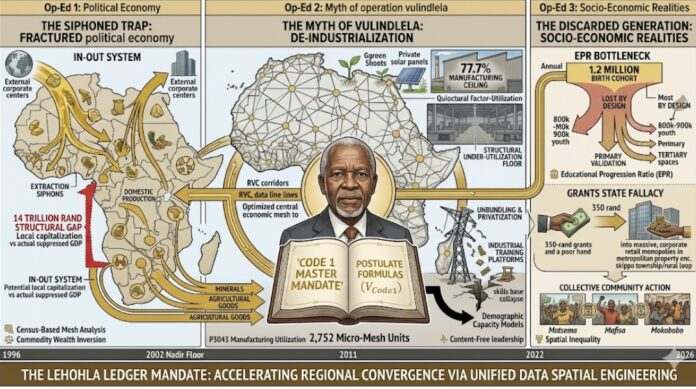
In this op-ed I explore the Educational Progression Ratio (EPR) bottleneck, the Fallacy of the Grant State and spatial inequality and the need to activate indigenous knowledge and collective action.
The true tragedy of contemporary South African society is captured not by volatile currency metrics but by the demographic tracking embedded in the EPR.
A census functions as a spatial time machine. By projecting demographic traits backwards through age cohorts, it exposes the deep structural engineering of human capital development. The latest numbers from the Quarterly Labour Force Survey and educational registries reveal a terminal bottleneck that condemns most of the population to structural path dependency.
Out of a raw annual birth cohort of 1.2 million children, a devastating system design failure results in 500 000 children being lost to the educational system before reaching secondary validation. Only 250 000 pupils complete a decent matriculation pass. The receiving end, in the form of a university, can take only 160 000 spaces. This means that approximately 800 000 to 900 000 youth are structurally discarded by the system every year.
Our astronomical youth unemployment rate is not an accident or a temporary macroeconomic shock; it is by design. When educational progression ratios show a perpetual downward trend for 90% of the majority population, the country is generationally regressing. In the absence of generational value-adding for the majority, the entire nation is destined to sink.
The fallacy of the grant state and spatial inequality
Rather than correcting this catastrophic design flaw, the state has chosen to administer poverty. The R350 monthly distress grant is celebrated as a survival mechanism but in reality, it perpetuates a system of dependency and extraction. The latest income and expenditure figures show that while the purchasing power of the black majority has shifted because of the social grants, corporate profits soared over the same period.
The grant state simply acts as a conduit: the R350 visits the accounts of the poor but no sooner has it landed, then it is immediately siphoned back to large retail monopolies and corporate enclaves. It does not circulate in the township or rural economy because the community lacks the economic levers to generate internal value.
The systemic exclusion is further mirrored in the Residential Property Price Index, which shows property value inflation aggressively concentrated inside exclusive metropolitan enclaves, while general household purchasing power is severely eroded. Most of the population — the commoners or molata —face grinding poverty, while the political and corporate elite compact — the monga motse — hides its own developmental failures (kotokoane) behind walls of speculative financialisation and spatial segregation.
Activating indigenous knowledge and collective action
To reverse the degeneration, South Africa requires a radical re-education of the native, moving beyond Eurocentric dependency and content-free leadership.
We must look back at our own history to diagnose the problem, using the principles of Mohlomiism and Moshoeshoeism as an economic function. King Moshoeshoe I demonstrated through highly sophisticated policies — such as matsema (collective labour), mafisa (livestock asset sharing) and mokobobo (communal grain sharing) — that the collective whole must always be held in the highest regard to systematically erase destitution.
We must deploy the Unified Indicator App Engine directly to the ward and community level, putting the raw, undisputed facts of local wealth extraction into the hands of traditional councils, civic organisations and schools.
By providing communities with concrete data on their local central place indices and historical enumeration area changes, we allow them to formulate their own development manifestos.
We must transform our massive local cultural brands into physical manufacturing clusters inside the 2 752 micro-mesh units, ensuring that everything from consumer goods to clothing is produced locally. The active citizenship and structural reform are the only path to halt the bleeding, re-absorb our discarded youth and build an inclusive, self-sustaining society.
Pali Lehohla is the former statistician-general of South Africa.
- South Africa's Educational Progression Ratio (EPR) reveals a systemic failure where out of 1.2 million children born annually, nearly 800,000 to 900,000 youth are lost from the education system before university readiness, fueling generational unemployment and structural inequality.
- The state’s reliance on the R350 social grant perpetuates poverty and economic dependency by channeling funds into major retail monopolies rather than stimulating local township or rural economies.
- Spatial inequality is intensified by property value inflation in metropolitan areas, benefiting elites while the majority remain trapped in poverty and exclusion from wealth generation.
- Revival of indigenous knowledge and collective action, grounded in the economic principles of historic leaders like King Moshoeshoe I, is proposed as essential for addressing poverty and social dysfunction through community-based collaboration and resource sharing.
- Empowering local communities with data via tools like the Unified Indicator App Engine and transforming cultural brands into manufacturing hubs can foster inclusive development, active citizenship, and sustainable economic reform.


