
The dominant debate that was raging among football lovers across the world this week, because of developments in the Fifa World Cup, was the question of just how far
corruption goes within the body governing the beautiful game globally.
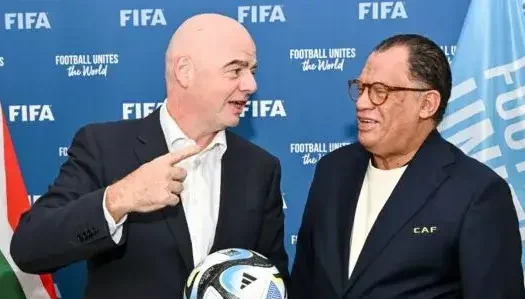
And Fifa president Gianni Infantino has emerged at the centre of this supposed corruption that is interfering with match outcomes directly and indirectly.
But maybe Infantino is not the root cause; the ultra-commercialisation of the sport is the real enemy, because all decisions seem to be made with the commercial aspect in mind.
The commercialisation of football on its own is not a bad thing, but when it becomes the centre of attention far above the game itself, it begins to erode the legitimacy and credibility of match outcomes.
The shenanigans that have been happening at the Fifa World Cup, co-hosted by the USA, Canada and Mexico are a symptom of the ultra-commercialisation problem.
Among other problems that have emerged is the corporate scam that has been sold as “hydration breaks”, which are double, two-minute-long breaks within both halves of the game.
During these breaks, the advertisers are cashing in, as are the official broadcasters who hold the broadcast rights from Fifa and ultimately, Fifa benefits.
These breaks, first and foremost, unnecessarily interfere with the flow of the game and can disorganise a team that was on a roll. It is also an unfair window for a quick change of tactics by the coach whose team is under attack.
The ultra-commercialisation factor has also presented a far bigger problem in which patterns of rigging matches for certain predetermined outcomes are far glaring to ignore.
In this World Cup, for instance, it has become evident that owing to the commercial weight carried by the names of sports stars Lionel Messi and Kylian Mbappé, the predetermined final is a clash between France and Argentina. And almost all sane football followers know that Argentina will then be crowned champions, even if they must be awarded as many dubious penalties as possible.
I can bet my last cent on this prediction.
The questionable on-field decisions in matches of both nations this week were telling.
The less said about the disgraceful decision-making in the Last-16 match between Argentina and Egypt the better.
Even my 11-year-old son could see that everything was done to ensure that Argentina progressed to the quaterfinals, by hook or crook.
As if that were not enough, this shameless conduct continued in the quarterfinal encounter between France and Morocco. A bogus penalty was awarded to France early on, and fate intervened because Mbappé missed the spot kick.
In this regard, the weaponisation of the video assistant referee (VAR) is obvious; to promote corruption is openly encouraged.
Contrary to what always happens by showing viewers the VAR review as it happens, it is only in this World Cup where Fifa decides which VAR reviews are to be shown to viewers while some are done in the dark.
But these controversies that have rocked the World Cup are probably part of Fifa’s commercial strategy. This because controversy brings eyeballs to the TV screens, advertisers milk it, and so does Fifa.
Forcing Messi and Argentina down our throats applies the same logic because a popular and highly divisive star like him brings eyeballs to the small screen. Those who love him watch to see him win, while his detractors, who believe he wins with Fifa’s assistance, hate-watch him, hoping he will lose.
Shame on Fifa for killing the beautiful game to push ultra-commercialisation.
- The FIFA World Cup has sparked widespread debate on corruption within the global football governing body, with FIFA president Gianni Infantino at the center of these allegations.
- The article argues that ultra-commercialisation, prioritizing money over the game itself, is the root problem eroding the sport's legitimacy and credibility.
- Controversial practices like "hydration breaks" are criticized for disrupting the game and serving corporate interests rather than player welfare.
- Match-fixing suspicions are highlighted, particularly favoring star players Lionel Messi and Kylian Mbappé, with questionable referee decisions seen as influencing outcomes.
- The manipulation of VAR reviews and orchestrated controversies are viewed as part of FIFA's strategy to attract viewers and advertisers, ultimately harming the integrity of football.


