


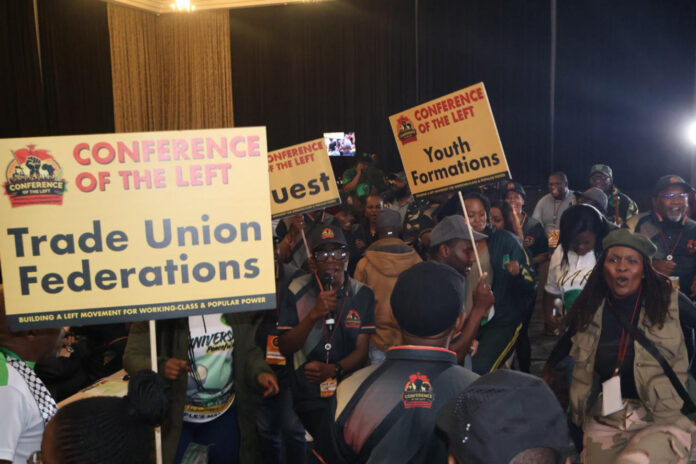
The Conference of the Left, convened by the SACP from May 29 to 31, concluded by adopting a historic final declaration. The final resolution outlined a strategic goal of building working-class power to move “beyond capitalism”, established a new Council of the Left to coordinate action and set an eight-point programme for implementation.
The ANC was notably absent from the conference. This raises the question on whether the ANC is situated on the Left or not?
When using Marxist-Leninist analysis, what comes to mind for me in understanding the South African historical problématique is Thabo Mbeki’s analysis in a 1978 address to the Parliament of Canada.
He stated the eternal problem statement that plagues our native land, when he said: “In South Africa the capitalists, the bourgeoisie are the dominant class. Therefore the state, other forms of social organisation and the ‘official’ ideas are conditioned by this one fact of the supremacy of the bourgeoisie.
“It would be therefore true to say that in its essential features, South Africa conforms to other societies where this class feature is dominant.”
In my mind, the Conference of the Left, reiterated the problématique. The solution we were sold has two stages. The first is that we must politically liberate our people, which means one man, one vote. That ought to be the basic mandate of the ANC.
The second stage of the National Democratic Revolution, is supposed to be economic emancipation of our people on a path to socialism. This ought to be the primary mandate of the SACP.
The question must then be: Who has failed our people thus far?
Who is in the Left? Although 103 organisations attended the conference, it still beckons the questions: Who are the organisations? Are they indeed anti- capitalism? Do they want to move the country towards socialism?
The final declaration, which was the centrepiece of the conference, was titled “Building a Left Movement for Working-Class and Popular Power”, which affirmed that South Africa’s crisis is rooted in capitalism and that the compromises of the 1994 settlement are unfinished.
It states that the strategic goal is a society based on social ownership, democratic economic control, wealth redistribution, land justice and ecological sustainability.
For many, the goal is socialism.
Coupled with this is an ever-worsening crisis of our triple challenges of poverty, inequality and unemployment.
Indian historian Vijay Prashad wrote: “We have not gathered to lament this crisis. We have gathered to organise against it.”
That was the hallmark of the conference: not a “talk shop” but a forum to deepen their capacity for political organisation of the working-class.
On Key Resolutions and Action Points, it concluded:
- Constitutional Reform: Calls for a review of the 1996 Constitution to address land, property and public ownership, aiming to tilt state power in favour of workers and the poor.
- Economic Transformation: Pushes for state-led industrialisation, democratic trade policies and nationalisation of key sectors like banking and mining.
- Land Expropriation: Commits to land restitution, redistribution and expropriation without compensation.
- Cost of Living and Corruption: Declares the cost of living a “central terrain of class struggle”, supports a permanent universal basic income grant financed by wealth taxes and demands accountability on the Phala Phala scandal.
- Organisational Structure: Formed a permanent Council of the Left (comprising the EFF, MK Party, PAC, Cosatu and so on) to coordinate anti-government of national unity campaigns.
In short, the conference stated that the task of the present period was to defend democratic gains while advancing beyond the limits of the 1994 settlement towards economic democracy, social ownership, land justice, working-class power and ultimately, socialism.
The picture above is what we, as citizens, can expect as we see the ANC losing electoral support among our people. The ANC, it seems to me, decided that a social democratic model is the best way forward but evidently the Left don’t see it that way clearly. As the power of the ANC withers and we know the DA embraces capitalism and neo-liberalism unapologetically, what does it spell for our beloved country?
- Dr Van Heerden is a senior research fellow at the Centre for African Diplomacy and Leadership at UJ.
- The Conference of the Left (May 29–31), organized by the SACP, adopted a historic final declaration with the goal of building working-class power to move beyond capitalism, forming a new coordinating Council of the Left and setting an eight-point programme.
- The conference highlighted South Africa’s ongoing capitalist crisis, poverty, inequality, and unemployment, emphasizing the failure to fully achieve economic emancipation since the 1994 settlement, and questioning the ANC’s role and leftist credentials.
- Key resolutions include constitutional reform to favor workers and the poor, state-led industrialization, nationalization of critical sectors, land expropriation without compensation, universal basic income funded by wealth taxes, and demands for corruption accountability.
- The newly formed Council of the Left will coordinate anti-government campaigns, with participation from groups like the EFF, MK Party, PAC, and Cosatu, underlining a shift towards deepening working-class political organization.
- The conference concluded that advancing beyond the 1994 democratic settlement toward socialism, land justice, and economic democracy is vital as the ANC loses support and the DA openly embraces neoliberal capitalism, raising questions about South Africa’s political future.


