


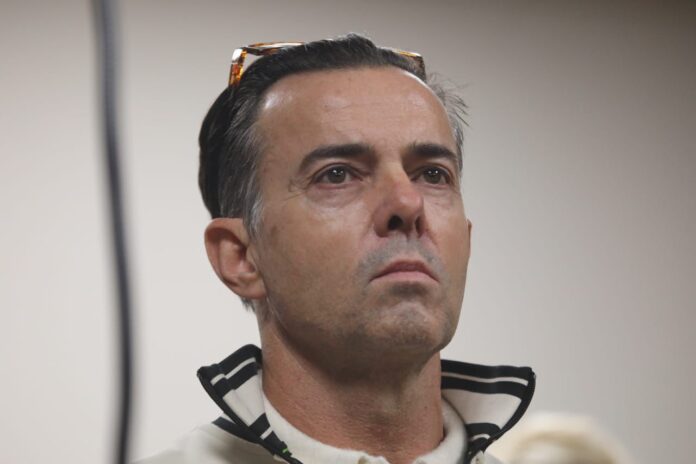
Disbarred attorney Peet Viljoen has accused the National Prosecuting Authority (NPA) of relying on withdrawn criminal cases, years-old civil disputes and misleading evidence in an attempt to oppose his bail application.
Viljoen’s advocate, Andre Steenkamp, spent much of Thursday morning reading his client’s replying affidavit into the record in the Pretoria Specialised Commercial Crime Court, where Viljoen is applying for bail after being arrested in connection with an alleged R27-million City of Johannesburg property fraud scheme.
In the affidavit, Viljoen disputes several allegations made by the investigating officer, arguing that the state has failed to demonstrate that he is either a flight risk or someone who committed further offences while out on bail.
Viljoen says state relying on outdated, irrevelant complaints
One of the central pillars of Viljoen’s response is his claim that the state is relying on criminal complaints that were either withdrawn years ago or stemmed from civil disputes involving his diamond dealer business.
“I now understand that criminal charges were laid in relation to these matters. However, those criminal charges were withdrawn several years ago,” the affidavit states.
Viljoen argues that if investigators genuinely believed there were strong criminal cases against him, the South African Police Service (SAPS) and the NPA would have prosecuted him at the time instead of reviving the allegations years later during his bail application.
He further contends that if the allegations suggested he had committed offences while already on bail, prosecutors had every opportunity to apply to have his bail revoked.
“As they did not do so, I fail to understand how they can now rely on them,” the affidavit reads.
Rejects intimidating witnesses
Viljoen also rejects allegations that he intimidated witnesses and officers of the court, saying the investigating officer had wrongly interpreted legal submissions and arguments made during previous court proceedings as intimidation.
He argues that legitimate legal arguments about the consequences of certain actions have been mischaracterised by the state.
The affidavit also questions the state’s handling of the criminal case after the high court ordered in October 2024 that the matter be placed before a different magistrate.
Viljoen says that despite the court order, no meaningful steps were taken for about 17 months to re-enrol the matter.
He questions why only he was eventually brought before court while the other accused were allegedly never served with summonses.
“What was done to place the other accused before the court?” the affidavit asks.
According to Viljoen, neither the NPA nor SAPS contacted his legal representatives or those acting for his co-accused to arrange for the matter to be re-enrolled as directed by the high court.
Instead, he says, the accused were left “in limbo” while waiting for the prosecution to act.
Media reports about US presence
Viljoen also suggests that renewed efforts to pursue him were prompted by media reports about his presence in the United States (US) rather than a genuine attempt to comply with the high court’s order.
“It appears to me that media reports about me while I was in the USA prompted these actions from the NPA,” the affidavit states.
The disbarred attorney further argues that after the original proceedings were struck from the roll, no reporting conditions or other active bail obligations were communicated to him.
He says he and his co-accused could not reasonably be expected to place their lives on hold indefinitely while waiting for the NPA to decide whether to re-enrol the matter.
Viljoen also rejected the state’s claim that he fled the United States, insisting that he voluntarily requested to be deported to South Africa despite knowing he would be arrested upon his return.
According to the affidavit, he initially applied for voluntary deportation, but after a US immigration judge was unable to hear the application on the same day, he chose to waive certain immigration rights and requested deportation instead.
“I asked to be deported to the Republic of South Africa,” the affidavit states.
Viljoen says he made the decision because of the conditions under which he was being detained in the United States and because delaying the immigration proceedings would have been highly prejudicial.
The affidavit quotes what it says were exchanges before the US immigration court in which Viljoen allegedly told the judge: “I have no option but to beg the court to deport me. I would like to be removed to Cape Town, South Africa.”
He says that by requesting deportation he knowingly accepted a 10-year ban on re-entering the United States.
Asthma claims
Viljoen also disputes the investigating officer’s claim that he falsely claimed to suffer from asthma, pointing to a medical certificate attached to his affidavit which he says confirms the diagnosis.
The affidavit further accuses the investigating officer of making “false sweeping statements” without properly investigating the facts, which the defence says undermines her credibility.
Viljoen also rejects allegations that he intimidated officials during his arrest.
The investigating officer alleges that he threatened those present by saying the matter had already been dismissed and that he would sue everyone involved.
Viljoen argues that these were not threats but lawful assertions of his constitutional rights.
“This is not a threat. This is an argument why I should not be arrested,” the affidavit states.
He further contends that informing officials of his intention to institute legal proceedings if he believed the arrest to be unlawful could not reasonably be interpreted as intimidation.
The affidavit also disputes the State’s reliance on numerous franchise-related complaints and commercial disputes, arguing that many arose from business transactions involving companies in which his wife, and not he, held interests.
Viljoen says several of the matters related to franchise agreements in the beauty industry, where disputes developed after franchisees allegedly failed to meet their contractual obligations. According to him, the resulting litigation was civil in nature and not evidence of criminal conduct.
He argues that if the complaints had disclosed criminal offences, the NPA would have prosecuted him years ago instead of relying on them now during bail proceedings.
“The reason nobody was arrested or brought before court was that the NPA realised these were civil matters where complainants attempted to use the SAPS as a debt collection mechanism,” the affidavit states.
The defence also dismisses ongoing civil litigation involving the Damitas Global trademark as irrelevant to the bail proceedings.
Fixed physical address
Viljoen further disputes the state’s assertion that he had no fixed address.
According to the affidavit, investigators were informed where he and his wife were residing through telephone conversations and correspondence long before his arrest.
The defence says transcripts of conversations between Mr Nieman and investigating officer Colonel Glen Heriff show that investigators knew the Pretoria address where Viljoen was staying. It argues that this information was ignored while the State continued to rely on another address to explain why summonses were allegedly not served.
Viljoen alleges that the investigating officer omitted communications that supported his version and instead presented incomplete and misleading evidence to strengthen the State’s opposition to bail.
His legal team told the court that transcripts of the conversations and supporting statements have been attached to the affidavit and will form part of its legal argument.
The bail application continues before the Pretoria Specialised Commercial Crimes Court, where the State is expected to respond to the defence’s replying affidavit before arguments on bail resume.
ALSO READ: Viljoen denies he’s flight risk after state paints him as fugitive in bail battle
- Disbarred attorney Peet Viljoen challenges the NPA's opposition to his bail, claiming reliance on withdrawn criminal cases, outdated civil disputes, and misleading evidence.
- Viljoen denies being a flight risk or committing offenses while on bail, arguing the state failed to revoke bail despite opportunities.
- He disputes allegations of witness intimidation and claims the investigating officer misinterpreted legal arguments as intimidation.
- Viljoen questions the prosecution’s delay in re-enrolling his case after a 2024 court order and suggests media reports on his US presence prompted renewed legal actions.
- He refutes claims of fleeing the US, voluntarily requesting deportation despite a resulting 10-year ban, and challenges the state's assertions about his medical condition, address, and criminal conduct.


