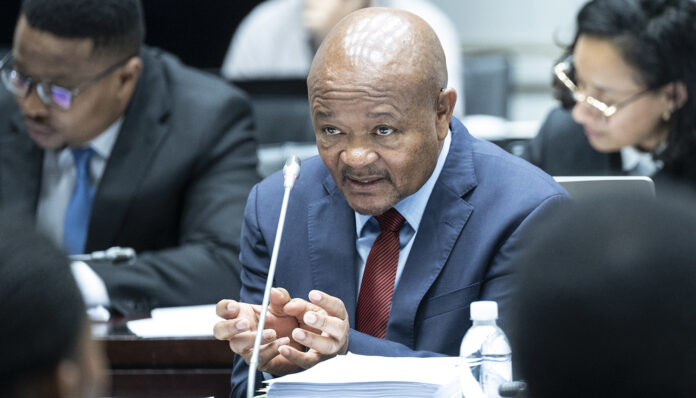
CAPE TOWN, SOUTH AFRICA - OCTOBER 16: Suspended Police Minister Senzo Mchunu at the Parliamentary Ad Hoc Committee inquiry into alleged corruption and political interference in the criminal justice system at Good Hope Chambers on October 16, 2025 in Cape Town, South Africa. The inquiry was set up to probe political interference, leadership failures, and internal dysfunction in the South African Police Service (SAPS) with a particular focus on allegations raised by Mkhwanazi about interference within the police command on July 6th. (Photo by Gallo Images/Brenton Geach)
Gcaleka says her investigation into Mchunu's alleged breach of the Executive Ethics Code is nearing completion.
Gcaleka says investigators have completed most of the evidence-gathering process.
The complaint centres on claims Mchunu breached Executive Ethics Code through alleged involvement in dismantling PKTT.
Public Protector Advocate Kholeka Gcaleka says her investigation into suspended Police Minister Senzo Mchunu’s alleged breach of the Executive Ethics Code is nearing completion, while cautioning Parliament against interfering in an ongoing inquiry.
In a letter dated July 17 to Parliament’s Portfolio Committee on Justice and Constitutional Development, seen by Sunday World, Gcaleka said investigators had completed most of the evidence-gathering process and were now preparing the final report. She did not, however, indicate when the report would be released.
The committee had requested an update on the progress of the investigation following a complaint lodged by the African Transformation Movement (ATM) in terms of the Executive Members’ Ethics Act.
The complaint centres on claims that Mchunu breached the Executive Ethics Code through his alleged involvement in the dismantling of the Political Killings Task Team, political interference and executive misconduct.
MPs not entitled to direct ongoing investigation
In her response, Gcaleka stressed that while her office remains accountable to Parliament, that responsibility does not entitle Members of Parliament (MPs) to direct or monitor the day-to-day conduct of an active investigation.
“Accountability requires the Public Protector to explain how her functions have been carried out and to report and account to the Assembly. However, this does not give the Assembly or any committee the power to probe, oversee, or second guess the substance, methods, or progress of an investigation while it is still ongoing,” Gcaleka wrote.
She warned that allowing Parliament to influence the investigation before its conclusion would undermine the constitutional independence afforded to the Public Protector as a Chapter 9 institution.
Gcaleka said the investigation had continued steadily since it was launched and had never stalled. However, she declined to reveal the witnesses interviewed, evidence collected or any preliminary findings, saying doing so could compromise the integrity of the investigation and prejudice those involved.
“Premature disclosure of such detail would compromise the integrity of the investigation, prejudice the rights of affected persons, including the right to procedural fairness, and risk trespassing upon the concurrent processes,” she said.
Parallel processes affecting pace of investigation
The Public Protector noted that her office was conducting its investigation while two other inquiries into related allegations were under way: the Judicial Commission of Inquiry chaired by retired Justice Mbuyiseli Madlanga and Parliament’s ad hoc committee established to investigate the allegations.
According to Gcaleka, those parallel processes have affected the pace of the ethics investigation because key witnesses have also been appearing before the commission and Parliament, while some relevant records remain with those bodies and other institutions.
“The timeline of the investigation has been materially affected by factors substantially beyond the control of the office, principally the availability of key witnesses owing to their commitments before the Madlanga Commission and the Parliamentary Ad Hoc Committee, as well as the availability of relevant evidence, information and records retained by both institutions and other bodies,” she wrote.
Gcaleka also defended the time taken to conclude the investigation, saying the 30-day reporting period contained in the Executive Members’ Ethics Act is impractical for complex matters.
She said investigations of this nature often require subpoenas, forensic examination of financial and communication records, interviews with numerous witnesses and the assessment of extensive documentary evidence.
“The Act is not aligned to the realities of complex investigations of this nature or the capacity of this office,” she said.
She also reiterated her office’s call for Parliament to review the Executive Members’ Ethics Act, arguing that the legislation does not adequately accommodate lengthy and complex ethics investigations.
The allegations against Mchunu arise from claims made by KwaZulu-Natal Police Commissioner Lieutenant General Nhlanhla Mkhwanazi in July last year. Mkhwanazi accused the suspended minister of improperly disbanding the Political Killings Task Team, interfering in police investigations and maintaining links with individuals alleged to have sought to influence policing matters, including political fixer Brown Mogotsi.
Public Protector Advocate Kholeka Gcaleka’s investigation into suspended Police Minister Senzo Mchunu's alleged breach of the Executive Ethics Code is nearing completion, with evidence-gathering mostly done.
Gcaleka cautioned Parliament against interfering in the ongoing inquiry, emphasizing that MPs have no authority to direct or monitor active investigations without undermining constitutional independence.
The investigation has been delayed by parallel processes, including the Judicial Commission of Inquiry and Parliament's ad hoc committee, which have involved key witnesses and evidence overlapping with Gcaleka’s probe.
Gcaleka criticized the 30-day reporting timeline imposed by the Executive Members' Ethics Act as unrealistic for complex investigations, calling for its review to better accommodate thorough ethics inquiries.
The allegations against Mchunu, made by KwaZulu-Natal Police Commissioner Mkhwanazi, involve claims of disbanding a task team, political interference, and associations with questionable individuals; Mchunu denies wrongdoing.