


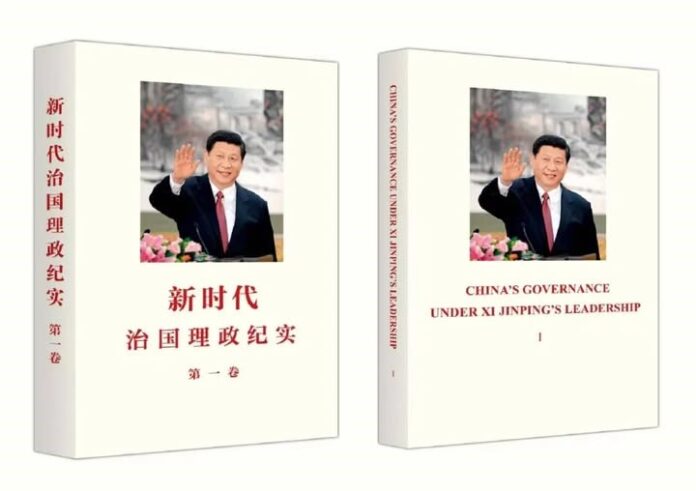
A reading seminar on the fifth volume of Xi Jinping: The Governance of China was held on Wednesday in the Tajik capital, bringing together participants from various sectors of China and Tajikistan to discuss the book’s themes and their relevance to modernization and bilateral relations.
The event, held under the theme “Advancing modernisation together and building a China-Tajikistan community with a shared future,” was jointly organised by China International Communications Group, the Chinese Embassy in Tajikistan, and the Dipservice under the Tajik Ministry of Foreign Affairs.
Participants shared reflections on the book and exchanged views on Chinese modernisation, governance, and the growing partnership between China and Tajikistan.
Ambassador highlights governance insights
Addressing the seminar, Chinese Ambassador to Tajikistan Guo Zhijun described the fifth volume as more than a record of China’s development journey. He said the publication offers deep reflections on state governance, social development, people’s well-being, and international cooperation.
According to Guo, the book provides the international community with an opportunity to better understand the latest development of Xi Jinping Thought on Socialism with Chinese Characteristics for a New Era. He added that it also helps readers gain greater insight into China’s approaches, experiences, and contributions to global development.
Scholars discuss China’s development experience
Among the keynote speakers was Rashid Alimov, former secretary-general of the Shanghai Cooperation Organization and professor at the Academy of Public Administration under the President of Tajikistan.
Alimov said the ideas contained in the book have been demonstrated both theoretically and through China’s practical development achievements. He pointed to China’s elimination of extreme poverty, its rise as a major economic power, and its advances in science and technology as evidence of the effectiveness and vitality of these ideas.
Chinese modernisation seen as a unique path
In a video address, Yang Jin, deputy director of the Center for Central Asia and the Caucasus Studies at the Institute of Russian, Eastern European and Central Asian Studies under the Chinese Academy of Social Sciences, emphasized that Chinese modernisation reflects a development path tailored to China’s national conditions.
Yang noted that the model is characterized by peaceful development, openness, and mutually beneficial cooperation. He said these qualities create broader opportunities for aligning the development strategies of China and Tajikistan and strengthening cooperation between the two countries.
Youth inspired by message of cooperation
The seminar also highlighted the perspectives of young people. Anora Nazhmuddinova, a Chinese-language student in Dushanbe preparing for further studies in Shanghai, said the book offers valuable insights into cooperation and development.
She noted that its emphasis on mutual benefit and shared progress resonates with young readers and expressed hope of drawing continued inspiration from the publication. Nazhmuddinova said she aspires to contribute to strengthening people-to-people ties and to serve as a young ambassador of friendship between China and Tajikistan.
Strengthening mutual understanding
The seminar underscored the growing interest in China’s governance experience and the importance both countries place on deepening exchanges in governance, development, and cultural understanding. Participants agreed that continued dialogue and cooperation can contribute to stronger China-Tajikistan relations and support shared aspirations for modernization and development.
- A reading seminar on the fifth volume of "Xi Jinping: The Governance of China" was held in Tajikistan’s capital, focusing on modernization and China-Tajikistan relations.
- The event was organized by China International Communications Group, the Chinese Embassy in Tajikistan, and Tajikistan's Dipservice under the Ministry of Foreign Affairs.
- Chinese Ambassador Guo Zhijun highlighted the book’s insights on state governance, social development, and international cooperation, emphasizing its role in explaining Xi Jinping Thought.
- Rashid Alimov and Yang Jin discussed China’s unique development model, pointing to its poverty elimination, economic rise, peaceful development, and opportunities for cooperation with Tajikistan.
- Young participants like Anora Nazhmuddinova appreciated the book’s message of mutual benefit and expressed aspirations to strengthen China-Tajikistan people-to-people ties.


