


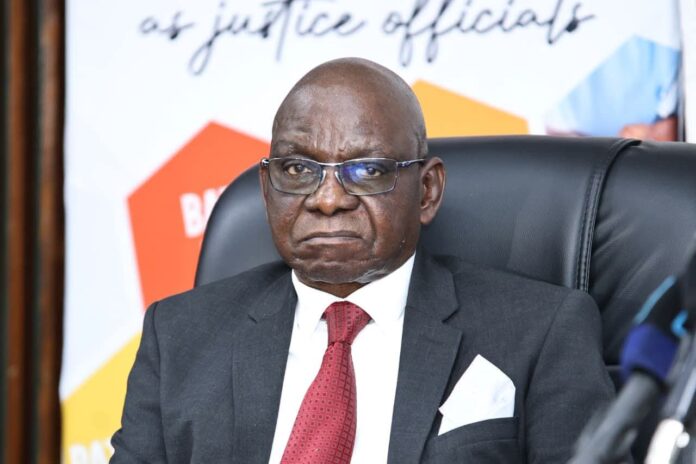
The National Prosecuting Authority’s elite anti-corruption unit will, for the first time, be subjected to independent scrutiny after retired judge Takalani Joseph Raulinga was appointed to police the conduct of the Investigating Directorate Against Corruption (Idac) through a newly established ombud’s office.
Justice and Constitutional Development Minister Mmamoloko Kubayi unveiled the new oversight body on Friday, saying the ombud’s office will operate from the SALU Building in Tshwane and has already begun assembling a dedicated investigative team.
Non-renewable five-year term
Raulinga has been appointed for a single, non-renewable five-year term and will oversee complaints ranging from abuse of power and maladministration to allegations of improper conduct within Idac.
“We have established a team with investigators. We have seconded investigators from the SIU to support the office and transferred officials from the Office of the Chief Justice. These officials will be permanently employed into the structure of the office,” Kubayi said.
The appointment comes at a pivotal moment for Idac, whose conduct has recently come under scrutiny following allegations involving some of its officials before the Madlanga commission.
Institutional integrity
The controversy has fuelled renewed debate over the credibility of the directorate, which was established as the National Prosecuting Authority’s specialist unit to investigate and prosecute South Africa’s most complex corruption, state capture and organised crime cases.
While the unit has been credited with pursuing politically sensitive investigations that few institutions were willing to tackle, critics have argued that its long-term legitimacy depends not only on high-profile arrests but also on institutional integrity, independence and successful prosecutions.
Dismantling the directorate ‘not an option’
Kubayi dismissed suggestions that the allegations warranted dismantling or rebuilding the directorate from scratch.
“I don’t think it’s appropriate for us to start from scratch. I don’t think the institution is at the point that it is hopeless. There are green shoots. That’s why the ombud, as an oversight mechanism, provides a buffer so that when things don’t go right, they can be investigated independently,” she said.
“Institutions cannot be broken on the basis that there are one or two things that have gone wrong.”
‘Protecting public institutions crucial’
The minister stressed that protecting public institutions was a constitutional obligation, even while ensuring individuals accused of wrongdoing were held accountable.
“Institutions must always be protected, and individuals can never be above and more important than the organisations. We will consistently evaluate and where appropriate, decisions and actions that need to be taken will be taken.”
She added that government would not comment on evidence before the commission but insisted Idac’s reputation could not be allowed to erode.
“Idac is very critical and its formation was for a specific reason. The work must remain credible. Its integrity must be high and the people who are within it must be of high ethical and moral standing. That cannot be compromised.”
‘Idac central to fight against grand corruption’
National Director of Public Prosecutions Advocate Andy Mothibi echoed those sentiments, describing Idac as central to the country’s fight against grand corruption.
“It was established initially to focus on implementing the outcomes of the Zondo commission. We would like to support it such as it executes its mandate without any shadow of doubt around it.”
Mothibi said should the allegations aired before the Madlanga commission ultimately be substantiated, the NPA would not hesitate to institute disciplinary action against those responsible.
The establishment of the ombud marks the first dedicated independent complaints mechanism for Idac, creating an additional layer of accountability as the directorate continues investigating some of South Africa’s most politically and financially sensitive corruption cases.
- Retired judge Takalani Joseph Raulinga was appointed to lead a new independent ombud's office to oversee the Investigating Directorate Against Corruption (Idac) for the first time.
- The ombud’s office, based in Tshwane, has started building an investigative team including seconded investigators from the Special Investigating Unit and officials from the Office of the Chief Justice.
- Raulinga's appointment is a non-renewable five-year term, tasked with investigating complaints about abuse of power, maladministration, and improper conduct within Idac.
- Justice Minister Mmamoloko Kubayi emphasized the importance of protecting Idac’s integrity and rejected calls to dismantle the directorate, highlighting the ombud as a key oversight measure to maintain accountability.
- National Director of Public Prosecutions Andy Mothibi affirmed Idac’s crucial role in fighting grand corruption and pledged disciplinary action if allegations of misconduct before the Madlanga commission are proven.


