


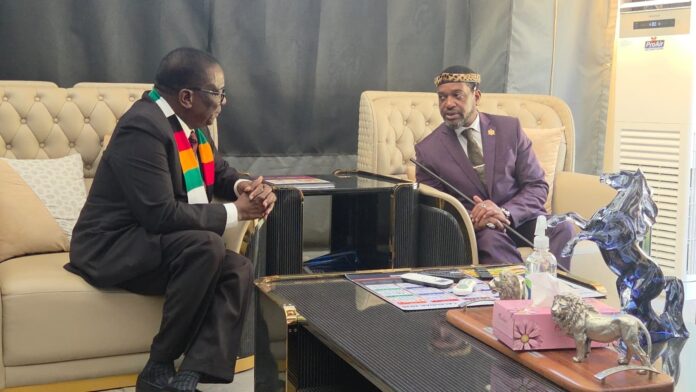
South African traditional leaders King Misuzulu kaZwelithini, the Zulu monarch, and King Ndamase Ndamase of the AmaMpondo ase Mnyandeni in Eastern Cape, on Monday clarified to Zimbabwe’s president, Emmerson Mnangagwa, that they were not in support of xenophobia.
The two traditional leaders met Zimbabwe’s president in Harare at the State House amid tensions that have resulted in mass repatriation of African nationals from South Africa in the face of xenophobic attacks.
The South African delegation comprised King Misuzulu kaZwelithini; Queen Nomzamo Myeni; King Ndamase Ndamase, the traditional prime minister of the Zulu Nation; Inkosi Phathisizwe Chiliza; and Arnold Ndamase, who is the private secretary to the AmaZulu King.
There was also Prince Sivile Mabandla of AmaBhele, who served as a special envoy for the talks.
On the Zimbabwean side, Mnangagwa was joined by ruling party Zanu PF’s spokesperson Christopher Mutsvangwa, members of the traditional chiefs’ council and Minister of Foreign Affairs and International Trade Amin Murwira.
The meeting between the three leaders started after the two kings and President Mnangagwa exchanged gifts.
Xenophobia not SA government’s policy
During the meeting, King Misuzulu categorically stated that xenophobia was not a South African government policy.
Instead, it was the works of rogue individuals bent on causing mayhem.
However, he emphasised that every country had its laws and people should abide by them; particularly immigration issues, which were at the centre of the discussions, should be taken seriously.
“This is not an African principle. It’s a universal principle of international law. Every member state of the UN maintains borders. Every member state issues visas. Every member state enforces immigration laws,” he said in a statement issued after the meeting.
He added: “Africa should never be expected to apologise for exercising rights that every sovereign nation in the world already exercises.”
People’s rights should be respected
King Misuzulu then sought to explain that at the core of the current wave of disturbances was crime, illegal entry, and fraudulent acquisition of identity particulars.
However, they were not an excuse to be xenophobic because they are issues to be dealt with at law.
He added that people’s rights should be respected.
“A person who lawfully enters another country, complies with its laws, contributes positively to society and respects the institutions of that nation should always be treated with dignity,” he said.
“However, unlawful entry, document fraud, organised human trafficking and deliberate violations of immigration legislation are matters of criminal justice and public administration – not questions of race or nationality.”
Strong historical ties
The three leaders took into account that, besides colonial boundaries, countries shared strong historical ties.
“Histories remind us that African identity has never been confined to colonial borders, and our shared ancestry should inspire mutual respect,” King Misuzulu said.
King Ndamase Ndamase, who is also chairperson of SA’s Chief Council, joined the chorus in explaining that South Africans were not xenophobic in nature. They outlined that South Africa has and continues to welcome refugees from other parts of the continent.
South Africa ‘a destination of choice’
They also spoke about how the country was a destination of choice for investors, students and other professionals.
Mnangagwa and the traditional chiefs agreed that continued collaboration and cultural diplomacy were essential to maintaining peace, fostering social cohesion, and safeguarding the welfare of citizens across the region.
Hence, King Ndamase Ndamase proposed a regional dialogue to solve migration issues because “African people are one”.
After the meeting, President Mnangagwa said it was “an honour and a privilege” to host the South African royal delegation and traditional leaders.
He said the meeting was about reinforcing “the deep, historical, and unbreakable cultural bonds that unite the people of Zimbabwe and South Africa”.
Speaking to journalists after the meeting, Mutsvangwa noted that the South African monarchs specifically requested a direct audience with President Mnangagwa.
So far, the Zimbabwean government said it has repatriated close to a hundred thousand of its people from South Africa.
The government said 70% of them were women and children.
- South African traditional leaders King Misuzulu kaZwelithini and King Ndamase Ndamase met with Zimbabwean President Emmerson Mnangagwa to clarify they do not support xenophobia amid recent xenophobic attacks in South Africa.
- King Misuzulu emphasized xenophobia is not government policy but the actions of rogue individuals, while enforcing immigration laws is a sovereign right of every nation.
- The leaders stressed that lawful immigrants should be treated with dignity, distinguishing lawful migration issues from crimes like illegal entry and document fraud.
- They highlighted strong historical and cultural ties between African nations, with King Ndamase proposing a regional dialogue to address migration challenges collaboratively.
- President Mnangagwa welcomed the delegation, underlining the importance of cultural diplomacy and cooperation to maintain peace and foster unity in the region amid ongoing repatriation efforts of Zimbabweans from South Africa.


