


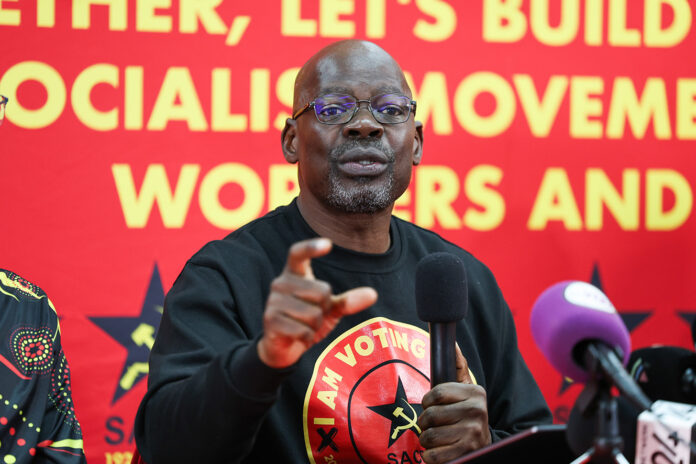
Old friends who cut their political teeth within the ANC have converged under a new banner outside the ANC in what has been billed as a new left alternative to the fragmenting ANC-led tripartite alliance.
In their opening political addresses at the Conference of the Left sitting in Bokburg, Gauteng, the SACP, the EFF and the MKP have called for an end to the disorganisation of left-leaning political parties.
A new political path
The gathering of about a dozen formations comprising political parties, trade unions, and civil organisations has been called upon to chart a new political path forward to fight against the “imperialism and neoliberal offensive” they believe has taken over the state.
The message was similar from SACP general secretary Solly Mapaila, EFF leader Julius Malema and MKP second deputy president Tony Yengeni.
The trio highlighted the profound economic and social crises exacerbated by capitalism, including wealth inequality, unemployment, and social unrest.
They poked holes in the global capitalist system for promoting survival over human dignity and solidarity, saying this system had led to societal fragmentation and authoritarian tendencies.
Unity of all forces of the left
In their view, the necessity of a transformative left movement, anchored on advocacy for economic power distribution, nationalisation, and state-led development in South Africa, was no longer a question of just rhetoric but one that requires immediate action and unity of all forces of the left.
Pan-African solidarity and regional industrialisation to counter imperialism and neoliberalism were paramount, they argued, citing China, Venezuela, and Cuba as examples of resilience against global capital.
“Cuba, despite decades of blockade, sanctions, and economic warfare imposed by the US, continues to achieve social outcomes in healthcare, literacy, and medical internationalism that many wealthier capitalist countries fail to achieve,” said Malema.
“Venezuela, despite relentless destabilisation, sanctions, and sabotage, continues resisting imperial domination and defending national sovereignty over resources.
Inspiration from Cuba, Venezuela
The significance of Cuba and Venezuela is not that they are perfect societies. No revolutionary process is perfect. Their importance lies in the fact that they refused to surrender national sovereignty entirely to global capital and insisted that society must prioritise collective social needs above corporate profit.
“That is why imperialism attacks Cuba and Venezuela relentlessly while embracing authoritarian capitalist regimes elsewhere in the world. The issue has never been democracy. The issue is control over resources, sovereignty and economic direction.”
The leaders emphasised the centrality of land redistribution, economic freedom and democratic governance as the core principles of the Conference of the Left.
All stated the need to form a revolutionary council that will be the driving force of resolutions taken at the inaugural gathering, with a responsibility to also convene the same formations at least once or twice per annum to ensure that there is not just a talk shop.
Prioritising black majority’s interests
The Conference of the Left, they said, must be a consistent platform that prioritises black majority’s interests, such as the transfer of commanding heights of the economy, like banks and the mines.
The ultimate goal of this new socialist front, they said, was to achieve true economic freedom, popular sovereignty, and social justice that aligns with the aspirations of African people.
“The wealth of the country continues to be concentrated in the hands of a tiny minority while the majority continues to be dispossessed and marginalised,” said Yengeni.
“The left front, therefore, advances the strategic objective of restructuring the economy so that it serves the interests of the majority, not just monopolies of foreign capital.
“The land and the mineral wealth must revert to the ownership of the people, led by the Black majority.”
Unified agenda for the working class and the poor
Mapaila outlined the importance of the Conference of the Left and its strategic importance as an alternative to the current political trajectory the country is taking.
He said the unity of leftist parties was the only hope to develop a unified agenda for the working class and ordinary people.
“Whilst the crises of capital deepen, the forces of the left remain too often divided, fragmented by historical mistrust, organisational competition, and tactical shortsightedness sometimes,” said Mapaila.
“Therefore, Conference of the Left cannot become another forum for abstract declaration or rhetorical posturing. It must be meant as a serious political instrument for ideological clarity and working-class mobilisation.
“We are not just merely custodians of a process; we are the builders of a political direction, a reorganisation of the working for a new revolution in this country. There is no going back.”
‘ANC betrayed the cause’
The underlying message across the board was clear and unambiguous – the ANC, under the GNU regime, can no longer be trusted to lead the struggle of the poor masses and the working class.
Malema charged, “For decades, the ANC occupied such a central position within the South African political life that sections of its leadership began confusing the organisation itself with the entire degree of liberation politics.
“The ANC thinks it is the only liberation movement and that we must always be like them. However, no political formation possesses permanent ownership of our history or revolutionary legitimacy on the aspirations of the working class,” he added.
“The alliance between the DA and ANC was a profound ideological revelation because it demonstrated the extent to which sections of the ANC leadership have come to reconcile with neoliberal governance and capitalist management.”
- Former ANC allies including the SACP, EFF, and MKP have united under a new left-wing coalition outside the ANC to offer an alternative to the ANC-led alliance amid its fragmentation.
- At the Conference of the Left in Bokburg, about a dozen political, trade union, and civil society groups committed to fighting imperialism, neoliberalism, and capitalism's social crises such as inequality and unemployment.
- Leaders emphasized the need for unity among left forces to push economic redistribution, nationalization, state-led development, and pan-African solidarity, citing Cuba and Venezuela as resilient models against imperialism.
- The conference prioritizes land redistribution, economic freedom, democratic governance, and the economic interests of the black majority, aiming to restructure the economy away from foreign monopolies.
- The leaders collectively condemned the ANC’s betrayal of the poor and working class under the GNU regime, calling for a revolutionary political direction and rejecting the ANC’s claim to liberation legitimacy.


