


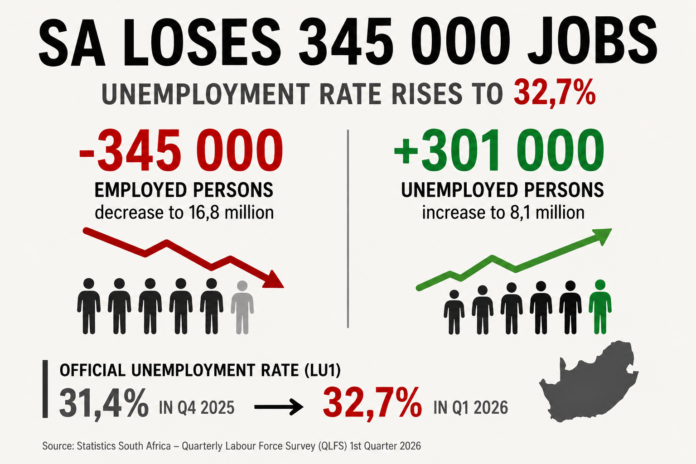
South Africa’s unemployment crisis deepened sharply in the first quarter of 2026 after the country shed 345 000 jobs, pushing the official unemployment rate to 32.7%, according to the latest figures released by Statistics South Africa.
In findings likely to pile pressure on President Cyril Ramaphosa’s administration over jobs and economic growth, Stats SA said “there was a decrease of 345 000 in the number of employed persons to 16.8-million” between January and March this year.
The agency further found that “there was an increase of 301 000 in the number of unemployed persons to 8,1-million compared with Q4: 2025 results”.
Stats SA said the devastating labour market shift “resulted in the official unemployment rate (LU1) increasing by 1.3 percentage points from 31.4% in the fourth quarter of 2025 to 32.7% in the first quarter of 2026”.
The report paints a grim picture of a country where millions remain trapped outside the economy despite repeated promises of job creation and economic renewal.
In another alarming finding, Stats SA said “discouraged job-seekers increased by 178 000 to 3.9-million”, showing that more South Africans are giving up on actively searching for work altogether.
The agency added that “persons outside the labour force… increased by 164 000 to 17.3 million in the first quarter of 2026”.
Beyond the official unemployment rate, broader measures of labour distress also worsened dramatically.
Political and economic debate
Stats SA said “the combined rate of unemployment and potential labour force (LU3) increased by 1.6 percentage points to 43.7%”.
Even more worrying, “the composite measure of labour underutilisation (LU4) … was 46.3% in the first quarter of 2026”.
The agency noted that these expanded measurements “highlight people in different situations and with different degrees of attachment to the labour market”.
The latest figures are expected to intensify political and economic debate about South Africa’s stagnant growth, collapsing infrastructure projects, and slowing private sector hiring.
Construction and community services were among sectors hardest hit during the quarter, further signalling strain in industries traditionally relied upon to absorb low- and semi-skilled workers.
For millions of households already battling rising food prices, electricity costs and debt, the numbers represent more than statistics; they reflect shrinking hope in an economy increasingly unable to absorb its own people.
Visual: South Africa’s unemployment crisis worsened sharply in the first quarter of 2026 after the country lost 345 000 jobs, pushing the official unemployment rate from 31.4% to 32.7%, according to Statistics South Africa
- South Africa’s unemployment crisis deepened sharply in the first quarter of 2026 after the country shed 345 000 jobs, pushing the official unemployment rate to 32.7%, according to the latest figures released by Statistics South Africa.
- In findings likely to pile pressure on President Cyril Ramaphosa’s administration over jobs and economic growth, Stats SA said “there was a decrease of 345 000 in the number of employed persons to 16.8-million” between January and March this year.
- The agency further found that “there was an increase of 301 000 in the number of unemployed persons to 8,1-million compared with Q4: 2025 results”.
- Stats SA said the devastating labour market shift “resulted in the official unemployment rate (LU1) increasing by 1.3 percentage points from 31.4% in the fourth quarter of 2025 to 32.7% in the first quarter of 2026”.
- The report paints a grim picture of a country where millions remain trapped outside the economy despite repeated promises of job creation and economic renewal.


