


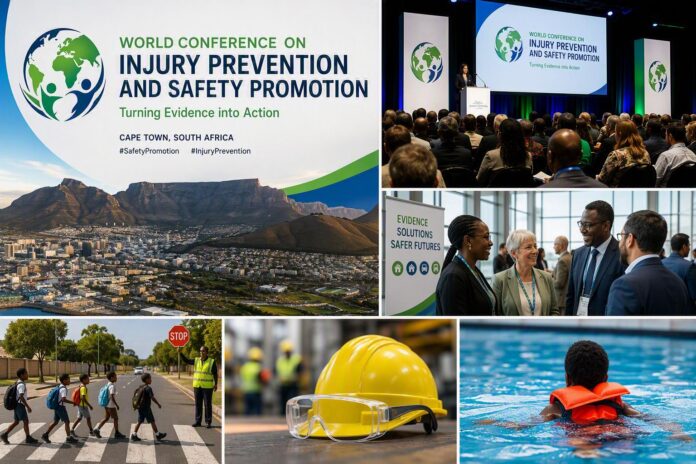
South Africa is set to become the centre of the global conversation on safety when researchers, policymakers, community leaders and safety experts from more than 80 countries descend on Cape Town this week.
The 16th World Conference on Injury Prevention and Safety Promotion, known as Safety 2026, will take place at the Cape Town International Convention Centre from September 1 to 4 under the theme “Ubuntu: United for a Safer Future.”
But organisers say the gathering is about far more than academics and policy discussions.
At its heart is a question that affects ordinary South Africans every day: what would it take to make people genuinely feel safe where they live, work, travel and raise their families?
The conference returns to Africa for the first time in two decades and coincides with the 30th anniversary of the landmark World Health Assembly Resolution WHA 49.25, which recognised violence as a major global public health concern.
Injuries, violence claim more lives every year
Three decades later, the challenge remains enormous. According to the conference organisers, injuries and violence claim more than 4.4 million lives globally every year, with low- and middle-income countries carrying a disproportionate share of the burden.
South Africa’s own safety crisis makes the conversation particularly urgent. Approximately two-thirds of South Africans do not feel safe walking alone in their neighbourhoods at night, while homicide rates are seven times the global average and road traffic injuries remain among the country’s leading causes of death.
Prof Richard Matzopoulos, director of the South African Medical Research Council’s Burden of Disease Research Unit and co-chair of the National Organising Committee, says violence and injury should not be viewed as unavoidable parts of life.
He argues that they are influenced by factors including inequality, gender, alcohol-related harm, unsafe environments and failures in systems designed to protect people.
“The evidence already tells us much about what works,” Matzopoulos says. “The challenge now is to connect that evidence to policy, implementation and accountability across every sector that influences safety.”
That means the responsibility cannot sit with the health sector alone.
A move from isolated initiatives towards a coordinated response
The four-day conference will bring together experts from health, policing and justice, transport, education, social development, human settlements, urban planning and local government.
It will also place communities, young people and people with lived experience at the centre of the discussion.
The programme will tackle some of the country’s and world’s most pressing safety challenges, including gender-based violence, violence against children, firearm violence, road and pedestrian safety, drowning, burns, mental health and trauma.
Delegates will also examine how urban design, climate change, disaster resilience, technology, data and emerging digital harms can influence safety. For organisers, the aim is to move away from isolated initiatives and towards a coordinated response.
Also Read: SMSA’s new safety measures to undergo Chiefs-Sundowns stress-test
Prof Shanaaz Mathews, chair of the International Scientific Committee, says Safety 2026 is intended to create a space where scientific evidence, lived experience and political responsibility meet.
“We have created more than a scientific programme,” he says. “We have established a platform through which evidence, lived experience and political responsibility can come together to prevent avoidable harm.”
Tangible policy outcome
And there is a tangible policy outcome expected from the gathering.
Two major documents will be finalised during the conference: the Ubuntu Cape Town Declaration for a Safer World and the Safety 2026 National Consensus Plan.
The declaration will establish shared global principles for preventing violence and injury, while the national plan is intended to translate those principles into practical priorities for South Africa and strengthen accountability around implementation.
Dr Gloria Maimela, CEO of the Foundation for Professional Development, says South Africa has already demonstrated what is possible when different sectors unite around a national crisis.
She points to the country’s HIV response as an example of government, business, scientists, civil society, communities and implementing partners working towards a shared goal.
Safety 2026 hopes to bring that same urgency to preventing violence and injury.
Importantly, members of the public will not be excluded from the conversation.
The Global Village, which runs alongside the conference, will be open to the public free of charge and without conference registration. From September 2 to 3, it will operate from 9.30am to 4.30pm, and from 9.30am to 2pm on September 4.
Visitors will be able to engage with experts, share their own experiences and contribute to the development of the declaration and national consensus plan through the Ubuntu stage, community market and thematic networking zones.
For a country where questions around crime, road safety, violence and public security are part of everyday life, organisers say the real success of the conference will not be measured by the number of delegates who attend or documents that are signed.
- The 16th World Conference on Injury Prevention and Safety Promotion (Safety 2026) will be held in Cape Town from September 1 to 4, with over 80 countries participating.
- The conference focuses on making people feel genuinely safe in their daily environments and marks the 30th anniversary of the World Health Assembly Resolution WHA 49.25, which recognised violence as a global public health issue.
- South Africa faces a severe safety crisis, with two-thirds of residents feeling unsafe walking alone at night, homicide rates seven times the global average, and road traffic injuries among the leading causes of death.
- The event aims to advance coordinated responses involving sectors like health, policing, transport, education, urban planning, and communities to address issues such as gender-based violence, road safety, mental health, and emerging digital harms.
- The conference will produce two key documents: the Ubuntu Cape Town Declaration for a Safer World and the Safety 2026 National Consensus Plan, setting global and national priorities for violence and injury prevention.


