


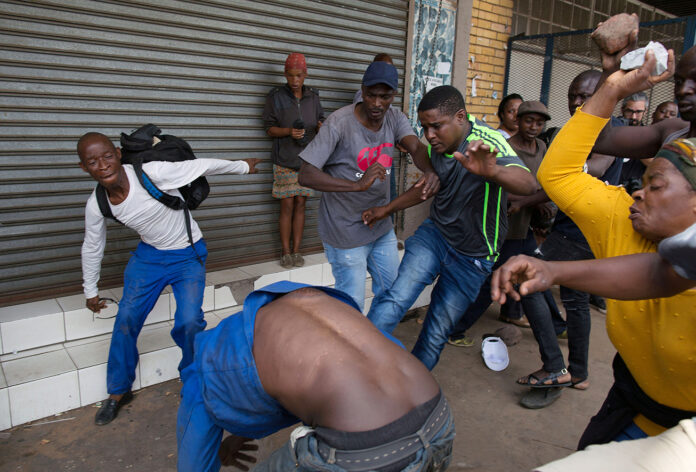
South Africans are once again engaged in heated debates about crime, migration, xenophobia, vigilantism and social disorder. The arguments are often framed in political or legal terms. Who belongs? Who is responsible? Who should act?
But there is another question we should be asking: What happens to a society when people no longer feel safe?
The crisis first surfaced in the health sector when vigilante groups began demanding proof of citizenship at hospitals and clinics.
The right to feel safe has been one of the foundations of organised society for thousands of years. The earliest tax systems were built around a social contract: citizens contribute resources, and the state provides security. The principle remains embedded in democracies.
In South Africa, the Constitution explicitly recognises the right. Section 12(1)(c) states that everyone has the right to freedom and security of the person, including the right to be free from all forms of violence from either public or private sources.
It is therefore not surprising that when people feel unsafe, they demand action. More police. More visible law enforcement. Stronger border controls. Tougher sentences.
The demands are largely directed at the Justice, Crime Prevention and Security Cluster. Yet there is an important omission. Health is rarely included in the conversation. Many people would understandably ask whether safety is a public health issue. The answer lies in how we define health.
In 1948, the World Health Organisation defined health as “a state of complete physical, mental and social well-being and not merely the absence of disease or infirmity”. If you do not feel safe, you are unlikely to experience mental or social well-being.
Feeling safe is not a luxury. It is a prerequisite for health.
South Africa understands this better than most countries. Thirty years ago, the country helped change how the world understood violence. In 1996, we played a leading role in securing a landmark World Health Assembly resolution that recognised violence as a major public health priority.
The resolution began the process that shifted the conversation away from viewing violence solely as a criminal justice issue and towards understanding it as a preventable societal condition with profound consequences for health and development.
Thirty years later, the evidence is overwhelming. Exposure to violence increases the risk of anxiety, post-traumatic stress disorder, depression, substance abuse, cardiovascular disease, poor educational outcomes and reduced economic participation. Children growing up in unsafe environments experience toxic stress that can affect development throughout their lives. This is why safety must be viewed through a public health lens. Law enforcement remains essential, but it should be the last line of defence rather than the first.
A public health approach focuses on the underlying drivers of violence and injury. Research consistently shows that these are shaped by a complex interaction of poverty, unemployment, inequality, substance misuse, inadequate housing, poor urban design, social exclusion, family instability and limited opportunities for young people.
These are not challenges that any single department, institution or profession can solve alone. From September 1 to 4, 2026, the country will host the 16th World Conference on Injury Prevention and Safety Promotion in Cape Town.
The conference provides an opportunity to launch the Cape Town Consensus Plan – a practical roadmap for creating safer communities through a whole-of-society evidence-based approach. The starting point is simple: if we want safer communities, we must address the systems that create risk as well as the systems that respond to it. There is a wealth of evidence on what works and how to implement such solutions.
The government provides policy direction and legislative frameworks, shifting from reaction to prevention. Provincial governments strengthen health, education and social development systems. Civil society organisations build trust, mobilise communities, become trusted implementation partners and hold institutions accountable. Researchers generate evidence. Businesses contribute through investment, job creation, targeted CSI and safer workplaces.
Communities become partners in creating safety.
Municipalities influence housing, transport, roads, lighting, sanitation, public spaces, recreational facilities and local economic opportunities. In many respects, they are the architects of everyday safety.
A poorly designed neighbourhood can amplify fear, isolation and violence. A well-designed one can strengthen social connection, economic participation and community ownership.
The next frontier in public safety is not simply controlling violence after it occurs. It is creating the conditions that prevent it from occurring.
- Dr Wolvaardt is the founder of the Foundation for Professional Development and has recently stepped down as managing director.
- South Africans are debating crime, migration, and social disorder, focusing on political/legal questions, but underlying these is the critical issue of societal safety and its impact on health.
- South Africa’s Constitution guarantees the right to safety, yet public demands focus mostly on law enforcement rather than addressing safety as a broader public health issue.
- The World Health Organization defines health as complete physical, mental, and social well-being, meaning feeling safe is essential for health; South Africa helped pioneer violence as a public health priority internationally.
- Violence and lack of safety have severe mental, social, and economic health consequences, driven by poverty, inequality, substance abuse, and social exclusion, requiring multi-sectoral, evidence-based prevention strategies.
- South Africa will host the 2026 World Conference on Injury Prevention, aiming to launch the Cape Town Consensus Plan, advocating a whole-of-society approach to creating safer communities by fixing systemic risk factors and promoting community involvement.


