


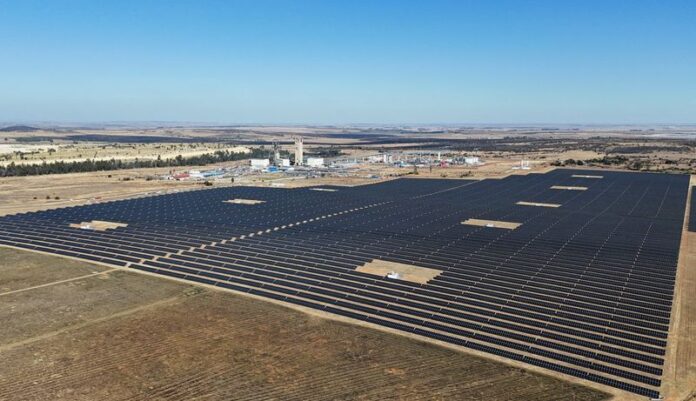
South Africa’s mining firms are accelerating investment in renewable energy as they seek to diversify power sources, cut costs and meet decarbonisation targets, marking a shift after decades of reliance on state utility Eskom.
Anglo American and Sibanye Stillwater are among the firms reducing their dependence on a national grid dominated by ageing coal-fired power plants that has struggled in recent years to keep Africa’s most advanced economy running.
However, executives say Eskom-supplied baseload power would remain part of the energy equation for years to come even as renewable power usage grows.
South Africa currently generates more than 80% of its power from coal, with renewables accounting for only around 10%.
READ: Eskom rolls out dedicated renewable energy arm
Anglo American’s renewable energy initiatives
Anglo is one of the companies partnering with independent power producers (IPPs) to develop renewable projects.
In 2022, it formed a 50-50 joint venture with EDF power solutions, a subsidiary of France’s EDF, to provide renewable energy to its units Kumba Iron Ore, diamond producer De Beers and former subsidiary Valterra Platinum.
The venture, Envusa Energy, currently generates 520 megawatts of power – 280 MW of wind and 240 MW of solar, representing 30% of Anglo mines’ energy consumption.
Its project pipeline is 1,500 MW, with ambitions to be generating 3,000 MW by 2030 for Anglo’s sites and other industrial users.
“You’re looking at somewhere between 20% and 30% cheaper on the renewable side if you’re just looking at wind and solar,” Envusa CEO Nicole Mason said.
“The next projects that we are focusing on are a couple of really strong wind projects as well as a number of behind-the-meter solar plus battery projects.”
Sibanye Stillwater’s power procurement
Sibanye, which met roughly 99% of its platinum group metals energy needs and 88% of its gold electricity demand through Eskom last year, has opted to buy renewable power through short and long-term supply deals rather than owning generation assets.
It has so far contracted 835 MW of renewable energy capacity, of which 164 MW is currently operational.
By the end of 2028, about 64% of total energy demand at Sibanye’s South African operations is expected to be supplied from renewables, CEO Richard Stewart said, sharply cutting reliance on Eskom.
“Our secured renewable energy portfolio is not only about reducing carbon emissions and enhancing energy security; it is also a business imperative that is expected to deliver meaningful cost benefits,” Stewart said.
He added renewable power should cost 20% to 30% less than forecast Eskom tariffs.
Still, Eskom will remain crucial for the foreseeable future, Stewart said. “Renewables are intermittent by nature, battery storage technology is still developing, and Eskom supplies essential baseload power,” he said.
Coal producers diversify with renewables
Coal producers too are pushing to ramp up renewables use. Exxaro Resources is pursuing revenue growth through its renewable energy subsidiary, Cennergi, which currently operates 297 MW of capacity and has a near-term pipeline of 593 MW.
The group is targeting 1,600 MW of net installed capacity by 2030, part of a broader plan to cut scope 1 and scope 2 emissions — those produced directly by the company and from its purchased energy, by 40% by 2030 and 70% by 2040, and to reach carbon neutrality by 2050.
Exxaro said a 68 MW solar plant has reduced its flagship coal mine Grootegeluk’s reliance on the national grid by 30%, saving the company 100 million rand ($6.25 million) annually in electricity costs and reducing scope 2 emissions by 22%.
Cennergi also sells power to Eskom and other industrial users.
“Our intention as part of decarbonization is that our mines could actually all go on to solar and wind energy, but obviously you still need a baseload of coal when you don’t have wind or solar,” CEO Ben Magara said.
Thungela Resources is betting on a coal-bed methane project to diversify away from coal.
Thungela explores methane project
Its Lephalale project aims to extract methane from coal seams in the Waterberg coalfield in Limpopo province and eventually develop a commercial liquefied natural gas business, with a timeline to be determined in part by how successfully the company uses the fuel itself.
About 19 wells have been sunk at Lephalale, and the firm has begun extracting gas that will fuel a generator at one of Thungela’s sites, said Chief Financial Officer Deon Smith.
“For the 19 holes we are able to save 30, 40 odd million rand on the Eskom utility bill per annum if those holes are fully functional,” Smith said, representing “around 6% to 7% of our total utility cost per year that we could reduce.”
- South Africa's mining firms, including Anglo American and Sibanye Stillwater, are increasing investment in renewable energy to reduce reliance on Eskom's coal-fired power and to meet decarbonisation targets.
- Anglo American formed a 50-50 joint venture with EDF to create Envusa Energy, which currently generates 520 MW of renewable power, representing 30% of Anglo mines' energy consumption, with plans to reach 3,000 MW by 2030.
- Sibanye Stillwater has contracted 835 MW of renewable energy capacity, with 164 MW operational, and expects 64% of its South African operations' energy demand to be met by renewables by 2028.
- Coal producer Exxaro Resources aims to reach 1,600 MW of renewable capacity by 2030 through its renewable subsidiary Cennergi and has reduced its Grootegeluk mine's grid reliance by 30% with a 68 MW solar plant.
- Thungela Resources is developing a coal-bed methane project at Lephalale, extracting gas to fuel its operations and saving about 6-7% of its annual utility costs, as part of diversification efforts away from coal.


