


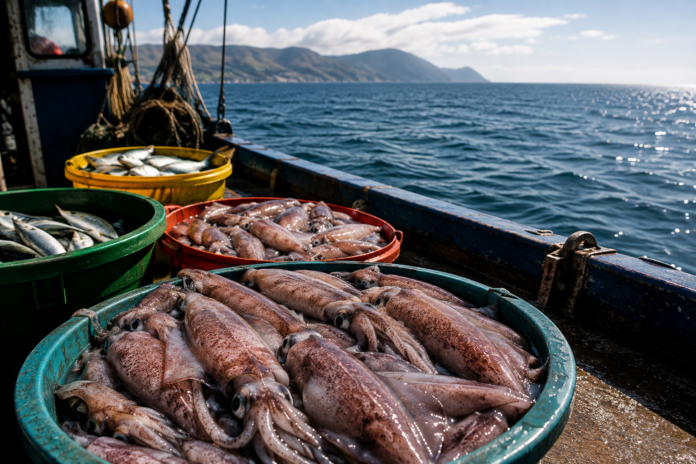
Government’s attempt to bring historically excluded small-scale fishers into South Africa’s lucrative squid industry has been thrown back into a legal battle after judges rejected attempts to have the challenge killed before its merits could be heard.
A full bench of the Western Cape High Court has ruled that a dispute over government’s decision to reserve at least 15% of squid fishing effort for small-scale fishers must return to court for proper scrutiny.
The case pits the South African Squid Management Industrial Association (Sasmia), which represents the established commercial squid industry, against the Department of Forestry, Fisheries and the Environment.
Government’s transformation project scrutinised
At the heart of the “squid game” is a simple question: did government follow the law when it opened a portion of the valuable squid resource to small-scale fishers?
Government’s transformation project dates back to November 2019, when squid was included among species available to small-scale fishing co-operatives.
Then, on June 3 2021, the director-general decided that 15% of the squid Total Allowable Effort, essentially the amount of fishing activity permitted, would go to the small-scale sector, while 85% remained with commercial fishers.
The small-scale allocation could later increase to as much as 25%.
Sasmia challenged the process, arguing that government had effectively divided the squid before properly determining how much fishing activity the resource could sustain.
Its lawyers argued that the department made the 85%-15% decision on June 3, but only determined the actual Total Allowable Effort on June 17.
Put simply, Sasmia says government divided the cake before knowing how big the cake was.
Lack of consultation
It also alleges that government failed to consult the Consultative Advisory Forum for Marine Living Resources and that the Minister’s later appeal decision was taken without a report required under regulation 5(3) of fisheries regulations.
Those allegations have not yet been proven.
Instead of deciding whether government acted lawfully, the first High Court hearing dismissed Sasmia’s case after accepting two preliminary objections from the state.
Government argued, firstly, that Sasmia had waited too long before approaching court.
Secondly, it argued that the dispute had become moot, meaning later fishing seasons and new annual decisions had overtaken the old decisions and there was therefore little practical purpose in reviewing them.
Bruises for both sides
The judges rejected both arguments in a judgment delivered on Thursday.
The full bench was particularly critical of the earlier court for treating the delay as largely a matter of counting days without properly examining whether Sasmia might have a strong case against the government decisions.
“None of the factors addressed in the court a quo’s judgment relate to the merits. The court a quo simply stopped at the statutory gateway of the PAJA 180-day time limit and refused the condonation application,” said Judge Constance Nziweni. “Therefore, it precluded itself from addressing the merits.”
Sasmia maintained that it had repeatedly asked government for documents and had used access-to-information applications to obtain records necessary to understand the decisions.
State accused of stonewalling
The association accused the state of effectively stonewalling it, saying some information was only eventually supplied in May 2023.
The appeal court held that even where there had been a delay, judges were required to consider its explanation together with the importance of the dispute and whether the challenge had reasonable prospects of succeeding.
The court was scathing about allowing procedure to protect decisions that could ultimately be found unlawful, saying, “Allowing a procedural bottleneck to insulate a potentially flawed administrative decision would constitute a grave failure of justice.”
Government’s second argument, that the matter was now too old to matter, suffered a similar fate.
The court found that the June 2021 decision may have consequences far beyond that particular fishing season because the 15% allocation was designed as a minimum starting point for the small-scale sector.
That means future fishing decisions could continue to be built upon the contested 15% foundation.
It added that the dispute remained important to both sides of the industry and particularly to small-scale communities seeking entry into a valuable resource from which they were historically excluded.
Court rules ‘no escape hatch from scrutiny’
The judges warned that court rules remained important, but said they should not become an escape hatch from scrutiny where important rights and potentially unlawful government conduct were involved.
In one of the judgment’s strongest passages, the court said: “In such isolated instances, a litigant should not, on the basis of a procedural infraction alone, be summarily non-suited and deprived of the opportunity to vindicate their substantive rights, particularly where the dispute raises live, structural issues of profound public and commercial importance.”
The full bench consequently granted Sasmia permission for its late challenge to proceed, dismissed government’s arguments on delay and mootness, and sent the dispute back to the lower court.
Importantly, the judges did not declare the 15% small-scale allocation unlawful.
Nor did they decide that historically excluded fishers should lose access to squid.
Instead, government will now have to defend the nuts and bolts of how the transformation decision was made, including whether the correct consultations, reports and sequence of decisions required by fisheries law were followed.
For small-scale fishers, therefore, the squid remains in the basket.
But the rules governing how it got there are now firmly back before the court.
- The Western Cape High Court has ruled that a dispute over the government's decision to allocate at least 15% of squid fishing effort to small-scale fishers must return to court for detailed examination.
- The South African Squid Management Industrial Association (Sasmia) challenged the allocation decision, arguing the government divided the squid quota before determining the total allowable fishing effort.
- The court rejected government arguments that Sasmia's challenge was too late or moot, stating procedural delays should not prevent review of potentially unlawful decisions.
- Sasmia accused the government of failing to consult required advisory forums and not producing required reports under fisheries regulations, allegations yet to be proven.
- The court did not declare the 15% small-scale quota unlawful but required the government to justify the decision-making process, including consultation and report compliance.


