


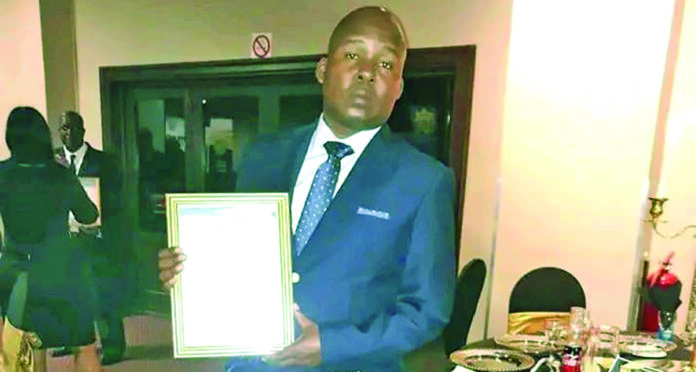
Disgraced Political Killings Task Team Officer Bonginkosi Anthony Dlamini has a criminal conviction against his name and a 17-year prison sentence to serve.
A magistrate found beyond reasonable doubt that the former award-winning detective accepted gratification and participated in efforts to undermine a murder prosecution.
Dlamini has not displaced that finding. What he is now trying to do from prison is establish that the events leading to his arrest began earlier than the criminal judgment suggests.
His case is not simply that State witness Celani Selby Dlamini lied. It is that an internal police conflict had developed before Celani ever opened the corruption case against him.
Whether that account can be independently established remains unresolved.
READ MORE: How the state brought down PKTT cop Bonginkosi Dlamini
Dlamini says his problems began while he was still part of the political killings machinery. His affidavit describes disputes over investigations, arrests and the handling of politically sensitive cases.
The most serious allegation concerns General Dumisani Khumalo.
Dlamini says Khumalo instructed him to arrest then-eThekwini mayor Zandile Gumede in connection with a murder despite Dlamini’s insistence that he did not have evidence implicating her.
He says he refused and asked for the instruction in writing.
The police conflict before his arrest
Material before Parliament’s police ad hoc committee records Dlamini’s version that he was removed from the political killings team soon afterwards.
Dlamini also says a Sergeant Khumalo became involved in an earlier case of defeating the ends of justice against him, which was opened at Berea Police Station in March 2019.
That is important because the magistrate later rejected Dlamini’s false-implication argument partly on the basis that there was no reason police officers would want to frame him.
Dlamini argues that the history leading up to his arrest creates the necessary context for his current case.
That remains his allegation.
READ MORE: The rise and fall of a star PKTT cop
The magistrate also found it suspicious that Dlamini approached Celani directly after he had already been removed from the Nxumalo investigation. If Dlamini genuinely believed Celani was going to be killed, the court asked, why did he not report the information through proper police structures?
Dlamini says the answer lies in the same internal conflict.
He maintains that by then he had already been removed from the task team, believed he was being investigated by colleagues and did not trust the command structure.
He says he nevertheless tried repeatedly to telephone Captain Khumalo before and while dealing with Celani, but could not reach him.
Those calls have not yet been independently verified through cellphone records.
The warning that divided the State and Dlamini
There is also an established fact that complicates the chronology without resolving it.
Long before the disputed October 2019 meeting, Celani testified that Dlamini had already been concerned about his safety. Dlamini had arranged accommodation for him away from home and organised witness protection, which Celani had declined.
Dlamini now relies on that earlier conduct to argue that his later warning about a threat to Celani’s life was consistent with previous concern.
The State saw the October warning differently.
READ MORE: PKTT scores another victory as gunman gets 13 years for attack on ANC councillor
It said the alleged threat became the mechanism through which Dlamini tried to persuade Celani to withdraw his statement.
The trial court accepted that version.
It also alleged that Celani later admitted during a departmental hearing against Dlamini – after which he was dismissed while in prison, that he had signed a fabricated statement.
Other material records an allegation that Celani said during a disciplinary process, that he had been called to provincial SAPS offices and influenced to open the case against Dlamini.
The actual disciplinary transcript has not yet been obtained.
Until it is, those claims remain allegations.
The testimony Dlamini wants revisited
The record could be significant because Dlamini’s later lawyers unsuccessfully applied to recall Celani for further cross-examination.
The magistrate refused, finding that Celani had already been extensively cross-examined and that a change of lawyers did not entitle Dlamini to reopen the process.
What is still unclear is what new evidence his lawyers wanted to put to Celani.
Other records remain outstanding.
They include the formal instruction removing Dlamini from the political killings team or the Nxumalo investigation, the earlier Berea docket, cellphone records relating to his alleged attempts to reach Khumalo, and testimony from the detective said to have witnessed the Gumede confrontation.
READ MORE: Puleng Dimpane hails PKTT breakthrough after witness-tampering cops jailed
None of those documents automatically overturn what the court found.
Some may ultimately support the judgment. Others may support parts of Dlamini’s account. Some may no longer exist or may prove inconclusive.
For now, two competing accounts remain.
A court found that Dlamini became part of a corrupt scheme to weaken a murder prosecution.
Dlamini, once nationally recognised for solving serious crimes, is trying from prison to assemble records and witnesses he believes will tell a fuller story of how he went from an awards ceremony in Pretoria to a prison cell.
- Disgraced Political Killings Task Team Officer Bonginkosi Anthony Dlamini has a criminal conviction against his name and a 17-year prison sentence to serve.
- A magistrate found beyond reasonable doubt that the former award-winning detective accepted gratification and participated in efforts to undermine a murder prosecution.
- Dlamini has not displaced that finding.
- What he is now trying to do from prison is establish that the events leading to his arrest began earlier than the criminal judgment suggests.
- His case is not simply that State witness Celani Selby Dlamini lied.


