


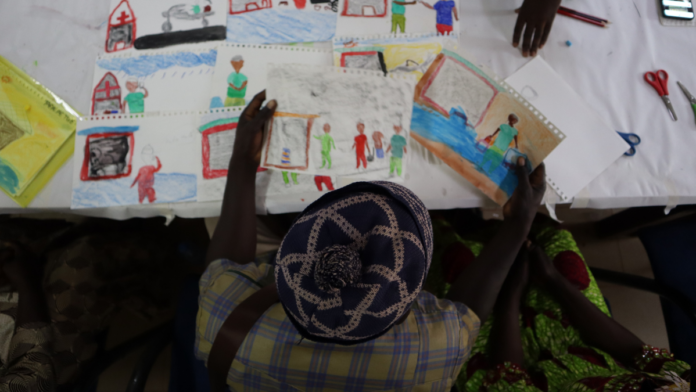
An interesting conversation took place in the Beneb Souka Hotel in Koudougou, Burkina Faso, in August 2025.
It happened over fried sides of a fish known here as Capitaine, elsewhere as Nile perch. It happened under the saccharine strains of a four-year-old hit song called Sugar Daddy, by Burkinabé star Floby, featuring Tanya.
Mental health challenges
The participants were mainly small-scale farmers from around Nouna and Dédougou, in the tropical western part of the country, where people face a convergence of pressures and risks, including violent attacks by armed groups, seasonal flooding of farmers’ fields and homes, food insecurity, extreme heat, limited access to schools, limited access to health services, and more. Exploring the mental health impacts of these converging pressures was the point of the gathering.
Earlier in the day, the group had been addressed by a psychiatrist from Ouagadougou, the nation’s capital, who had delivered, in French, quite a detailed exposition of mental health conditions, which translators had attempted to then communicate to the farmers in Dioula. Burkina Faso is a modern-day Babel, in which more than 70 languages are spoken, 66 of them indigenous. Mutual understanding is never a foregone conclusion, especially when city and rural folk mix.
Supernatural influences
“Did you understand?” one of the translators joked over lunch.
The translator – a former television star named Sanogo Hamadou – said, “People in Burkina Faso don’t have a [Western] concept of mental health. If you describe someone who talks to themselves, or someone walking about with no clothes, or eating refuse, then yes, people are familiar with this type of behaviour, but they would say it is caused by a spirit, something supernatural. If you speak of depression, anxiety and these kinds of things, they will simply not get it. They will say these are problems of white people,” he said.
One of the farmer participants duly shared a story about an aunt who used to wander from home. The family had consulted a marabout, a spiritual healer, who wrote out some verses of the Qur’an and then placed the scrap of paper in a bowl of water, adding herbs. The holy herbal water was supposed to drive out the spirits that had caused his aunt’s mind to stray.
Making sense of mental health
An enthusiastic youth had chimed in, suggesting that exposure to “Chinese sweets” was causing a lot of people to speak in tongues in his village, especially younger people. A farmer noted that all the “foolish” people in his town had disappeared.
“They were tolerated, but today you hardly see them. People believe they have been taken away by the government. If a family has a relative who is a foolish person, they will hide them at home.”
Rich as it was in misinformation (Burkina Faso’s mentally ill are not being scooped up by the government, and no connection has been established between “Chinese sweets” and psychosis) the dining hall conversation raised an interesting question: how does one start making sense of mental health in a country as culturally and linguistically layered as Burkina Faso?
Burkina Faso and the global mental health movement
One obvious place is the website of the World Health Organisation (WHO). In 2000, at the dawn of the modern global mental health movement, the WHO launched Project Atlas, an attempt to address major gaps in country mental health information. The initiative has since published seven editions of the “World Mental Health Atlas”, each compiling data on mental health financing, policies, laws and the availability of relevant services. The trends described in the Atlas reports are typically very broad, however, and data is limited in lower- and middle-income countries. For example, the most recent Atlas (2024), found that service coverage for people with psychosis – which includes hearing voices or seeing things that are not there, and other severe behavioural abnormalities – in low-income countries was 8%, compared to over 54% in wealthier nations. It also found that care for the mentally ill is still way too centralised in major psychiatric hospitals (62% of all in-patient beds), when countries really should be trying to integrate these services into community-based facilities.
The Atlases do focus on what is happening at the regional level as well, but here again the analysis is top-line. The 2024 report found, for instance, that the Africa Region has only about 2 mental health workers per 100 000 people, the lowest of all WHO regions, with many countries spending under 1% of their healthcare budget on mental health.
If you dig around on the WHO’s “mental health dashboard” for the African region, you will find individual country reports that do provide some useful bits of information, but these are quite sparse, and they are mostly out of date.
Mental health on back burner
The 2020 country profile for Burkina Faso (the 2024 country report is yet to be published) notes, for example, that the country adopted its first ever stand-alone policy for mental health in 2020, but without allocating any funds for its implementation. The country’s output of research articles on mental health amounted to four papers in 2019, up from two papers in 2016, and the total number of mental health professionals working in the country, which has a population of over 20-million, is set down as 103: 11 psychiatrists, 5 psychologists, 86 specialist mental health nurses and a single occupational therapist. And yet the profile says the total number of community-based mental health facilities in the country is 683. How can this be?
To make sense of this seemingly contradictory data I seek out the prominent Burkinabé psychiatrist, Désiré Nanema, who heads the department of psychiatry at the Regional University Hospital of Ouahigouya, and who had trained under Arouna Ouédraogo, widely regarded as one of the fathers of modern psychiatric practice in the country.
The short, rich history of modern psychiatry in Burkina Faso
I mention the story about the farmer’s aunt and the marabout.
“This is a common practice,” Nanema says, speaking to me online, with the help of an interpreter.
“You must understand that psychiatry in Burkina is quite young – it is only with French colonisation that we started psychiatric treatment in a modern manner. In pre-colonial times we had this concept of disease in our societies being caused by spirits and genies. Later, and still very much active today, are religious understandings of mental illness, where psychosis, schizophrenia, or sudden behavioural changes are thought to be caused by supernatural forces such as shaitan, and jinns, with treatment including such things as prayers and exorcism. Voilà.”
Nanema proceeds to give a potted history of modern psychiatry in Burkina Faso, explaining that the first psychiatric unit was established in Bobo-Dioulasso in 1957, just before independence in 1960. The finance had been put up by France’s development finance arm for its colonies, Fonds d’Investissements pour le Développement Économique et Social, which also funded the establishment of psychiatric hospitals in Senegal, Ivory Coast and Niger. In 1960, another psychiatric unit was established in Ouagadougou.
“What you would find even some years into independence is that French doctors were running these units, hired by this ministère de la coopération, which ensured very close ties between the former colonial power and newly independent Burkina Faso,” Nanema says.
One of those French doctors was Jean-Louis Renauld, who was appointed to lead the Bobo-Dioulasso psychiatric unit in 1972. He found a place more reminiscent of a prison than a hospital, where hundreds of patients were locked away from society, and their families.
“[The unit] has become the main obstacle to treating the mental patients”, Renauld later recalled, calling it “a poisoned chalice offered by the former mainland to the new independent country”.
Renauld, who was strongly influenced by the deinstitutionalisation approach of the psychiatry school in Dakar, established in 1958 by the French psychiatrist Henri Collomb, opened up the walls and the windows of the psychiatric unit and even created, with the help of patients, a “psychiatric village” to bring some outside life to the centre.
“The approach was referred to as psychiatrie sans frontières (psychiatry without borders), and it had a very big influence on the system that developed here,” Nanema explains, adding that the first generation of Burkinabé psychiatrists – “people like the late Sanou Zezouma and Arouna Ouédraogo” – were all trained in Dakar in the 1970s.
After a moment’s reflection, Nanema says, “You will find in most African countries that their first psychiatrists were trained in the universities of the colonising power, and the institutions and systems they then helped to build in their home countries bear the influence of that connection.”
“In West Africa,” he continues, “the francophone countries were all influenced by the French School [of Psychiatry], and even today psychiatrists in Burkina, Mali, Niger, Sénégal and even Benin, Togo and others, have this group called la Société Africaine de Santé Mentale, which hosts scientific meetings on a regular basis where we share experiences and opinions. West Africa’s anglophone countries such as Ghana and Nigeria do the same thing – their psychiatrists remain extremely cooperative, and it all comes back to their shared connection to English psychiatry. There are so many excellent things that we could have taken from them, and they too could have taken from us, and yet we do not talk to each other!”
In 1979, Zezouma became the first Burkinabé to be appointed head of the Bobo-Dioulasso psychiatric unit, where he worked a great deal with returning Bukinabé migrant workers, many of whom were overwhelmed with anxiety related to family expectations. Nanema points out that migration, both “non-forced and forced”, remains a fact of life for millions of people in Burkina Faso, and a great source of anguish.
In the late 1980s, following the 1987 Bamako Initiative, which sought to improve access to essential medicines and health services in sub-Saharan Africa, Zezouma, Ouédraogo, Jean-Gabriel Wango, who is the former secretary-general of the ministry of health, and others drove an expansion of psychiatric care beyond the country’s two major cities, and made sure that a cadre of nurses specialised in mental healthcare was trained to support the new services.
After stalling in the early 2000s the decentralisation drive picked up again after Burkina Faso endorsed the 2013 World Health Assembly resolution for the achievement of “mental health for all”. Working primarily with Expertise France, the French agency for international development and cooperation, Burkina Faso’s health ministry expanded mental health services to medical centres and regional hospitals spread about the country.
“We managed to set up quite a few, at different levels of the system, including 40 new services in district medical centres, facilitated by specialised nurses working with one or more psychiatrists,” Nanema says.
The government also partnered with NGOs, notably the Christoffel Blinden Mission (CBM), which trained nurses working in 683 of the country’s most basic health centres to provide psychological first aid to people experiencing emotional distress. This, I realise, is the source of the confounding number on the WHO’s country profile for Burkina Faso. Speaking on condition of anonymity, a CBM staff member said the number of health centres currently able to provide mental health support is significantly lower today.
By all accounts sustaining the movement has been difficult. Since independence, the country’s major healthcare programmes have relied upon external support, but security concerns in the last decade have led many NGOs to desert the country. In 2025, Nanema conducted a review of structures offering mental health services and found that the country’s capacity was much diminished, and that many of the services still functioning were understaffed.
“The problem we have is a lack of appropriately skilled human resources. We had about 30 psychiatrists but unfortunately around half of them are now working outside the country, mostly in France. Five have retired, one passed away. We had around 130 specialised nurses working in our hospitals and medical centres but many are leaving for retirement.”
Burkina Faso does train its own psychiatrists and speciality nurses, but Nanema says that around half of all psychiatrists who graduate leave the country, or join NGOs, while the programme that trains specialised nurses has been suspended and will only resume in 2027.
‘Always in the background is the family’
For another take on these pressures I had spoken earlier to Ali Sié, director of the Nouna Research Centre in Burkina Faso’s Nouna district, near the country’s border with Mali. He confirmed that the district’s one specialised mental health nurse had been poached by an NGO. Two of his own doctors were poached in 2025.
“One is still in the country, he joined Paf (Pharaon Healthcare Africa) and now works in Ouagadougou, the other is in Niger working for Epicentre. With all these disasters going on elsewhere on the continent, people are really circulating. How can you control this one? The truth is, you can’t. I don’t try and prevent people from leaving, I simply ask that they continue to support our cause from the outside, and often they do. A lot of our current funding comes from the very organisations that poached my doctors,” Sié says.
In the face of such steep challenges, Nanema is optimistic.
“In a year or two the training of [specialised] nurses is set to resume. The government has also announced a plan to train and employ 5 000 health workers over the next five years, including 60 psychiatrists,” he says.
In the meantime, access to psychiatric care will remain difficult for most Burkinabé people. The barriers include out-of-pocket payments for medicines and some services, and prohibitive transport costs. There is also the issue of stigma around institutional care for mental health, which Nanema says is so high that many people who need care simply do not report to a healthcare facility.
“Most people do not see the hospital as a solution to mental health issues. They may use a psychiatrist’s services to bring down the symptoms but as soon as they are better, they disappear. For treatment of the issue, another kind of person is sought: a traditional healer, or a religious personality, and the service may be a sacrifice, a herbal drink or a prayer ritual,” says Nanema, adding that when it comes to coping in Burkina Faso, either with serious psychiatric conditions or with common disorders such as depression, anxiety, grief and other forms of extreme emotional distress, the government enjoys a subsidy that does not receive the attention it merits.
“Families are absolutely essential in everything [relating to mental health]. In most of Burkina Faso, people still live collectively, especially in the villages. No matter what happens in an individual’s life, always in the background is the family, supporting and guiding those who are unwell and struggling,” he says.
- This story was produced by the Bhekisisa Centre for Health Journalism. Sign up for the newsletter.
- In Burkina Faso, mental health issues are often understood through a supernatural lens rather than Western psychiatric concepts, with traditional healers playing a key role in treatment, especially in rural areas facing multiple socio-economic pressures.
- Modern psychiatry in Burkina Faso started with French colonial influence; psychiatric units were established in the late 1950s and 1960s, but institutional care was initially prison-like until reformers introduced more humane, community-oriented approaches.
- Despite adopting a mental health policy in 2020, Burkina Faso’s mental health services remain underfunded, understaffed, and centralized, with many skilled psychiatrists emigrating and significant challenges in sustaining decentralized community care.
- NGOs have trained nurses in many health centers to provide psychological support, but security issues and staff poaching have reduced service capacity; training programs for mental health nurses were suspended and are only set to resume in 2027.
- Families play a crucial role in supporting those with mental health challenges in Burkina Faso, where stigma around institutional care is high and many people rely on traditional and religious healers alongside limited psychiatric services.


