


To map the human geography of the South African platinum belt is to read a history written in blood, sweat, and displacement. If you look closely at the municipal registries of the Moses Kotane Local Municipality, you will find Sefikile near Mokgalwaneng. Shift your coordinates slightly towards the perimeters of Phokeng, and you run into the dense shack settlement known locally as Pekinini Transkei.
To the untrained macroeconomic accountant, these are merely informal settlement zones – peripheral clutter on a corporate balance sheet. But to a statistician armed with forty years of census data, these names possess a profound, devastating toponymic character. They carry the language, the memory, and the trauma of the deep rural interior of the Eastern Cape – specifically the Alfred Nzo District Municipality.
When the Xhosa men left their ancestral homes to migrate hundreds of kilometers northwest into the platinum reefs of the North West, they brought their history with them, naming their informal shacks after the distant landscapes they were forced to abandon to feed the insatiable engines of mineral extraction.
1. The gory reminder
From Alfred Nzo to the Koppie of Death The historical pipeline from the Alfred Nzo district to the platinum belt was
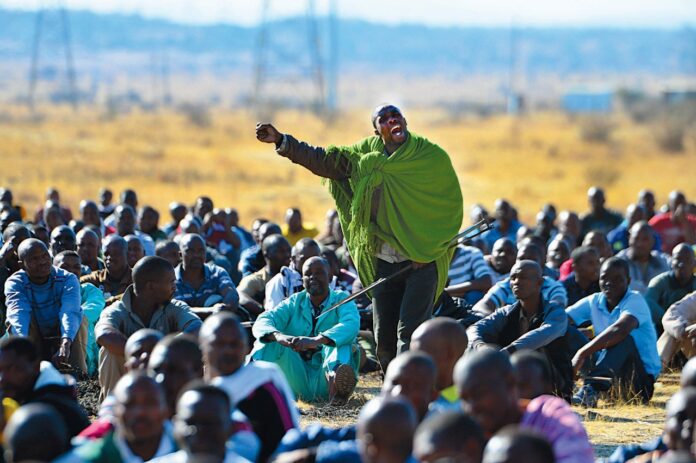
built on an In-Out paradigm. The system treated these men not as citizens, but as disposable units of labor – navigating dark shafts to extract the wealth of the Merensky Reef. But this extraction geography has a breaking point, and its most gory reminder occurred on August 16 2012, at a barren rock formation in Marikana.
The gunning down of 34 miners by state security forces was not an isolated aberration; it was the violent, inevitable intersection of our macroeconomic blind spots. The rock drill operators who stood on that koppie were the very same Xhosa men from the Eastern Cape diaspora who populated the shacks of Sefikile and Pekinini Transkei. They were men driven to desperation, trying to maintain two distinct spatial households—one in the dust of the platinum belt and one in the poverty of the rural interior—on wages that treated their lives as cheap inputs. The 34 lives ended at Marikana stand as an unassailable, bloody monument to the cost of a siphoned nation.
2. The livelihood fracture and the ‘vulture vortex’
The democratic transition of 1994 legally dismantled the hostel compounds, but it left the underlying economic pipeline entirely intact. When the living-out allowance was introduced, mine workers did not integrate into wealthy suburban enclaves. Instead, they built autonomous, crowded shack settlements like Sefikile and Pekinini Transkei. The contemporary reality of these settlements exposes the deep flaw within our national fiscal policy: the Grants-State Fallacy. Modern policy architectures attempt to patch over rural and peri-urban poverty by distributing individual social grant transfers (R350–R370).
However, forensic spatial analysis proves that without a localised asset anchor, these individualistic cash drops fail to build a resilient economic floor.
The money enters the informal mesh, but because there is no community-owned manufacturing or retail infrastructure, it is immediately externalised through metropolitan retail monopolies. The settlement remains an economic vacuum.
Furthermore, as we observe the macroeconomic landscape of 2026, the global mining sector is shifting rapidly toward mechanization and automation. The traditional reliance on large volumes of manual rock drill operators is declining. This structural mutation leaves the aging migrant workforce from the Eastern Cape stranded in severe Spatial NEET Traps. They face an automated industry that no longer requires their raw physical labor, yet they cannot return to a hollowed-out economy in the Eastern Cape. They are trapped by design, not by accident.
3. The question for local government elections
As the nation approaches local government elections, the toponymic scars of Sefikile and Pekinini Transkei, alongside the ghosts of Marikana, stand as a direct challenge to our political landscape. Ward politicians will canvas these informal settlements, offering temporary palliatives — a communal water tank, a promise of road graveling, or sporadic food parcels.
But forty years of census tracking demonstrate that superficial budgeting adjustments cannot close a structural deficit. The underlying economic model continues to extract the resource wealth of the North West while externalising the human costs back to the families of the Eastern Cape.
The question I pose to the residents of these settlements, and to the country at large, is clear: Will we continue to accept a system that treats our rural working class as disposable inputs until they are driven to the koppie, or will you demand a fundamental structural shift towards localised asset retention?
True economic sovereignty requires moving past individualistic grant dependency. It demands the operationalization of Policy #99: State-Matched (1:1 Ratio) Pooled Communal Assets. The wealth generated from our mineral reserves must be legally anchored at the geographic site of production, matching pooled community funds to establish self-managed, durable economic platforms (Lenaka la Mohlomi).
The numbers do not lie. I have recorded the figures across decades, and the diagnostic verdict is unassailable. Sefikile and Pekinini Transkei are the visible evidence of an extractive economy. To honor the 34 men who died at Marikana and the generations who built the foundations of our mineral wealth, we must find the structural courage to re-engineer the economic floor.
- Dr Pali Lehohla is a Professor of Practice at the University of Johannesburg, a Research Associate at Oxford University, and a distinguished Alumni of the University of Ghana. He is the former Statistician-General of South Africa.
- Informal settlements like Sefikile and Pekinini Transkei near the South African platinum belt are named after the rural Eastern Cape regions, reflecting the displacement of Xhosa mine workers.
- The 2012 Marikana massacre, where 34 miners were killed by state forces, exemplifies the violent consequences of treating mine workers as disposable labor in the extractive economy.
- Post-1994, despite the dismantling of hostel compounds, mine workers created informal settlements due to inadequate integration and flawed social grant policies, resulting in economic vulnerability.
- The mining industry's shift toward mechanization threatens the livelihood of aging migrant workers from the Eastern Cape, trapping them in spatial NEET (Not in Education, Employment, or Training) situations.
- A proposed solution, Policy #99, advocates for State-Matched Pooled Communal Assets to anchor wealth locally and establish sustainable economic platforms, moving beyond grant dependency.


