


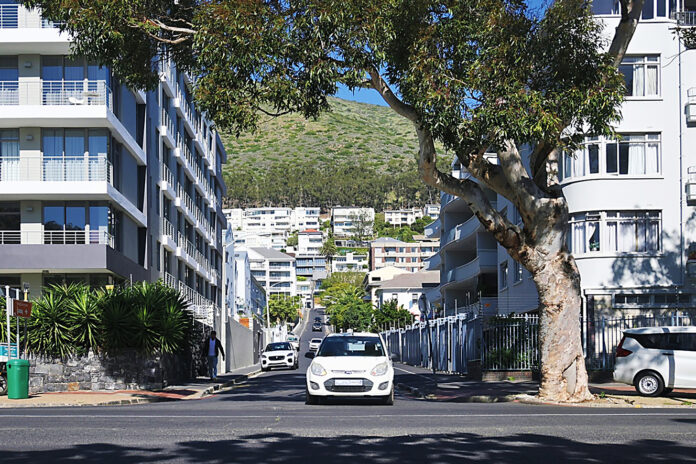
As 620 political parties prepare to battle for votes in the local government elections, residents of Cape Town’s two Green Points, just 30km apart, are united only by a desire for change.
In Green Point, Khayelitsha, residents are pleading for basic services such as toilets and decent housing.
In the affluent Green Point below Signal Hill, the priority is quieter streets, less traffic and fewer disruptions from events at Cape Town Stadium.
This week, 59-year-old Bhutiza Mguga was dwarfed by timber frames of the shacks he builds and sells in Green Point, Khayelitsha. He said about 500 shacks stand in the settlement, with several people often sharing a single home.
For Mguga, who has lived there since 1998, the election promises are familiar.
“I have lived in this area since 1998 after I lost my job at a pawn shop in Goodwood,” said the father of seven. “We have heard several promises from politicians, but all we want are toilets and proper homes.”
The settlement is a mix of formal houses and densely packed shacks. Dirty, stagnant water runs through narrow footpaths between homes. Mguga has been building shacks since losing his job nearly three decades ago. “…I have never worked since I lost my job. I used to get the R350 government stipend, but I have not received it in two years. Crime is also a huge problem. We also have drug addicts.”
On the other side of the city, Green Point on the Atlantic Seaboard presents a different picture. The streets are clean, tourists fill the pavements and residents speak less about basic services than about the impact of living next to one of Cape Town’s busiest event venues.
Most residents declined to be named. One who had recently returned from overseas said, “Things work here. It is safer than London.”
Another said election campaigns rarely addressed issues affecting the suburb.
“Residents find themselves subjected to inhumane and severe levels of event noise from events outside the stadium. Because the area is shaped like an amphitheatre, sound travels far and is amplified as it goes up the hill and up to 2km away.
Residents are trapped in their homes due to traffic congestion from events and cannot work, rest or receive visitors. This puts them into a state of general anxiety, often enduring up to 20 hours of bombardment, frequently until late at night.”
The Electoral Commission of South Africa ran its final voter registration drive this weekend from 23 699 voting stations across the country, staffed by 48 212 electoral officials.
Political analysts say coalition governments are now an unavoidable feature of local politics. They also warn that instability is likely to continue, driven less by coalitions themselves than by political self-interest, weak local governance and frustration over service delivery.
Zwelethu Jolobe, a partner and director of Sovereign Indaba Advisory, said the elections would be shaped by local concerns rather than ideology.
“While national debates often dominate airtime, local voters are increasingly evaluating parties on tangible, immediate performance,” said Jolobe.
“In metros such as those in Gauteng, eThekwini and Nelson Mandela Bay, voting behaviour will likely reflect a reaction against coalition gridlock. Voters are experiencing coalition fatigue after repeated motions of no confidence, stalled budgets and declining city centres.”
He said rural voters were more likely to focus on water supply and municipal debt rather than party labels.
“The sheer number of competing parties makes hung councils even more likely than in 2021. More parties competing for a finite pool of seats increases the chances that micro-parties holding 1% or 2% of seats will become kingmakers.
“While the government of national unity established a working relationship among major parties, those agreements are far more difficult to replicate in municipal councils,” he said.
Nelson Mandela University political studies lecturer, Mbasa Mvenene, said unemployment, particularly youth unemployment, would dominate the election campaign. “Other key issues are likely to include irregular immigration, governance, and the high cost of living.
“The Madlanga commission has also sharpened public concern around criminality, corruption and the possible abuse of state institutions, which may become a major campaign issue.
“… not all voters vote on issues alone. Some still vote according to identity, historical loyalty or party attachment.
However, South Africa’s shift away from dominant-party politics suggests issue-based voting is becoming increasingly important,” Mvenene said.
Mvenene said coalition governments were now part of South Africa’s political landscape. “I do not think voters can simply vote in a way that avoids coalitions because the country has moved beyond the era of dominant-party politics.”
“Coalitions are not inherently bad. They can strengthen democracy in post-colonial societies where former liberation movements risk becoming as dominant and unaccountable as the regimes they replaced.”
- Cape Town’s two Green Points highlight stark contrasts: Khayelitsha residents demand basic services like toilets and housing, while affluent Green Point residents seek quieter streets and less event disruption.
- In Khayelitsha, poor living conditions persist with overcrowded shacks, lack of government support, crime, and drug issues, despite repeated election promises.
- Affluent Green Point residents are primarily concerned about noise and traffic from Cape Town Stadium events, causing significant disturbance and anxiety.
- Analysts predict coalition governments will continue due to many political parties competing, with local issues like service delivery, unemployment, and governance driving voter behavior more than ideology.
- Coalition politics, while potentially unstable, are seen as a new norm in South Africa, potentially strengthening democracy by preventing dominance of single parties.


