


The South African government, chiefly the National Treasury, has come under heavy attack for advancing budget cuts that are hollowing out the public service.
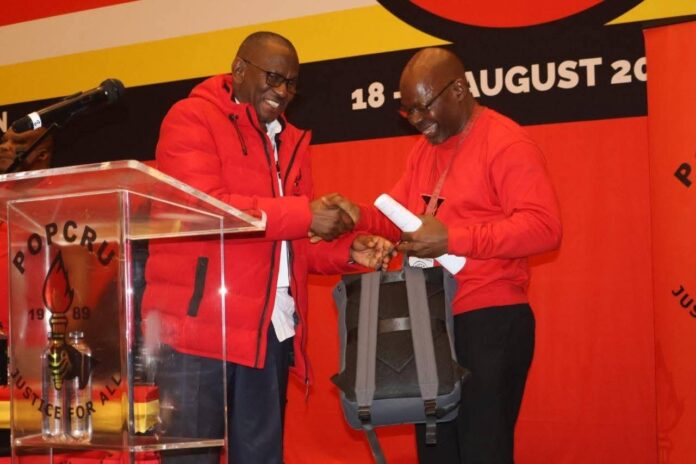
This was the common thread at the ongoing Police and Prisons Civil Rights Union (Popcru)’s central executive committee (CEC) meeting taking place at the Birchwood Hotel in Boksburg, east of Gauteng.
Speaker after speaker, including Popcru president Thulani Ngwenya, South African Communist Party (SACP) general secretary Solly Mapaila, and Congress of South African Trade Unions (Cosatu) president Zingiswa Losi were all singing from the same hymn book.
According to the three, the budget cuts in public service were a ruse to tilt the scales in favour of business, which was now getting into the space of providing services that historically were reserved only for the public sector.
A case in point is the provisions of identity documents and passports through some banking institutions, which meant fewer jobs for workers within the Department of Home Affairs.
READ: Home Affairs teams up with Capitec, FNB to deliver smart IDs, passports
According to statistics presented by Ngwenya, as a result of austerity measures, the number of prison wardens has almost halved in the past 16 years, from 40,000 in 2009 to 26,000 now, while the number of inmates continues to rise. This in a space where private players like security firm G4S having entered.
Driving the point further, Mapaila pointed to the South African Democratic Teachers Union (Sadtu)’s recent revelations that there were 27,000 outstanding posts within the basic education sector, which breeds fertile ground for more private schools to enter the space.
Ngwenya said time for tiptoeing around the issue of the negative impact of budget cuts was over as it was time to face who they perceive as an enemy in this regard – National Treasury.
Ngwenya said:
“Our enemy as workers is National Treasury. Your ammunition and AK47s must be directed to the National Treasury, not wrong places. National Treasury is busy implementing neoliberal policies that are against the working class.”
“What makes matters worse is that the minister at National Treasury is a worker (former Numsa general secretary Enoch Godongwana). He is one of the people who were teaching us about how bad GEAR was. Today he is one of those telling us that we do not understand”, he continued.
“When there are budget cuts and critical posts are left vacant, those are policy choices which should never be blamed on “lazy” public servants. Some functions are outsourced that could be performed by the state.”
Ngwenya said the “policy choices” of the government of the day to centralise its strategy on budget cuts should never be a burden of public servants who automatically become overworked.
Mapaila accused the ANC-led government of making it their “policy choice” to embark on austerity way before the birth of the government of national unity in which known liberal parties also have a stake.
According to Mapaila, the policy choice of the ANC to pursue neoliberal decisions, including budget cuts, had led to, among other anomalies, understaffed police stations, broken police vehicles, overcrowded prisons, collapsing infrastructure and public service centres carrying impossible loads.
“These are outcomes of budget cuts – austerity imposed by a capitalist government. The weakening of the state is not neutral; it is a capitalist project that shifts its crisis on to the workers and the poor,” said Mapaila. He added that the government was demanding workers to do more, with less, while growth is being witnessed in the same areas in the private sector.
READ: Pragmatism must override austerity on budget day
Losi hammered the final nail in the budget cuts’ coffin when he said South Africa can kiss building a developmental state goodbye if austerity measures are the order of the day.
“The ultimate end is that the state itself, its capacity, becomes weak. And therefore, comrades, a developmental state cannot be built through austerity. A capable state cannot be built by continuously reducing its capacity,” she said.
“That is why Cosatu said we need a developmental budget, a people’s budget – that invests in people, that invests in infrastructure and that invests in industrialisation and the frontline public services.
- The South African government, led by the National Treasury, is being criticized for budget cuts that are weakening the public service, according to Popcru and allied unions at a meeting in Boksburg.
- Budget cuts have resulted in a significant reduction of prison wardens from 40,000 in 2009 to 26,000 currently, despite rising inmate numbers, and have opened space for private firms like G4S.
- The Department of Home Affairs is outsourcing services such as identity documents and passports to banks, leading to fewer jobs in the public sector.
- The South African Democratic Teachers Union revealed 27,000 outstanding posts in basic education, which is encouraging growth of private schools.
- Cosatu president Zingiswa Losi stated that austerity measures undercut building a developmental state because they weaken the state's capacity by continuously reducing its resources.


