


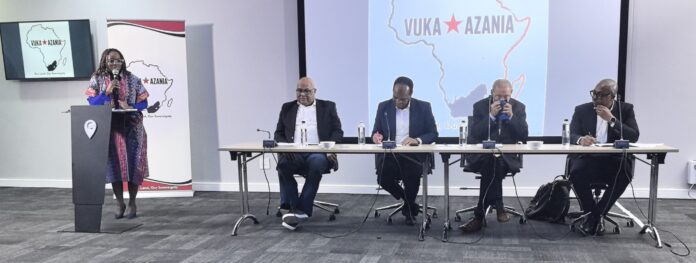
A new advocacy group led by senior advocate Muzi Sikhakhane, former spy chief Arthur Fraser, cleric Allan Boesak and academic Isaac Shai has declared the post-1994 political settlement incapable of delivering Black emancipation and pledged to challenge the ownership of land, wealth and state power.
Vuka Azania, launched on Friday as a non-profit company, says formal democracy left the architecture of colonial dispossession intact and merely placed Black representation inside institutions that still reproduce racial domination.
The organisation enters an already contested political terrain with an agenda extending beyond policy reform. It wants land restoration, redistribution of wealth, decolonised education, legal reform, African cultural renewal and a change of the country’s name from South Africa to Azania.
“Black liberation cannot be reduced to representation inside colonial structures,” the founding statement says. “It requires the dismantling of material, psychological, legal, spiritual and epistemic systems that continue to reproduce racial domination.”
That position places Vuka Azania in direct conflict with the central claim of the democratic state: that the Constitution and its institutions provide the machinery through which historical injustice can be corrected.
‘Black poverty has been normalised’
The group argues that those institutions have failed to reverse the most consequential outcomes of conquest and apartheid. Land and economic power remain concentrated, black poverty has been normalised and the legal system still carries colonial assumptions, it says.
Vuka Azania will operate outside electoral party politics, but its stated programme places it squarely in battles that political parties, courts and the state have failed to settle.
It says it will conduct research, shape policy, organise programmes, support lawful mobilisation and pursue strategic litigation. Those tools could bring it into confrontation with government over land, state assets, economic restructuring and the limits of constitutional reform.
The group has not yet identified its first legal or political target. But its statement makes clear that ownership will be the organising question.
“African people must own their land, control their wealth, govern their affairs and restore their historical, cultural and spiritual dignity,” it says.
Quest for economic redress for colonial and apartheid-era theft
On land, Vuka Azania presents dispossession not as an unresolved policy problem but as the foundation of the country’s current economic order. It says land is the basis of food, ancestry, memory, belonging and national sovereignty and promises to pursue legal, political and economic redress for colonial and apartheid-era theft.
The statement does not specify whether this will mean expropriation without compensation, expanded restitution, state ownership or community control. That choice will test whether Vuka Azania intends to work within the existing constitutional framework or force a more fundamental rupture.
Its economic programme is equally direct. The organisation rejects the continued positioning of African people as “labourers, consumers, petitioners and spectators” in an economy built on their land and labour.
It proposes community-owned enterprises, cooperatives, worker initiatives, food production, youth development and locally controlled systems of production. The stated objective is not simply increased participation in the existing economy but control over productive assets.
Education and culture form the second front. Vuka Azania says schools continue to produce alienation by separating African children from their history, languages and knowledge systems.
It wants an education system that produces “historical consciousness, intellectual independence and purpose”, alongside the restoration of African names, spirituality, customs and philosophies.
Country must be renamed Azania
The call to rename the country Azania turns that cultural argument into a political demand.
“Names carry history. Names carry memory,” the statement says. “A liberated people must have the right to name their land and themselves.”
The organisation’s founders give it immediate political weight but also expose it to scrutiny over whether it can convert rhetoric into power.
Sikhakhane brings legal influence and a record of intervention in high-stakes constitutional disputes. Fraser brings experience from the centre of the intelligence state.
Boesak carries the authority of liberation-era politics, while Shai adds an academic base to an organisation presenting itself as both a think tank and a mobilisation vehicle.
Vuka Azania now faces the test contained in its own declaration: whether it can confront entrenched power without becoming another elite forum diagnosing Black dispossession from above.
Its statement promises litigation, mobilisation and institutional challenge. Its credibility will depend on what it chooses to fight first — and whether it is prepared to force a decision when the state refuses to move.
- Vuka Azania, a new advocacy group led by prominent figures, challenges the post-1994 political settlement as inadequate for Black emancipation, aiming to overhaul land, wealth, and state power ownership.
- The group argues formal democracy preserved colonial dispossession structures, demanding land restoration, wealth redistribution, decolonized education, legal reform, cultural renewal, and renaming South Africa to Azania.
- Operating outside traditional politics, Vuka Azania plans research, policy influence, lawful mobilization, and strategic litigation focused on Black ownership of land, wealth, and governance.
- It critiques existing institutions for normalizing Black poverty, maintaining economic and land inequality, and perpetuating colonial legal assumptions, seeking systemic redress beyond policy adjustments.
- The founders' varied backgrounds provide political and legal weight; the group's future impact hinges on its ability to actively confront entrenched power and select high-impact targets for change.


