


In the heart of Tongcheng City in east China’s Anhui Province, Liuchi Alley stands as a quiet yet powerful symbol of harmony and mutual respect. Barely two meters wide, the narrow passage draws visitors from across the country who come to learn about a story that has endured for more than three centuries.
The alley takes its name from its width of six Chi, a traditional Chinese unit of length. Yet its significance extends far beyond its physical dimensions. It represents an enduring example of how understanding, compromise and respect can resolve conflict and strengthen community ties.
The story behind the six-foot alley
Liuchi Alley’s origins date back to the Qing Dynasty (1644-1911) and a property boundary dispute between Zhang Ying, a senior government official, and his neighbour. Rather than prolong the disagreement, both families agreed to move their courtyard walls back by roughly three feet, creating a six-foot-wide lane between their homes.
The gesture transformed a potentially divisive conflict into a lasting lesson in neighborly goodwill. Over the centuries, the story has become a cherished example of traditional Chinese values, emphasizing mutual restraint, courtesy and respect.
Xi Jinping highlights traditional wisdom
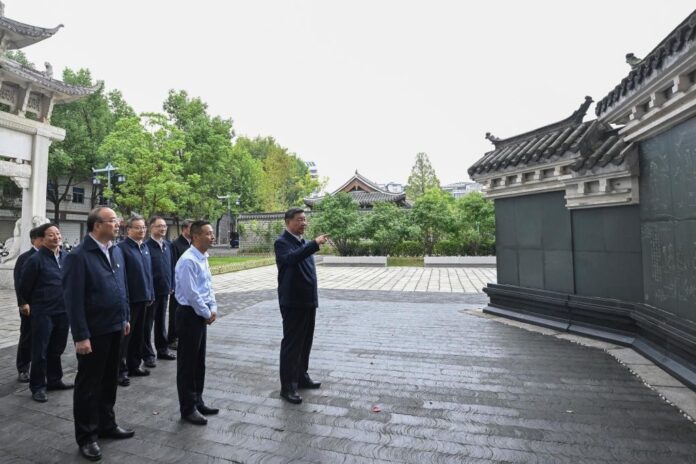
The alley gained renewed national attention in October 2024 when Chinese President Xi Jinping visited the site during an inspection tour of Anhui Province.
While viewing a wall that recounts the famous story, Xi described Liuchi Alley as a model of traditional Chinese wisdom in dispute resolution. He emphasized the importance of preserving and promoting China’s cultural heritage and encouraged the continued practice of courtesy and modesty to help create a harmonious society where people can live and work in peace.
Xi also stressed the need to strengthen the protection of historical and cultural heritage while encouraging the creative transformation and innovative development of China’s fine traditional culture.
Bringing ancient values into modern community governance
Today, the spirit of Liuchi Alley has become an integral part of local grassroots governance. Zhang Yun, head of the Liuchi Alley community’s Party organization and a 12th-generation descendant of Zhang Ying, regularly shares the alley’s story with visitors and residents.
According to Zhang, President Xi’s visit has strengthened local people’s sense of identity and pride. The values embodied by the alley are increasingly being applied in the management of community affairs, helping resolve disputes through dialogue, empathy and compromise before tensions escalate.
However, Zhang emphasizes that compromise does not mean abandoning principles. Instead, the approach encourages the stronger party to take the initiative in seeking common ground while ensuring that morality and the law work together to achieve fair outcomes.
From ancient alley to provincial policy
The influence of the Liuchi Alley philosophy is expanding beyond Tongcheng. On July 24, the Standing Committee of the Anhui Provincial People’s Congress adopted a decision promoting the “Liuchi Alley work method” as a tool for improving grassroots governance.
The move marked Anhui Province’s first legislative effort to institutionalise the approach, reflecting growing recognition of the role that dialogue and mediation can play in maintaining social harmony.
Resolving disputes at a busy railway station
One of the most visible examples of the approach in action can be found at Hefei railway station, where approximately 90 000 passengers pass through each day.
Station staff have embraced the values associated with Liuchi Alley and established a mediation room where travelers can resolve disagreements through conversation and understanding.
In one case, a passenger occupying several seats was persuaded to make space for others after staff appealed to his sense of consideration for fellow travelers. In another incident, two passengers involved in a dispute after a charger accidentally struck one traveler were invited to the mediation room. Following more than half an hour of discussion, an apology was offered, compensation for a medical examination was agreed upon, and the matter was peacefully resolved.
Since opening in 2024, the mediation room has successfully settled more than 650 disputes.
Harmony and rule of law working together
Experts stress that mediation inspired by Liuchi Alley complements rather than replaces the legal system. According to Peng Fenglian, a law professor at Anqing Normal University, the law establishes rights, responsibilities and boundaries, while Liuchi Alley culture encourages communication, accommodation and mutual understanding.
Rather than conflicting with legal principles, the two approaches reinforce one another by helping prevent disputes from escalating while ensuring that justice and fairness remain protected.
A timeless message for modern society
More than 300 years after its creation, Liuchi Alley continues to offer lessons for modern society. What began as a simple act of mutual compromise between neighbors has evolved into a model for community building, conflict resolution and grassroots governance.
As visitors walk through the narrow lane in Tongcheng, they encounter more than a historic site. They experience a living reminder that respect, dialogue and understanding can create space for harmony, even in the midst of disagreement.
- Liuchi Alley in Tongcheng City, Anhui Province, is a narrow lane created over 300 years ago as a compromise between neighbors to resolve a property boundary dispute.
- The alley symbolizes traditional Chinese values of mutual restraint, courtesy, and respect, and has become a model for dispute resolution and community harmony.
- In October 2024, President Xi Jinping visited Liuchi Alley, praising it as an example of traditional Chinese wisdom and emphasizing the protection and promotion of cultural heritage.
- Anhui Province officially adopted the "Liuchi Alley work method" in July 2024 to improve grassroots governance through dialogue and mediation.
- A mediation room at Hefei railway station has resolved over 650 disputes since 2024, applying the principles of Liuchi Alley to promote understanding alongside the legal system.


