


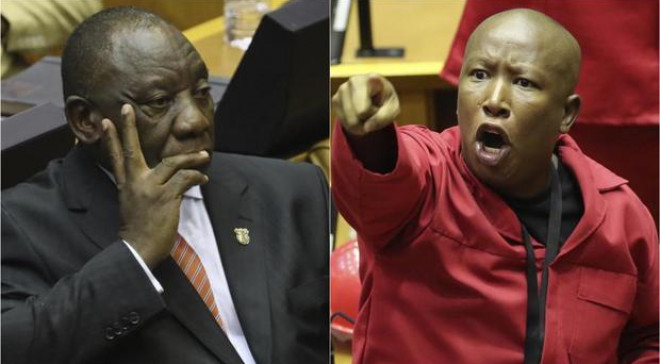
The Western Cape High Court on Wednesday questioned whether President Cyril Ramaphosa’s opponents are effectively requiring him to prove his innocence before Parliament’s Phala Phala impeachment committee.
Adv Mfesane Ka-Siboto, representing Julius Malema’s EFF, argued that the impeachment committee offered Ramaphosa the proper forum to answer the allegations and challenge the factual findings in the independent panel report.
He said Ramaphosa could place evidence before the committee, confront the allegations and clear his name through a process capable of testing competing versions.
“The veracity of the claims can only be dealt with at the impeachment committee,” Ka-Siboto said.
‘Technical objections not necessary’
He argued that technical objections to the panel report would not resolve the central factual dispute over what happened at Phala Phala.
“It is him showing his innocence of the charges that will truly exonerate him,” Ka-Siboto said.
A judge immediately intervened.
“Doesn’t that put an onus on the president that he must prove his innocence?”
Ka-Siboto said it might be unfair to frame the issue in those terms because Ramaphosa would appear as a witness rather than an accused person in a criminal trial.
‘Ramaphosa must provide evidence’
But he maintained that Ramaphosa would need to provide evidence if he wanted to displace the panel’s finding that there was a prima facie case for him to answer.
“If he wants to disturb that finding, he must provide the evidence,” Ka-Siboto said.
He said the impeachment committee had powers the independent panel did not possess. It could call witnesses, test evidence and examine Ramaphosa’s version.
“He has not been examined on it,” Ka-Siboto said.
“For evidence to be fully tested, it must be tested on examination, and countervailing evidence may be led.”
What if report is later overturned?
The bench then asked whether the committee process itself could cause harm if it relied on a report that was later overturned.
“Will that not cause harm to the president if, for instance, they use a report which is ultimately going to be found unlawful?” a judge asked.
“The impeachment committee gets its teeth into the president and puts him on the spot by being cross-examined on something that, if it were not there, they could not have done the cross-examination.”
Ka-Siboto accepted that there could be harm.
“I accept that,” he said.
‘Potential harm not exceptional’
But he argued that the harm was not exceptional and did not justify stopping Parliament.
“What is exceptional about that?” he asked.
“It is in the ordinary course where people are subjected to reports that are against them. They are tested and, if they come right, they are exonerated.”
Ka-Siboto compared the process to a criminal accusation in which a person places a version before the relevant forum and is eventually cleared if the evidence does not sustain the charge.
“There is nothing exceptional with the president,” he said.
“There is nothing being asked of the president that is not asked of anyone else who is a member of society.”
He argued that Ramaphosa’s position as head of state did not exempt him from answering allegations.
“That he is the state president is of no moment for the purposes of the argument I make,” Ka-Siboto said.
Ka-Siboto also relied on the separation-of-powers principle, arguing that a court should interfere with Parliament’s constitutional work only in exceptional circumstances.
He said Ramaphosa had not pleaded the exceptional circumstances required to stop another branch of government from exercising its powers.
The committee, he argued, was the institution empowered to decide whether the allegations could ultimately be sustained.
- The Western Cape High Court questioned if President Cyril Ramaphosa’s opponents are forcing him to prove his innocence before Parliament’s Phala Phala impeachment committee.
- Advocate Mfesane Ka-Siboto, representing the EFF, argued that the impeachment committee is the proper forum for Ramaphosa to present evidence, challenge allegations, and clear his name.
- Ka-Siboto acknowledged Ramaphosa must provide evidence to dispute the independent panel’s finding of a prima facie case against him and noted the committee’s powers to test evidence and examine witnesses.
- The court raised concerns about potential harm to Ramaphosa if the committee relies on a report later deemed unlawful, but Ka-Siboto argued such harm is not exceptional or a reason to stop Parliament’s proceedings.
- Ka-Siboto emphasized the principle of separation of powers, stating courts should only intervene in Parliament’s constitutional processes under exceptional circumstances, which Ramaphosa has not demonstrated.


