


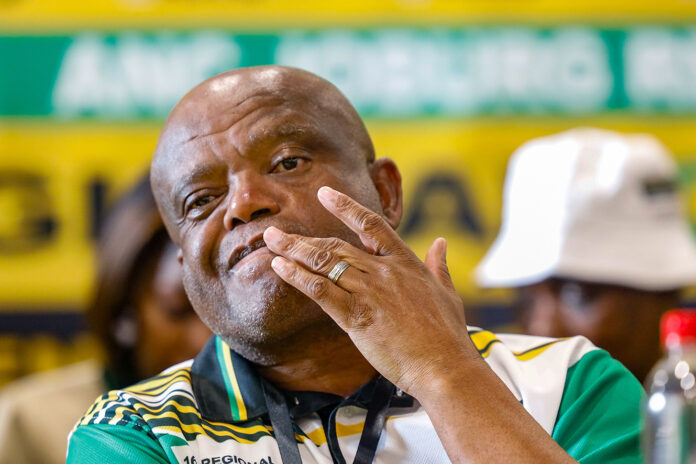
There are few crueller rituals in ANC politics than the internal nomination meeting.
It is there, away from the slogans and the staged unity, that leaders discover whether they still matter. Not in the speeches. Not in the posters. Not in the mayoral chains. In the room. In the vote. In the raised hands. In the silence when their names are called.
Johannesburg mayor Dada Morero has now had his moment in that room.
He may still occupy the mayoral office in the country’s richest metro, but the ANC region that helped put him there appears to have decided that it will not be the structure that carries him into the next contest.
According to sources, the ANC Johannesburg regional executive committee has resolved to submit three names to the party’s national leadership for consideration as mayoral candidates: deputy mayor Loyiso Masuku, former deputy finance minister Jabu Moleketi and ANC deputy chief whip Makhosazana “Makhosi” Ndlela.
Morero fails to make the cut
Morero’s name was raised, but he failed to make the cut.
Worse for him, one account of the meeting, according to reports, says Masuku was agreed to unanimously; Moleketi and Ndlela received enough support; Reverend Frank Chikane received two votes; and Morero received none.
If that version holds, this was not a technical defeat. It was a political stripping.
Morero was not pushed aside by a mysterious administrative hand. He was placed before his own regional structure, and the structure looked elsewhere. That is the sort of message ANC politicians understand long before the public does.
The region has not removed him as mayor. It has done something more subtle and perhaps more damaging. It has declined to protect him.
‘A disciplined act of renewal’
That is why the Joburg process matters beyond one man’s ambitions. It tells us something about the ANC in Gauteng at a time when the party is trying to present its mayoral selection process as a disciplined act of renewal.
The ANC is finalising mayoral candidates for Gauteng’s metropolitan municipalities under pressure from its national leadership, its Top 7 and its electoral committee. The language of the process is clean and noble. Candidates must be capable, ethical, disciplined and accountable.
That is what the guidelines say.
But ANC guidelines always walk into the room with ANC factions. The result is usually not a clean contest between merit and mediocrity but a negotiation between power, fear, loyalty, gender requirements, public credibility and old grudges dressed up as principle.
Johannesburg has already shown that.
The first process was disputed after the REC reportedly nominated Masuku and left regional office bearers to choose two more names from a broader pool. Morero’s camp complained that the authority to nominate belonged to the REC and not to the regional office bearers.
The electoral committee is understood to have sent the matter back for proper REC consideration. That should have settled the process.
Instead, it opened the next fight.
Morero’s camp aggrieved
Morero’s supporters were said to be unhappy that the vote was conducted by a show of hands rather than a secret ballot. They also complain that there was no proper discussion of the candidates’ qualifications and experience.
Those complaints may still travel upward. In the ANC, process is often the ambulance called after a faction has lost the vote.
But even if Morero’s camp fights on, the political wound is visible. The region has placed Masuku, Moleketi and Ndlela before national leaders. Morero is absent from that list.
Masuku’s position is particularly telling. She is not an outsider parachuted into the contest. She is already deputy mayor and appears to have emerged as the strongest regional name. Moleketi brings an old technocratic respectability that the ANC often reaches for when its municipal record is in trouble. Ndlela brings council experience and organisational proximity.
Together, they represent three different answers to the ANC’s Joburg problem: continuity with a different face, administrative credibility, and internal machinery.
Morero, for now, represents the cost of incumbency without protection.
The same pattern is playing out, in different forms, across Gauteng.
Battle rages in Ekurhuleni, Tshwane
In Ekurhuleni, the contest has narrowed around current mayor and regional chairperson Nkosindiphile Xhakaza and regional secretary Jongizizwe Dlabathi. That is not a small contest. It places the incumbent mayor against the regional engine room.
In Tshwane, the initial regional list, which included roads and transport MMC Tlangi Mogale, was apparently rejected by national structures and sent back for further consideration. That tells its own story. The national leadership is not simply rubber-stamping regional wish lists.
The ANC wants the public to see a party applying discipline to its candidate selection. It wants to say it has learnt from collapsing metros, unstable coalitions, weak governance and voter punishment.
But these processes also show a party still trapped in the habits that brought it here.
Every region wants renewal, provided renewal does not wound its faction. Every leader supports vetting, provided vetting does not become a weapon against their camp. Every structure wants credible candidates, provided credibility does not defeat the local power arrangement.
That is the ANC’s Gauteng dilemma.
It needs candidates who can persuade angry urban voters that the party still knows how to govern. But it must find them through structures that are themselves bruised, divided and often more concerned with internal survival than public confidence.
Office no longer a guarantee of power
Morero’s fall from the shortlist is therefore not just a Joburg story.
It is a warning.
In the ANC of today, office is no longer a guarantee of power. A mayor can sit in the chamber, wear the chain, chair the meetings and still discover that the people who matter have moved on.
The mayoral selection process has not yet produced the ANC’s final Gauteng candidates.
But it has already revealed something important.
Some big names are not falling because the opposition has defeated them. They are falling because their own comrades have stopped lifting them.
- Johannesburg mayor Dada Morero has been excluded from the ANC Johannesburg regional executive committee's shortlist for the next mayoral candidate, signaling loss of internal support despite still holding office.
- The ANC regional committee nominated deputy mayor Loyiso Masuku, former deputy finance minister Jabu Moleketi, and deputy chief whip Makhosazana Ndlela as mayoral contenders, sidelining Morero entirely.
- Morero’s camp has raised complaints over the nomination process, particularly about the public show-of-hands vote and lack of discussion on candidate qualifications, but these may not reverse the outcome.
- Similar internal battles are occurring in other Gauteng metros like Ekurhuleni and Tshwane, reflecting factional divisions and national leadership’s intervention in vetting candidates.
- The selection process highlights the ANC’s ongoing challenges in balancing demands for renewal, factional loyalty, and credible leadership — with sitting officials no longer guaranteed political survival within the party.


