


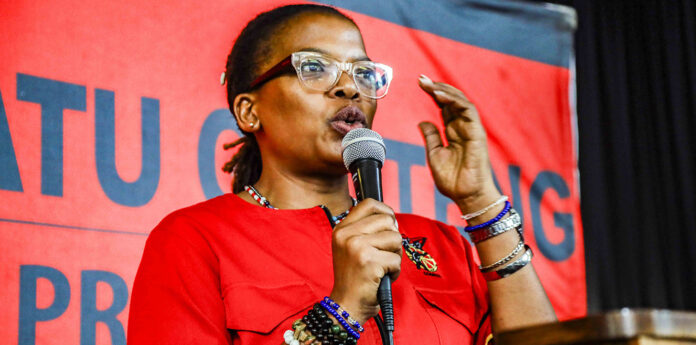
COSATU wants South Africa’s police service expanded to at least 200,000 officers, warning that detective caseloads, low salaries and inadequate equipment are weakening the state’s ability to protect communities.
“We must continue to push to reach at least 200,000 SAPS officers and, in particular, more detectives who are saddled with more than double the recommended caseloads,” federation president Zingiswa Losi said.
Her intervention, ahead of COSATU’s 15th National Congress from September 14 to 17, frames crime as a labour issue extending beyond attacks on victims. “Workers have paid a heavy price, from postal workers losing jobs to municipal workers robbed of salaries,” Losi said. COSATU argues that increasing the number of officers will achieve little unless the government also recruits detectives, forensic specialists, prosecutors and magistrates capable of carrying cases from investigation to conviction.
Losi said the federation had persuaded the government not to allow police numbers to continue declining. Recruitment was now lifting the SAPS establishment beyond 180,000.
She cautioned against police officers being treated as an unlimited source of labour while receiving inadequate pay and carrying risks.
“Too many SAPS members are paid a pittance and drowning in debt, yet are expected to risk life and limb,” Losi said. “This is simply unsustainable.”
COSATU’s position exposes a contradiction confronting public-sector workers. Communities demand faster policing and better services, while frontline institutions face vacancies, equipment shortages and budget pressure. Workers absorb both institutional failure and public anger about it.
The federation wants October’s Medium-Term Budget Policy Statement to provide police stations with among other things, working vehicles, body armour, rape kits, modern computers and improved forensic laboratories. “There is no shortcut to winning this existential war,” Losi said.
COSATU pointed to the decline in police deaths on duty, from 84 in 1994 to 12 during the past financial year, as evidence of progress. “However, even 12 is 12 too many,” Losi said.
The federation also wants stronger legislation and enforcement against attacks on police, gender-based violence, money laundering and the proceeds of crime, with proposals including tightening public procurement and holding senior state managers liable for corruption committed under their watch.
COSATU said these measures were necessary to dismantle syndicates that had treated South Africa “as a playground”. “Crime syndicates do not confine themselves to a single country,” she said, adding that trafficking in people, drugs and weapons required cross-border cooperation.
The federation presents the South African Revenue Service’s recovery as a model for rebuilding law-enforcement institutions. Losi said SARS had demonstrated the importance of appointing competent managers, removing corrupt officials, filling frontline vacancies, upgrading staff skills and investing in infrastructure.
The argument places workers on both sides of the crime emergency. Police face dangerous and under-resourced workplaces. Other workers face robbery, violence, lost income and collapsing public services when crime and corruption overwhelm the state.
COSATU says its affiliates POPCRU, SAMWU and SATAWU have campaigned on these problems while organising workers across policing, corrections, municipalities, transport and security.
Losi acknowledged recent declines in murder and other violent crimes but said they did not justify complacency. “Crime remains painfully high,” she said. “This is a war that COSATU will push to be intensified.”
- COSATU calls for South Africa’s police service to be expanded to at least 200,000 officers, including more detectives to handle excessive caseloads.
- Federation president Zingiswa Losi emphasized that increasing police numbers alone is insufficient without recruiting detectives, forensic specialists, prosecutors, and magistrates.
- Police recruitment has lifted the SAPS establishment beyond 180,000, with COSATU persuading the government to halt the decline in police numbers.
- COSATU demands the Medium-Term Budget Policy Statement to provide police stations with working vehicles, body armour, rape kits, modern computers, and improved forensic laboratories.
- The federation wants stronger legislation and enforcement against attacks on police, gender-based violence, money laundering, and corruption, along with enhanced cross-border crime cooperation.


