


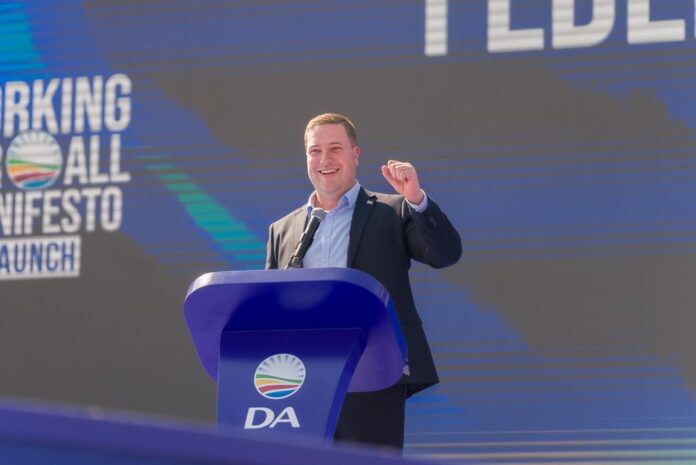
The Democratic Alliance (DA) has launched an aggressive local government election campaign centred on service delivery, clean governance and a sharp critique of the ANC’s performance in municipalities, arguing that South Africans should no longer accept failing towns and cities as normal.
The party unveiled its 2026 local government election manifesto on Saturday in Newtown, Johannesburg, before a crowd of members and supporters. DA leaders used the event to paint a picture of municipalities struggling with deteriorating services, corruption and poor financial management, while positioning the party as a proven alternative.
DA leader and Cape Town Mayor Geordin Hill-Lewis said the party’s campaign would focus on the everyday needs of residents, describing reliable municipal services as essential to restoring dignity and improving quality of life.
Focus on basic services
Hill-Lewis said many South Africans are grappling with persistent water and electricity interruptions, poor refuse collection, broken streetlights, unsafe communities and declining road infrastructure.
“An ordinary life has become an extraordinary privilege,” he said.
He argued that effective local government should function so seamlessly that residents rarely have to think about it.
“Your municipality should be the least dramatic part of your day,” Hill-Lewis told supporters.
The DA said its election platform is designed around delivering consistent municipal services and creating communities where residents can depend on local government to meet their basic needs.
Attack on ANC governance
The DA leader also used the manifesto launch to launch a direct attack on the ANC, accusing the governing party of normalising municipal failure and fostering patronage networks.
“How many of you out there know that where the ANC governs, jobs are only for the politically connected?” Hill-Lewis asked.
He pledged that municipalities governed by the DA would appoint people based on merit rather than political affiliation.
“Municipal jobs will go to people who can actually do the work. They will not go to the politically connected,” he said.
Hill-Lewis further promised to end what he described as cadre deployment in local government, arguing that municipalities should be managed by qualified professionals, including engineers and experienced administrators.
Zero tolerance for corruption
Corruption emerged as another key pillar of the DA’s campaign message.
Hill-Lewis said officials involved in corruption or who fail to perform their duties would be held accountable under DA administrations.
“Under the DA, public money is never party money,” he said.
The party committed itself to greater transparency in procurement processes and promised to overhaul municipal billing systems. According to Hill-Lewis, revenue collected from services such as water and electricity should be ringfenced and reinvested in maintaining and upgrading infrastructure.
“Every rand collected for water will be protected for water. Every rand collected for electricity will be protected for electricity,” he said.
He argued that municipal funds should not be diverted to excessive salaries, politically driven projects or corrupt contracts.
Promises to support businesses
The DA also used the manifesto launch to outline measures aimed at stimulating local economic activity and supporting entrepreneurs.
Hill-Lewis said the party would reduce red tape by simplifying permit processes for informal traders and creating safer, serviced trading spaces.
The proposal forms part of the DA’s broader vision of municipalities as enablers of economic growth rather than obstacles to business development.
Pointing to DA-run municipalities
A central theme of the campaign was the party’s claim that it has already demonstrated its governing model in municipalities under its control.
The DA highlighted Midvaal Local Municipality as an example of successful governance, contrasting it with the ANC-led City of Johannesburg and Emfuleni Local Municipality, which Hill-Lewis cited as examples of municipal decline.
“We are not guessing about how to fix South Africa. We are not guessing about how to make your town and city work. We have done it,” he said.
The party argued that its municipal track record provides evidence that improved service delivery, financial management and accountability can be achieved.
Seeking broader support
Beyond its traditional voter base, the DA sought to present its governance model as one that serves all residents regardless of political affiliation.
Hill-Lewis concluded the launch by declaring that the party was committed to repairing broken municipalities and restoring public confidence in local government.
He said the DA’s mission was to fix what has been damaged, restore hope and build municipalities that work for all South Africans.
- The Democratic Alliance (DA) has launched an aggressive local government election campaign centred on service delivery, clean governance and a sharp critique of the ANC’s performance in municipalities, arguing that South Africans should no longer accept failing towns and cities as normal.
- The party unveiled its 2026 local government election manifesto on Saturday in Newtown, Johannesburg, before a crowd of members and supporters.
- DA leaders used the event to paint a picture of municipalities struggling with deteriorating services, corruption and poor financial management, while positioning the party as a proven alternative.
- DA leader and Cape Town Mayor Geordin Hill-Lewis said the party’s campaign would focus on the everyday needs of residents, describing reliable municipal services as essential to restoring dignity and improving quality of life.
- Focus on basic services Hill-Lewis said many South Africans are grappling with persistent water and electricity interruptions, poor refuse collection, broken streetlights, unsafe communities and declining road infrastructure.


