


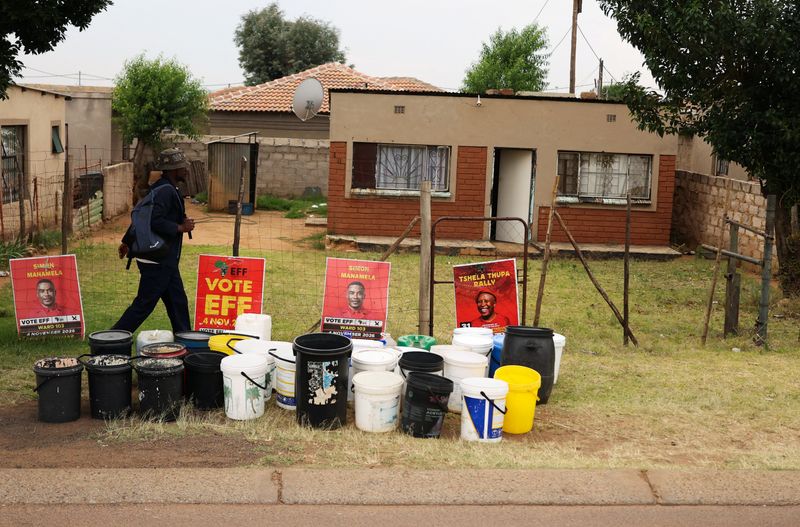
The Economic Freedom Fighters (EFF) is prepared to enter into coalition agreements with parties it opposes at national level but wants a share of positions and participation in municipal administrations in exchange for its support.
EFF secretary-general Marshall Dlamini said the party would prioritise service delivery when negotiating local government coalitions, arguing that national political differences should not necessarily determine which parties it could work with in municipalities.
Speaking at the National Results Operation Centre (ROC) in Midrand on Thursday night, Dlamini said the EFF’s position on working with the Democratic Alliance (DA) and Freedom Front Plus (FF+) at national level should not automatically determine its approach to municipal coalitions.
“We always said that when it comes to national, because that is where policy is made, that has been our position [not to work with the DA and FF+]. With local government, there is no policy and no laws, so there is just service delivery. So anyone that agrees on service delivery and prioritises our people in the townships and villages, those are people we can talk to,” he said.
READ: DA leaves door open to ANC coalitions, but no chance for EFF deal
However, the EFF does not intend to simply lend its support to other parties without participating in the administration of municipalities.
Dlamini said the party expected to secure positions and play an active role in local government where it entered into coalition agreements, arguing that it had demonstrated its ability to govern.
“Even this time around we participated in government, and we have proved we are an organisation which has invested in governance. We are ready, but the coalition talks will inform that we are participating in government. Our priority should be the programme of action because whatever happens, we will not give up or surrender,” he said.
He pointed to the party’s participation in the Gauteng provincial government, where its provincial chairperson, Nkululeko Dunga, serves as finance MEC, as an example of its experience in government.
Dunga’s appointment to the provincial executive marked the EFF’s first entry into a provincial government.
The EFF’s existing parliamentary partnership with the likes uMkhonto weSizwe (MK) Party through the Progressive Caucus also forms part of its broader opposition relationships.
However, Dlamini indicated that municipal coalition negotiations would not necessarily be restricted to the party’s existing political allies.
He also drew a line at working with parties he considers racist, saying the EFF would not compromise on that principle in its coalition arrangements.
His comments come as political parties prepare for coalition negotiations following Wednesday’s local government elections, with the outcome in several municipalities dependent on agreements between parties that failed to secure outright majorities.
READ: EFF’s Maotwe takes on ‘patriarchy’ during Tshwane mayoral debate
Dlamini also acknowledged that the EFF had fallen short of its electoral ambitions, admitting that the party had hoped to emerge as the country’s biggest political force but remained fourth nationally.
“We wanted to win, that is the intention of contesting elections. We are not where we wanted to be, but we are here. We wanted to be on top, number one, but we are sitting at number four nationally, and we entered the elections at number four,” he said.
Asked whether the party’s position on immigration had contributed to declining support in townships, Dlamini said it would be irresponsible to reach conclusions before the party had analysed its electoral performance.
He said the EFF needed to examine differences in its rural and township support, as well as whether young people, whom he identified as part of the party’s core constituency, had turned out to vote.
“It would be irresponsible of me as a leader. We would have to sit down and go through the results. There is a difference in the rural votes we are getting and the votes we are getting in the township. There are a lot of issues and dynamics we have to look at, including our constituency, which is the youth vote. Did they turn out to vote?” he said.
- The EFF is willing to enter coalition agreements with nationally opposed parties if it receives positions and participates in municipal administrations.
- EFF secretary-general Marshall Dlamini emphasized prioritizing service delivery over national political differences in local government coalitions.
- The party expects to secure roles in local government coalitions, citing its governance experience, including holding the finance MEC position in Gauteng.
- The EFF will not work with parties it considers racist but may negotiate beyond its established political allies.
- Dlamini admitted the EFF did not meet its goal of becoming the top national political force, remaining fourth in the recent elections.
The Economic Freedom Fighters (EFF) is prepared to enter into coalition agreements with parties it opposes at national level but wants a share of positions and participation in municipal administrations in exchange for its support.
EFF secretary-general Marshall Dlamini said the party would prioritise service delivery when negotiating local government coalitions, arguing that national political differences should not necessarily determine which parties it could work with in municipalities.
Speaking at the National Results Operation Centre (ROC) in Midrand on Thursday night, Dlamini said the EFF's position on working with the Democratic Alliance (DA) and Freedom Front Plus (FF+) at national level should not automatically determine its approach to municipal coalitions.
"We always said that when it comes to national, because that is where policy is made, that has been our position [not to work with the DA and FF+]. With local government, there is no policy and no laws, so there is just service delivery. So anyone that agrees on service delivery and prioritises our people in the townships and villages, those are people we can talk to," he said.
READ: DA leaves door open to ANC coalitions, but no chance for EFF deal
However, the EFF does not intend to simply lend its support to other parties without participating in the administration of municipalities.
Dlamini said the party expected to secure positions and play an active role in local government where it entered into coalition agreements, arguing that it had demonstrated its ability to govern.
"Even this time around we participated in government, and we have proved we are an organisation which has invested in governance. We are ready, but the coalition talks will inform that we are participating in government. Our priority should be the programme of action because whatever happens, we will not give up or surrender," he said.
He pointed to the party's participation in the Gauteng provincial government, where its provincial chairperson, Nkululeko Dunga, serves as finance MEC, as an example of its experience in government.
Dunga's appointment to the provincial executive marked the EFF's first entry into a provincial government.
The EFF's existing parliamentary partnership with the likes uMkhonto weSizwe (MK) Party through the Progressive Caucus also forms part of its broader opposition relationships.
However, Dlamini indicated that municipal coalition negotiations would not necessarily be restricted to the party's existing political allies.
He also drew a line at working with parties he considers racist, saying the EFF would not compromise on that principle in its coalition arrangements.
His comments come as political parties prepare for coalition negotiations following Wednesday's local government elections, with the outcome in several municipalities dependent on agreements between parties that failed to secure outright majorities.
READ: EFF’s Maotwe takes on ‘patriarchy’ during Tshwane mayoral debate
Dlamini also acknowledged that the EFF had fallen short of its electoral ambitions, admitting that the party had hoped to emerge as the country's biggest political force but remained fourth nationally.
"We wanted to win, that is the intention of contesting elections. We are not where we wanted to be, but we are here. We wanted to be on top, number one, but we are sitting at number four nationally, and we entered the elections at number four," he said.
Asked whether the party's position on immigration had contributed to declining support in townships, Dlamini said it would be irresponsible to reach conclusions before the party had analysed its electoral performance.
He said the EFF needed to examine differences in its rural and township support, as well as whether young people, whom he identified as part of the party's core constituency, had turned out to vote.
"It would be irresponsible of me as a leader. We would have to sit down and go through the results. There is a difference in the rural votes we are getting and the votes we are getting in the township. There are a lot of issues and dynamics we have to look at, including our constituency, which is the youth vote. Did they turn out to vote?" he said.


