


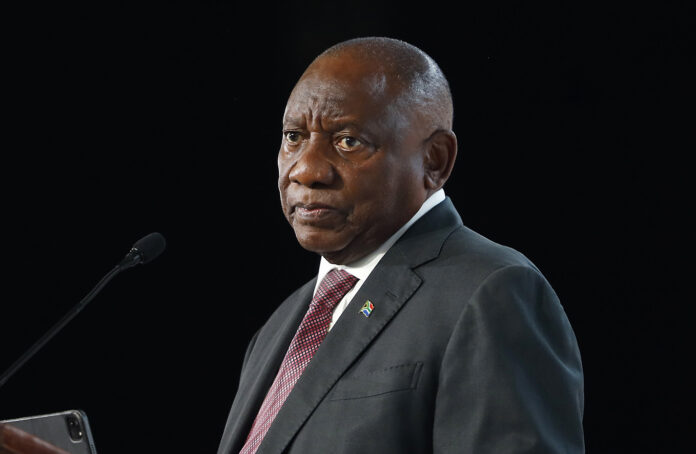
President Cyril Ramaphosa faces a fresh test of his authority after Democratic Alliance (DA) leader Geordin Hill-Lewis publicly announced sweeping changes to the party’s representation in the Government of National Unity (GNU) before the presidency had formally announced the appointments.
Is Ramaphosa still exercising his presidential power to appoint and dismiss ministers and deputy ministers, or has that power effectively been ceded to coalition partners who decide who serves in government on their behalf?
Changes not presented as proposals
In a statement released on June 17, Hill-Lewis said he had written to Ramaphosa “setting out several changes to the Democratic Alliance’s representation in the National Executive”.
But the DA statement did not present the changes as proposals awaiting the president’s decision. It stated as fact that Willie Aucamp “will replace” John Steenhuisen as minister of agriculture, David Maynier “will take up” the post of minister of forestry, fisheries and the environment, and Steenhuisen “will replace” Alexandra Abrahams as deputy minister of trade, industry and competition.
The statement also said Abrahams would move to deputy minister of electricity and energy, Yusuf Cassim would be appointed deputy minister of higher education and training, and Jack Bloom would become deputy minister of water and sanitation.
‘Constitutional prerogative of the president’
That wording has triggered discomfort in the African National Congress (ANC), which accused the DA of treating the president’s constitutional power as though it were subject to party instruction.
“The appointment and removal of members of the executive is a constitutional prerogative of the president. It is not subject to the directives of coalition partners, lobby groups or opposition parties,” the ANC said in a statement on Thursday.
The governing party said the DA’s announcement had been “presented as a directive to the president” and exposed what it called the party’s selective respect for the Constitution.
The issue is politically sensitive because the GNU was built on negotiated power-sharing after the ANC lost its parliamentary majority in the 2024 elections. In practice, parties represented in the GNU have an interest in who serves in the Cabinet on their behalf. But the Constitution does not give party leaders the power to appoint ministers or deputy ministers.
That power belongs to the president.
What will Ramaphosa do?
The question now is whether Ramaphosa will merely confirm the DA’s internal deployment decision, or whether he will visibly exercise his own discretion before changing the national executive.
The DA announcement places Ramaphosa in a difficult position. If he approves the list exactly as announced, he risks deepening the impression that GNU partners can publicly decide on Cabinet movements and leave the president to formalise them. If he rejects or changes the list, he risks a direct confrontation with the DA at a time when the GNU depends on managed compromise between the ANC and its largest coalition partner.
The matter is also embarrassing for the ANC because it raises the same question in reverse. The ANC itself has long deployed party leaders and allies into executive positions, and its national leadership routinely influences who represents the party in government. The difference in this case is that the DA announced the changes publicly in language that appeared to leave no room for presidential discretion.
Reshuffle framed as DA accountability
Hill-Lewis framed the reshuffle as an act of DA accountability.
“Following a careful assessment of the DA’s team in the Government of National Unity, I have written to President Ramaphosa setting out several changes to the Democratic Alliance’s representation in the National Executive,” he said.
He said the “renewed team” would strengthen the DA’s contribution to government and give effect to the mandate the party received from 3.5-million voters in the 2024 elections.
He also linked the reshuffle to performance, saying Aucamp’s immediate mandate would be to deal with legal proceedings related to foot-and-mouth disease, work with the agricultural sector to overcome the crisis, and restore confidence through practical steps.
Steenhuisen’s move from agriculture to deputy minister of trade, industry and competition was presented as a redeployment to focus on market access, industrial growth, competitiveness and job creation.
But the ANC sharply criticised the move, saying the Department of Trade, Industry and Competition (DTIC) should not be treated as a “dumping ground” for DA underperformers or internal factional opponents.
The ANC said the DTIC was central to industrialisation, localisation, investment promotion, economic transformation, job creation and inclusive growth.
The dispute now leaves Ramaphosa with more than an administrative decision. He must decide how to handle the DA’s requested reshuffle without creating a precedent that GNU party leaders can announce executive changes before the president does.
At stake is not only Steenhuisen’s demotion or the DA’s internal reset. It is whether the GNU has quietly shifted cabinet appointment power from the Union Buildings to party headquarters.
- President Cyril Ramaphosa faces a fresh test of his authority after Democratic Alliance (DA) leader Geordin Hill-Lewis publicly announced sweeping changes to the party’s representation in the Government of National Unity (GNU) before the presidency had formally announced the appointments.
- Is Ramaphosa still exercising his presidential power to appoint and dismiss ministers and deputy ministers, or has that power effectively been ceded to coalition partners who decide who serves in government on their behalf?
- Changes not presented as proposals In a statement released on June 17, Hill-Lewis said he had written to Ramaphosa “setting out several changes to the Democratic Alliance’s representation in the National Executive”.
- But the DA statement did not present the changes as proposals awaiting the president’s decision.
- It stated as fact that Willie Aucamp “will replace” John Steenhuisen as minister of agriculture, David Maynier “will take up” the post of minister of forestry, fisheries and the environment, and Steenhuisen “will replace” Alexandra Abrahams as deputy minister of trade, industry and competition.


