


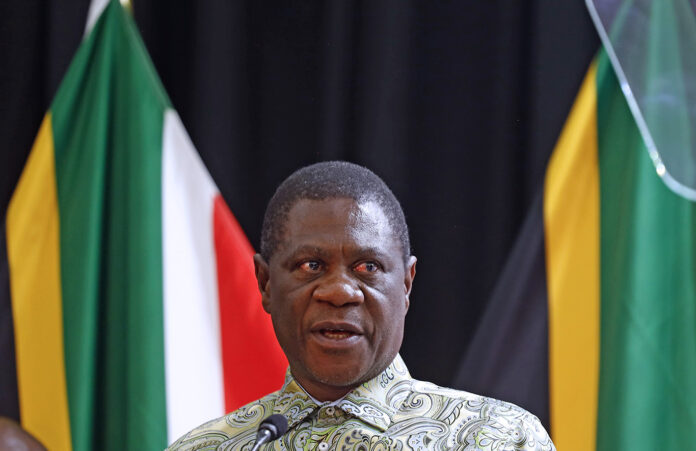
Deputy President Paul Mashatile’s prolonged a sence from public duties has turned the management of his health information into a test of government communication, with weeks passing between his last public appearance and the first official explanation of why he had stepped away from the public stage.
Mashatile has not made a confirmed public appearance since July 18, when he officiated at the Mandela Day Water Services Project Launch and Acceleration Programme in KwaZulu-Natal.
Five days later, International Relations Minister Ronald Lamola delivered a keynote address on his behalf at the Kgalema Motlanthe Foundation Winter Seminar.
Yet it was only on August 4 that the Presidency publicly addressed his absence, announcing that Mashatile was recovering from a “minor surgical procedure”. “The president visited the deputy president this afternoon and was assured that his deputy will soon be back at work,” the Presidency said.
ANC secretary-general Fikile Mbalula again addressed the matter on the eve of the party’s manifesto launch, August 23, saying Mashatile was recovering.
The episode has raised broader questions about communication when senior constitutional office-bearers are unable to perform normal public duties.
The president, deputy president and finance minister occupy positions at the centre of executive authority, government continuity and economic confidence. While public office does not remove an individual’s right to medical privacy, prolonged absence from such positions creates legitimate questions about whether duties are being performed and responsibilities reassigned and when normal engagements will resume. Instead, limited communication has allowed competing accounts of Mashatile’s condition to emerge.
A source briefed on developments told Sunday World that Mashatile had at one stage been admitted to ICU before being discharged. Two other sources separately raised suspicions that poisoning might have been involved, while another said consideration had been given to sending Mashatile to Russia for medical treatment.
A source close to Mashatile said the deputy president had first received medical attention in Cape Town before returning to Johannesburg for further treatment. He had been discharged and continued receiving care as an outpatient.
Sunday World could not independently verify the medical details supplied by the sources, including claims that Mashatile had been admitted to the ICU, that poisoning was suspected or possible treatment in Russia.
Mashatile’s acting spokesperson Keith Khoza provided the clearest official explanation of how the deputy president came to be hospitalised.
“The deputy president did not feel well whilst he was home in Johannesburg. Under the supervision of his medical detail, he went to the hospital for a check-up,” Khoza said. “He was … admitted for a minor procedure and observation … He was later discharged and advised to get some rest. I can confirm that he is in good health.”
Sources in the Presidency said the lack of more detailed communication was partly linked to Mashatile’s office not providing sufficient information.
Mashatile has continued receiving political visitors. A source close to him said Mpumalanga Premier Mandla Ndlovu had visited him last week, while senior ANC leaders from the Free State were also expected to visit him. Ramaphosa had visited Mashatile on more than one occasion.
Mashatile’s social media platforms carried official and ANC campaign material.
A Facebook item associated with Mashatile’s page around the SADC summit appeared as his “live broadcast” accompanied by personalised messages directed at him, although material reviewed by Sunday World did not establish that Mashatile was physically present.
A report portraying Mashatile as a leader who “works the ground in silence” was also circulated through a WhatsApp linked to his campaign to succeed Ramaphosa as ANC president.
Ramaphosa added to questions around Mashatile’s schedule when he made an unannounced appearance at the Black Business Council Annual Black Summit on August 13.
He told delegates that Mashatile had been expected to address the gathering but had SADC commitments.
The uncertainty around his absence has political consequences.
Sources say some Cosatu unions expected to endorse him as Ramaphosa’s successor have held back, while his support network in North West has shown signs of weakening.
- Deputy President Paul Mashatile has not made a confirmed public appearance since July 18, when he officiated at an event in KwaZulu-Natal.
- The Presidency announced on August 4 that Mashatile was recovering from a minor surgical procedure after weeks of limited official communication regarding his absence.
- Sources have claimed that Mashatile was admitted to ICU, poisoning was suspected, and treatment in Russia was considered, but these claims have not been independently verified.
- Mashatile was hospitalized following health concerns at home in Johannesburg, underwent a minor procedure and observation, and has since been discharged and advised to rest.
- The lack of detailed communication about Mashatile's condition has caused political uncertainties, including hesitations among Cosatu unions to endorse him and signs of weakening support in North West.


