


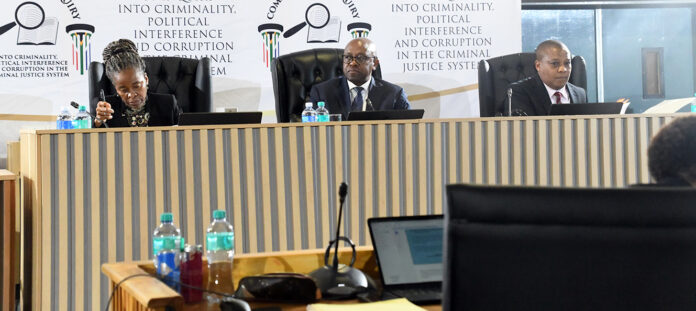
A former senior Crime Intelligence official who managed the police’s secret funds says the Madlanga Commission refused to hear evidence that he believes goes to the centre of allegations of corruption, political interference and abuse of intelligence structures.
Brigadier Tiyani Lincoln Hlungwani, a former section head of finance and administration services in the Crime Intelligence Secret Services Account (SSA), submitted a draft affidavit to the commission outlining allegations involving procurement irregularities, intelligence operations and internal battles for control of the division.
But the commission declined his request to testify, telling him that the matters he raised did not fall within its mandate.
Hlungwani’s affidavit, submitted in support of his request to appear, runs to more than 100 pages and details his claims about alleged misuse of the account, disputed procurement decisions and alleged interference with investigations. He says he served as a whistleblower after refusing to approve transactions he believed did not comply with procurement rules. He says this resulted in retaliation, including transfers, disciplinary action and his eventual dismissal.
Among the matters he wanted the commission to hear was his account of alleged irregularities involving intelligence equipment, including the procurement of interception technology known as “grabbers”.
Hlungwani alleges that he raised concerns about compliance with the Regulation of Interception of Communications and Provision of Communication-related Information Act before the equipment was purchased.
He also raised allegations relating to procurement involving I-View Integrated Systems and businessman Inban Kistiah, including contracts for intelligence technology and equipment. These allegations have previously featured in other investigations and disputes involving SAPS structures.
A major part of his affidavit challenges the narrative around Crime Intelligence leadership battles. Hlungwani says internal conflicts have been presented as factional disputes while, in his view, they involve deeper questions about control of intelligence resources and accountability.
He specifically challenged evidence and allegations involving senior police figures, including Lt-Gen Dumisani Khumalo, Lt-Gen Nhlanhla Mkhwanazi and National Commissioner Gen Fannie Masemola.
In a letter dated February 12, the commission secretary, Dr Nolitha Vukuza, said Hlungwani’s submissions had been considered. “The commission is mandated to inquire into systemic criminality, political interference, and corruption within the criminal justice system,” the letter states. It added that the inquiry was not empowered to adjudicate individual disputes or investigate matters outside its defined scope.
Hlungwani disputes that characterisation.
In correspondence to the commission, he argued that his evidence was directly relevant because it concerned alleged corruption, intelligence failures and interference within Crime Intelligence.
“I believe that my submissions and testimony will assist the commission in getting to the root cause of the corruption in the justice system, particularly SAPS,” he wrote.
The refusal means the commission will not publicly test Hlungwani’s allegations against those he implicates unless they arise through other evidence before the inquiry.
Spokesperson Jeremy Michaels said the Commission was engaging with people who had made submissions. He said the inquiry was “guided by its terms of reference” and was not a “free ranging investigation” into alleged SAPS corruption. Hlungwani confirmed that he had exchanges with the commission but declined to comment.
- Brigadier Tiyani Lincoln Hlungwani, a former section head in Crime Intelligence, submitted a detailed affidavit to the Madlanga Commission alleging corruption and procurement irregularities but was refused an opportunity to testify.
- Hlungwani's affidavit, over 100 pages long, alleges misuse of secret service funds, retaliation against his whistleblowing, and procurement issues including the purchase of interception technology called "grabbers."
- The commission declined Hlungwani's request to testify, stating his matters did not fall within its mandate to investigate systemic criminality, political interference, and corruption within the criminal justice system.
- Hlungwani disputes the commission's refusal, arguing his evidence directly relates to corruption, intelligence failures, and political interference within Crime Intelligence.
- The commission's spokesperson said it is engaging with submitters but is limited by its terms of reference and not conducting an unrestricted probe into SAPS corruption.


