


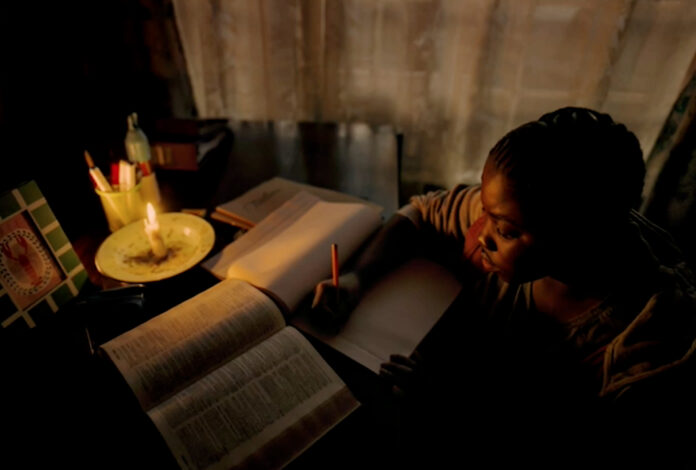
The EFF’s November 4 election advert, released on Tuesday, clearly targets Black, working-class voters who live in townships, informal settlements, rural villages, or neglected urban communities.
This voter is unemployed, underemployed, or trapped in insecure, poorly paid work. They may have matric, vocational training, or a tertiary qualification, but education has not produced economic mobility.
The advert opens with rubbish piled around a settlement before moving into a poorly lit home. A prepaid electricity meter and a woman sitting in darkness establish the voter’s immediate world. Politics is experienced through electricity units, empty taps, municipal neglect, and the daily struggle to keep a household functioning.
The woman represents a voter responsible for children, elderly relatives, or unemployed family members. She must secure food, water, and electricity while absorbing the consequences of failing public institutions. The advert seeks to reach women who may agree with the EFF’s economic diagnosis but remain uneasy about its aggressive, male-dominated image.
A man appears with a horse and embraces a child. His inclusion broadens the target beyond the urban activist associated with the EFF. He represents a rural worker, parent, or jobseeker removed from economic opportunities but subject to the same exclusion.
People are then shown waiting in a crowded public facility, while an elderly woman stands behind bars or a security gate. The state becomes something the voter waits upon rather than controls.
Water containers and a tanker make scarcity physical. The targeted voter may not know which sphere of government is responsible for the interruption. That matters less than the advert’s conclusion that the political establishment has failed.
A young man moving through the city represents a voter whose aspirations exceed available opportunities. He was told education, effort, and democracy would create opportunities, yet he cannot enter the economy or support a household securely.
The underlying beliefs are practical. The economy is unfair. Wealth and opportunity remain concentrated.
The advert excludes Julius Malema. This suggests the intended voter knows the EFF but has reservations about its conduct. Showing ordinary citizens first prevents established feelings about Malema from blocking the message.
A Mandela portrait addresses another obstacle. The targeted voter may be disappointed with the ANC while respecting the liberation struggle. The portrait allows the voter to separate liberation history from the ANC’s current performance.
The turning point comes when isolated suffering becomes political recognition. A young woman adopts the red beret. People move into the street. South African and EFF flags appear, the crowd grows, and fists are raised. Militancy arrives only after deprivation has justified it. The beret becomes a symbol of protection, belonging, and recovered agency rather than confrontation alone.
The target may also be an irregular voter or abstainer who believes elections change little. The movement from isolated people to a crowd challenges that resignation. Collectively, numbers, organisation, and votes can threaten those controlling public institutions.
The typical target is not a committed revolutionary. It is an insecure, historically conscious, and politically homeless citizen. The grievance already exists. The uncertainty is whether the EFF represents ordinary families, can govern competently, and deserves their vote. The advert answers representation more convincingly than competence. Its intended conversion is precise. Private hardship becomes political grievance, grievance becomes collective identity, and collective identity becomes an EFF vote.
- The EFF’s November 4 election advert targets Black, working-class voters living in townships, informal settlements, rural villages, or neglected urban communities who face unemployment, underemployment, or insecure, poorly paid work.
- The advert depicts everyday struggles with electricity, water scarcity, and municipal neglect, emphasizing the voter's responsibility for family and the failure of public institutions.
- It excludes Julius Malema, suggesting the voter knows the EFF but may have reservations about its leadership, and includes a Mandela portrait to separate liberation history from the ANC's current performance.
- The advert transitions from portraying isolated suffering to collective political recognition, ending with the adoption of the red beret as a symbol of protection, belonging, and agency.
- The targeted voter is typically insecure, politically homeless, historically conscious, possibly irregular or abstaining, and the advert seeks to convert private hardship into political grievance, collective identity, and ultimately an EFF vote.


