


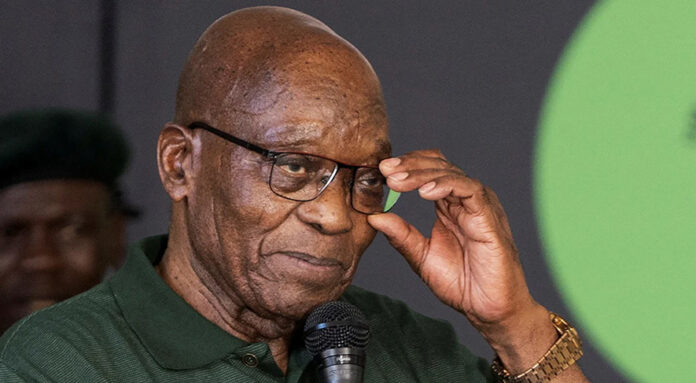
Former president Jacob Zuma has announced a sweeping ideological and structural overhaul of the MK Party, including the disbandment of its powerful national high command, the establishment of a new centralised “institute” to run party affairs, and a renewed push for constitutional change grounded in what the party calls “African identity restoration”.
In a lengthy five-page statement issued on Friday, Zuma said the reorganisation followed an 18-month “Organisational Health, Ideological and Strategic Assessment Study” aimed at determining whether the MK Party should continue operating as a conventional political party or evolve into what he described as a “concentrated liberation movement”.
The announcement marks one of the most significant internal restructurings since the MK Party’s dramatic emergence ahead of the 2024 national elections, where it rapidly displaced the ANC in large parts of KwaZulu-Natal and became a major opposition force nationally.
“The findings of the study are clear,” the statement reads. “Conventional party politics across the world is increasingly becoming a weak mobilising force.”
Zuma said the party had benchmarked itself against “international institutional models and strategic formations” in countries including Singapore, China, Russia, Brazil, Iran and states in the Sahel region, while also drawing ideological inspiration from Pan-Africanism, Black Consciousness, Afrocentrism and decolonial theory.
At the centre of the shake-up is the creation of what the party calls “The MK Party Institute”, a body that will now assume control over the “strategic, ideological, philosophical, organisational and liberation agenda” of the movement.
The institute will be politically led by MK Party deputy president Dr Mandlakayise Hlophe and will include senior figures such as Gen Mduduzi Manana, Oupa Mathebula, Khanyisile Litchfield-Tshabalala, party spokesperson Nhlamulo Ndhlela, chief whip Mmabatho Mokoena-Zondi and newly appointed head of the presidency Lindelani Mbambo.
The party further announced that members of the institute would automatically become ex officio members of all existing party structures during what it called a “transitional and reconfiguration process”.
The statement also formally confirmed the dissolution of the MK Party’s national high command, replacing it with a new national executive committee that will be assembled under the guidance of the institute.
Zuma said the restructuring was necessary because the assessment identified “serious internal and external threats” facing the movement, including “infiltration, factionalism, power mongering, opportunism, and position-based politics”.
The reorganisation also places strong emphasis on ideology and constitutional transformation.
In one of the statement’s most politically charged sections, the MK Party argued that South Africa required “a new constitutional conversation rooted in the aspirations, history, traditions, values, and indigenous consciousness of African people”.
The party claimed the current constitutional order remained heavily influenced by Roman-Dutch and English legal traditions and did not adequately reflect “the civilisational realities and aspirations of the African majority”.
It further declared support for a constitutional order grounded in “justice, dignity, Africanism, sovereignty, and genuine democratic participation by the people themselves”.
Zuma also used the statement to advance a philosophy he referred to as “Ntuversalism”, which he described as an ideological framework centred on “the restoration of Bantu and uMuntu consciousness, African identity, collective dignity, spiritual continuity, and societal sovereignty”.
The former president said the philosophy would officially be launched in Johannesburg on May 28.
In language certain to provoke controversy, the statement accused Afrikaners of attempting to “legitimise their colonial roots on our African soil” and linked this to historical land dispossession.
The party also confirmed a series of new organisational deployments ahead of the 2026 local government elections and the 2029 national elections.
Among the changes announced were that the office of the secretary-general would focus on organisational structures and local government election preparations, while the treasurer-general’s office would focus solely on fundraising.
The statement said the party was now preparing for “total power during the 2029 national government elections” through intensified grassroots mobilisation campaigns, community structures and activist formations.
It also announced plans for a “National Community-Based Contact Centre” aimed at strengthening engagement with activists, traditional leaders, councillors, youth formations, women and workers.
The statement closes with a call for churches, traditional leaders, intellectuals, workers, women and activists to unite behind what it termed a programme of “liberation, dignity, sovereignty, and African restoration”.
- Former president Jacob Zuma announced a major overhaul of the MK Party, disbanding its national high command and creating a centralized “MK Party Institute” to lead strategic, ideological, and organizational affairs.
- The restructuring follows an 18-month study deeming conventional party politics increasingly ineffective, pushing the MK Party to evolve into a concentrated liberation movement with influences from Pan-Africanism and global political models.
- The party advocates for constitutional change emphasizing African identity, sovereignty, and justice, criticizing the current constitution for its colonial legal heritage and proposing a new order reflecting indigenous values and aspirations.
- Zuma introduced “Ntuversalism,” an ideology focusing on the restoration of African identity and dignity, to be launched in late May, and accused Afrikaners of trying to legitimize colonial land dispossession.
- MK Party plans intensified grassroots mobilization, new organizational roles focused on elections and fundraising, and the establishment of a National Community-Based Contact Centre to prepare for total power in the 2029 national elections.


