


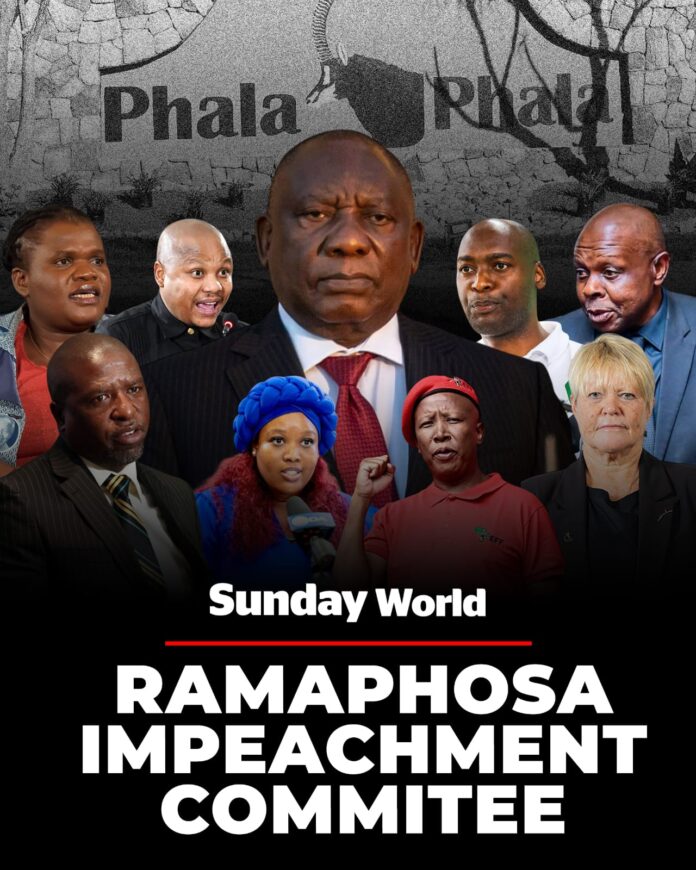
A heated dispute has erupted in Parliament’s impeachment committee over draft rules that could allow President Cyril Ramaphosa to avoid personally appearing before MPs probing the findings of the Section 89 Phala Phala report.
The committee was considering draft procedures that will regulate how witnesses are called, how evidence is presented, and how the president will participate in proceedings arising from the Section 89 panel chaired by former chief justice Sandile Ngcobo.
At the centre of the disagreement are provisions dealing with the president’s participation, which opposition MPs say could be interpreted in a way that allows him to rely on legal representatives instead of appearing before the committee in person.
A key point of contention is Rule 9 of the draft impeachment procedures, which states that the president may be assisted by a legal practitioner or other expert of his choice during the inquiry and that he may appoint or remove such a representative at any stage.
“9.2.1. appoint a legal practitioner or other expert as the President’s representative; and 9.2.2. terminate the mandate of the president’s representative, with or without appointing another legal practitioner or expert as the President’s representative,” the rule states.
‘President must appear in person’
Opposition MPs warned that the wording, read together with other provisions, could create room for the president to avoid appearing in person before the committee.
ATM leader in Parliament and committee member Vuyo Zungula was the first to flag the concern during Wednesday’s meeting, insisting that the rules must not leave discretion over whether the president testifies.
“If the president chooses to testify, that is the first and most important issue that we need to address. It cannot be left to the president to choose to testify or not,” Zungula said.
He argued that once the committee issues a summons, attendance must be compulsory.
“If he is summoned by the committee, and I think that is what the committee will do, it will summon him, then he has no choice whether to come or not to come. He must come if he is summoned. The rules can’t give him the leeway to decide what to do,” he said.
Clampdown on permissive terms
Zungula also called for stronger wording in the rules, arguing that permissive terms such as “may” should be replaced with “must” to remove any ambiguity.
“So anywhere that it says ‘elect’ or ‘may’, it must be clear that if he’s summoned, we must change the ‘may’ to ‘must’,” he said.
MK Party MP Andile Mngxitama echoed similar concerns, questioning why a president under investigation should be able to avoid direct engagement with the committee.
“The president cannot have an option of whether to appear before this committee or not. This committee is set up precisely to try to deal with matters related to his conduct. How can he then choose not to appear before this committee?”
He added that while written submissions are acceptable, they cannot replace in-person accountability.
‘Constitution empowers Parliament’
Meanwhile, ANC MP Cameron Dugmore urged members to rely on the Constitution rather than over-interpreting the draft rules.
Referring to Section 56 of the Constitution, Dugmore said Parliament already has the authority to summon any person to appear before it or its committees.
“It’s very clear that the National Assembly or any of its committees may summon any person. We should be guided by the Constitution in terms of our powers to summon who we need to appear. So let’s give precedence to the Constitution in terms of that particular issue.”
Another issue that came under discussion was whether the senior counsel appointed to lead evidence should undergo a vetting process.
MPs split on vetting of senior counsel
EFF leader Julius Malema opposed the idea, arguing that legal counsel would already be bound by oath and professional obligations to act impartially and follow parliamentary rules.
Malema also insisted that evidence should be presented in person rather than through hybrid or virtual formats.
“There is no evidence that is going to be given on a hybrid or virtual one. Every evidence is going to be presented in a physical meeting of any witness. We have to calmly sit and give that evidence,” he said.
Only three MPs, MK Party’s Khanyisile Litchfield-Tshabalala, National Coloured Congress leader Fadiel Adams and United African Transformation’s Wonderboy Mahlatsi, voted in favour of vetting the senior counsel. The majority opposed the proposal.
Committee chair Makashule Gana ruled that parties are expected to continue internal consultations on the draft rules before returning with formal inputs. Each party will also submit proposals for the appointment of evidence leaders, although the committee will make the final decision on appointments.
- Parliament’s impeachment committee is debating draft rules for the Section 89 Phala Phala inquiry, with contention over provisions that may allow President Ramaphosa to avoid appearing in person by using legal representatives.
- Opposition MPs argue the rules, especially Rule 9, should mandate the president's personal attendance when summoned, urging removal of ambiguous terms like “may” to enforce compulsory appearances.
- ATM’s Vuyo Zungula and MK Party’s Andile Mngxitama emphasized the necessity for direct presidential accountability and warned against optional testimony or reliance on written submissions.
- ANC MP Cameron Dugmore stressed that the Constitution already empowers Parliament to summon witnesses, advocating adherence to constitutional provisions over strict interpretation of draft rules.
- The committee debated vetting senior counsel to lead evidence, with most MPs, including EFF’s Julius Malema, opposing it; Malema also insisted all evidence be presented in physical meetings rather than virtually.


