


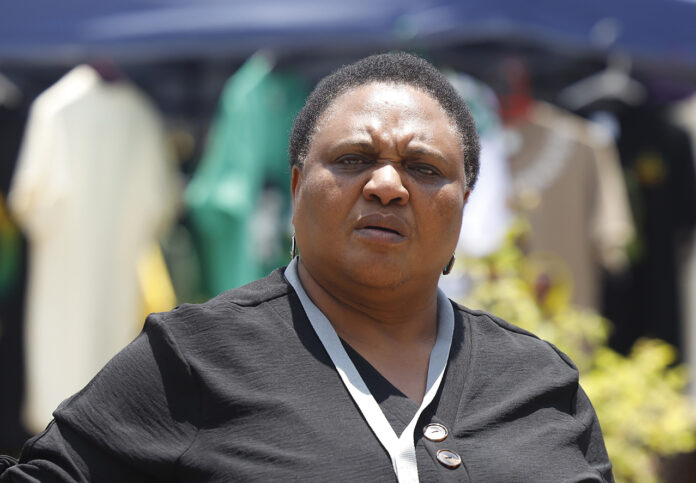
National Assembly Speaker Thoko Didiza survived an attempt to remove her from office on Wednesday night after MPs overwhelmingly rejected an EFF-led motion of no confidence.
The virtual sitting descended into heated exchanges as MPs debated whether Didiza had failed to discharge her constitutional responsibilities and whether her conduct warranted her removal.
The motion was defeated by 282 votes to 101.
READ: MK Party moves to subpoena Didiza over Ramaphosa impeachment case
The ANC, DA, IFP, Patriotic Alliance, ActionSA and other parties voted against the motion, while the EFF, MK Party, ACDP, ATM and UAT backed Didiza’s removal.
But the party’s battle with the Speaker predates Wednesday night’s no-confidence vote.
At the centre of the EFF’s case against Didiza was her handling of the Section 89 impeachment process involving President Cyril Ramaphosa.
In a letter dated 27 May, EFF parliamentary chief whip Ntando Nolutshungu accused Didiza of being conflicted over the Section 89 process and demanded that she oppose Ramaphosa’s application to set aside the report of the independent panel chaired by former chief justice Sandile Ngcobo.
The EFF argued that the independent panel process was an important constitutional accountability mechanism and warned that allowing its report to be challenged without opposition from Parliament would undermine the authority and integrity of the National Assembly.
The party also objected to the manner in which legal representation for Parliament was being considered, arguing that the process should involve all political parties represented in the National Assembly rather than being handled through consultations involving only the ANC chief whip.
READ: State pays bulk of Ramaphosa’s Phala Phala game farm court bill
Nolutshungu further argued that Didiza was conflicted because she had voted against the continuation of the impeachment process on 13 December 2022.
“It would therefore be improper for the same person who voted against the continuation of the impeachment process to unilaterally take decisions regarding legal opposition to matters arising from that very process,” the EFF said.
The EFF warned that it could approach the courts if Didiza failed to act on its demands.
But ANC MP Soviet Lekganyane rejected the EFF’s interpretation, arguing that Didiza’s actions had to be considered against the constitutional and legislative framework governing Parliament.
Lekganyane said the judicial rationale being relied upon by the EFF was contrary to Section 57 of the Constitution, which empowers Parliament to determine its internal arrangements, proceedings and procedures.
He also pointed to Section 11 of the Powers, Privileges and Immunities of Parliament Act, which distinguishes between the legal standing of the Speaker, who acts on behalf of the National Assembly, and committee chairpersons, who act on behalf of the committees they lead.
He further cited Section 23(2)(b) of the same Act, which he said gives committees the power and authority to litigate on behalf of the National Assembly, together with Rule 167 of the Rules of the National Assembly.
“All these provisions are read together with Rule 167 of the Rules of the National Assembly,” Lekganyane said.
“So you can see that with that legislation, the Speaker has not done anything wrong, unless we would have wanted her to act against the law.”
Lekganyane also placed on record that Didiza had rejected a request from Ramaphosa to limit the work of the impeachment committee.
“We put it on record, Honourable Deputy Speaker, that the Speaker unequivocally declined the request by the President to have the work of the impeachment committee restricted to preparatory work,” he said.
The ANC’s argument effectively sought to turn one of the EFF’s central attacks on its head, arguing that Didiza had not frustrated the impeachment process but had instead allowed the committee to proceed with its work within the powers granted to Parliament.
The DA also rejected the EFF’s case, although it acknowledged that it had disagreed with some of Didiza’s decisions.
DA chief whip Glynnis Breytenbach warned MPs against turning the no-confidence mechanism into a political weapon.
Breytenbach said:
“As honourable members, a motion of no confidence is a very serious constitutional instrument. It should not become a convenient political weapon whenever a party disagrees with a ruling or decision of the Speaker,”
“The question before us is not whether the Speaker has made mistakes. She has. The question is whether those shortcomings are of such a nature and magnitude that this House should conclude that she has fundamentally failed to discharge the responsibilities of her office and should therefore be removed.”
Breytenbach said the DA did not believe the threshold for removal had been met.
“We do not believe that the case has been made,” she said.
She pointed to Didiza’s actions following the Constitutional Court’s judgment on the Section 89 process, saying she had established the required impeachment committee, referred the relevant matters to it and put the necessary parliamentary processes in place.
“The Speaker has, notwithstanding our disagreements with her, continued to facilitate the constitutional work of this House,” Breytenbach said.
READ: Speaker Thoko Didiza blocks ATM’s motion against Cyril Ramaphosa
She warned that removing a presiding officer whenever political parties disagreed with a controversial decision would set a dangerous precedent.
“We should also be careful not to create a dangerous precedent whereby every controversial decision by a presiding officer becomes grounds for removal,” she said.
“If we do that, we diminish the authority of the office itself.”
The DA’s position, coupled with the ANC’s legal defence of Didiza, helped ensure that the EFF’s attempt to unseat the Speaker failed decisively.
For the EFF and its allies, however, the dispute goes beyond a disagreement over an individual ruling.
The party has maintained that Didiza’s handling of the Section 89 process raises fundamental questions about Parliament’s independence, the Speaker’s constitutional obligations and the legislature’s ability to hold the executive to account.
Wednesday’s vote ended the immediate threat to Didiza’s position but did little to resolve the deeper political and legal dispute over her role in the contentious Ramaphosa impeachment process.
- National Assembly Speaker Thoko Didiza survived a no-confidence motion led by the EFF, which was defeated by 282 votes to 101.
- The EFF accused Didiza of conflict of interest and mismanagement in the Section 89 impeachment process against President Cyril Ramaphosa.
- ANC, DA, and other parties defended Didiza, arguing her actions complied with constitutional and parliamentary regulations.
- DA chief whip Glynnis Breytenbach emphasized that mistakes by the Speaker did not justify removal without fundamental failure.
- The no-confidence vote resolved the immediate threat to Didiza but did not settle the ongoing political and legal disputes related to the impeachment process.


