


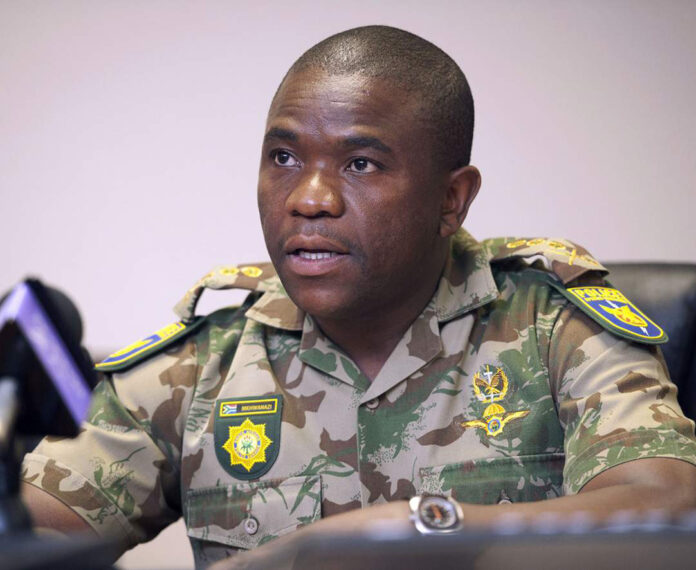
When Lt-Gen Nhlanhla Mkhwanazi held his explosive media briefing in July 2025, South Africans were left with a choice.
Either a senior police officer had uncovered an attempt to frustrate investigations into organised crime, or he had launched an extraordinary public attack based on suspicion and internal police tensions.
The draft report prepared by Parliament’s evidence leaders does not settle every dispute, but it moves the debate much further than it has ever been before.
Its most important achievement is not that it repeats Mkhwanazi’s allegations. It is that it turns those allegations into a parliamentary evidentiary record.
Buried in the conclusion is a finding that may become the defining outcome of the entire inquiry.
The report states that “a credible evidentiary basis exists for the inference that the disbandment [of the Political Killings Task Team] was influenced by the success of investigations into criminal syndicates rather than the operational reasons advanced afterwards”.
That sentence carries enormous weight.
The report does not say former police minister Senzo Mchunu protected criminals. It does not say corruption has been proved. It does not make a criminal finding against anybody.
But it does conclude that the evidence heard by Parliament supports an inference that the official reasons given for dismantling the Political Killings Task Team were not the real reasons.
That is a significant shift.
Until now, Mkhwanazi’s allegations could be dismissed as claims made by a police general. The report changes that. Parliament’s evidence leaders have now examined the witnesses, tested the documents and reviewed the competing versions.
Their conclusion is that the evidence points in a particular direction.
The report builds that conclusion piece by piece.
Major finding on PKTT disbandment
It records that the directive disbanding the task team was issued on New Year’s Eve in 2024 while national commissioner Fannie Masemola was on leave.
It records that there was no consultation with the national commissioner, the president, the National Prosecuting Authority, the State Security Agency or the Civilian Secretariat for Police.
The president himself told the committee that he learnt about the directive through social media.
Those facts matter because they weaken the argument that the disbandment formed part of a carefully considered government process.
The report also attacks the reasons later advanced to justify the decision.
Mchunu conceded that he had never met whistleblower Patricia Mashale, whose allegations featured prominently in the matter. He also conceded that the inspector-general informed him that between 75% and 80% of her allegations were untrue.
The report further notes that the 2019 work-study report relied upon by Mchunu did not recommend the disbandment of the task team.
As the explanations become weaker, the obvious question becomes stronger.
Why was the task team shut down?
The report repeatedly returns to the work of the PKTT.
The unit had investigated 612 dockets and secured 128 convictions. It had recovered 156 firearms and helped secure 29 life sentences.
More than 1 800 years of imprisonment had been imposed in cases linked to its work.
The national commissioner had also approved a further budget extension in April 2024 and endorsed the continuation of the unit.
Task team’s success was the problem
Against that background, the report concludes that there is a credible evidentiary basis to infer that the task team’s success may have contributed to its downfall.
That finding is the political centre of the report.
The document also performs another important function. It largely removes President Cyril Ramaphosa from responsibility for the disbandment.
The report repeatedly records that the president neither approved nor authorised the directive. It accepts that he was not consulted and that he only became aware of the decision after it had been issued.
The conclusion reinforces that point by stating plainly that the president did not sanction the disbandment.
That finding is likely to become politically important because it separates the conduct of Mchunu from that of the president.
The report also reaches beyond the task team itself.
Its examination of businessman Vusimuzi Matlala, political operative Brown Mogotsi and the R360-million SAPS healthcare tender paints a picture of deep governance failures inside the police service.
One of its strongest recommendations is that Lieutenant-General Fannie be referred to the Investigating Directorate Against Corruption for further investigation into possible breaches of the Public Finance Management Act.
Yet even those findings support the report’s broader theme.
This is not simply a story about one directive signed on New Year’s Eve.
Entrenchment of criminal networks
It is a story about whether criminal networks have penetrated parts of the state deeply enough to influence policing decisions.
That is why the report spends so much time on crime intelligence, procurement failures, political interference and accountability mechanisms.
Viewed as a whole, the document paints the picture of institutions under strain and of law-enforcement structures struggling to defend themselves from manipulation.
The committee may still amend the report before adopting it. Findings may change and recommendations may be refined.
But one conclusion already stands out.
Nearly a year after Mkhwanazi’s media briefing shook the country, Parliament’s evidence leaders have produced a report that does more than record allegations.
It gives them institutional weight.
And in doing so, it may have transformed a police general’s warning into one of Parliament’s most consequential findings since the state capture era.
- A parliamentary draft report supports Lt-Gen Nhlanhla Mkhwanazi's 2025 claim that the Political Killings Task Team (PKTT) was disbanded due to its successful investigations into criminal syndicates, not official reasons given.
- The disbandment directive was issued without consultation from key officials, including the national police commissioner and the president, who learned of the decision via social media.
- The report highlights the PKTT's strong track record, including hundreds of convictions and recoveries, suggesting its effectiveness may have led to its closure.
- President Cyril Ramaphosa was not involved in or aware of the disbandment decision beforehand, shifting responsibility largely to former police minister Senzo Mchunu.
- Broader findings reveal deep governance and corruption challenges within the police service, with recommendations for further investigations into possible financial misconduct.


