


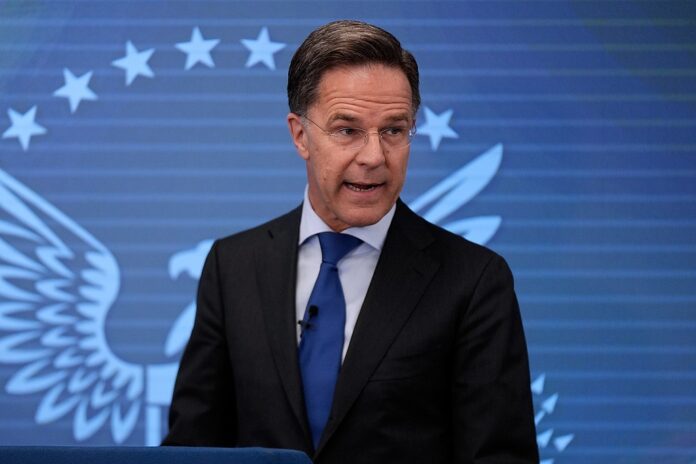
NATO secretary-general Mark Rutte dismissed concerns over a potential US withdrawal from the alliance in an interview published on Saturday.
In an interview with the German newspaper Welt am Sonntag, Rutte said he did not see the US leaving NATO but stressed the need for a stronger Europe within a stronger alliance.
Trump calls NATO paper tiger
The remarks came amid tensions fuelled by recent comments from US President Donald Trump, who complained that European allies were unwilling to support the war with Iran, calling NATO a “paper tiger”, and saying he was considering withdrawing from the alliance.
Trump is visibly disappointed with some NATO members, Rutte said, adding that he understands the US president’s frustration, and reaffirming that the US nuclear umbrella remains the “ultimate guarantor” of European security.
Earlier this month, tensions between Washington and NATO allies flared up as Trump said he was considering pulling the US out of the military alliance due to its European members’ refusal to send ships to unblock the Strait of Hormuz.
And while any withdrawal from the alliance would require congressional approval, the president could still move troops or assets out of Europe or withhold support using his authority as commander-in-chief.
It is this eventuality that the European plans are meant to tackle.
What would a ‘European NATO’ look like?
Rather than to rival the current alliance, European officials seek to sustain deterrence against Russia, ensure operational continuity, and uphold nuclear credibility – even if Washington withdraws its forces from Europe or declines to come to its defence.
But while Germany’s decision to come on board marks a major development, the plans for “European NATO” face several major challenges.
Current NATO’s entire structure is based around American leadership at virtually every level, ranging from logistics and intelligence to the alliance’s top military command.
And while Europeans are starting to shoulder more responsibilities and stepping into more leadership roles, they still lack critical capabilities due to years of underspending and reliance on the US.
A very large force
In raw military terms, even without the US, NATO would still be a very large force.
A recent assessment by the Center for Strategic and International Studies (CSIS) estimates that European NATO countries have 1.86 million active military personnel, suggesting that Europe’s challenge lies less in overall numbers than in readiness, coordination, and the ability to deploy rapidly.
After all, the US is not just another large ally within the alliance; it remains the single largest military contributor, both in overall spending and in many of the capabilities that enable NATO to operate at speed.
According to NATO’s latest annual report, the US accounted for 60% of total alliance defence expenditure in 2025, with Europe and Canada together making up the remaining 40%.
One of the many areas where Europeans lack in comparison to their American counterparts is high-end airpower.
Drawing on the International Institute for Strategic Studies report The Military Balance 2025, CSIS estimates that the US fields around 3 300 combat-capable aircraft, compared with roughly 2 100 across the European NATO members in its dataset, which excludes Türkiye.
While European allies would still retain substantial land forces, major navies, advanced combat aircraft, and two nuclear powers in the UK and France, they would lose a disproportionate share of their most advanced, deployable, and integrated military capabilities.
Europe’s reliance on US
But perhaps the greatest challenge comes in the form of Europe’s reliance on the US to provide the continent-wide nuclear umbrella that underpins the alliance’s founding principle of deterrence through strength.
Discussions are already underway, prompted in part by Trump’s threats to invade Greenland, between German Chancellor Friedrich Merz and French President Emmanuel Macron on whether France’s nuclear deterrent could be extended to cover other European nations, including Germany.
But, as with other areas where Europeans lag behind, most notably intelligence, satellite surveillance, and missile-warning systems, catching up and replacing those capabilities will require time and significant investment.
A Europeanisation of NATO “should have come before now”, retired US Admiral James G Foggo, who held senior posts in and linked to NATO, told the WSJ.
He said European members have many very professional officers and leaders.
“I think they have the capability. They’ve got some of the hardware” but need to invest and develop capabilities faster, Foggo said.
Visit SW YouTube Channel for our video content
- NATO Secretary-General Mark Rutte dismissed fears of a US withdrawal from NATO but urged for a stronger European role within the alliance amid recent Trump criticisms.
- President Trump called NATO a "paper tiger," criticized European allies' low support in the Iran conflict, and considered pulling US troops from Europe, raising tensions.
- European NATO plans aim to maintain deterrence against Russia and operational continuity even if the US reduces its military involvement in Europe.
- Europe's military, while sizable, lacks readiness, coordination, and high-end capabilities compared to the US, which contributes 60% of NATO's defense spending and leads in advanced assets.
- Europe's dependence on the US nuclear umbrella poses a major challenge; discussions are underway about extending France’s nuclear deterrent to other European countries, but significant investment and time are required.


