


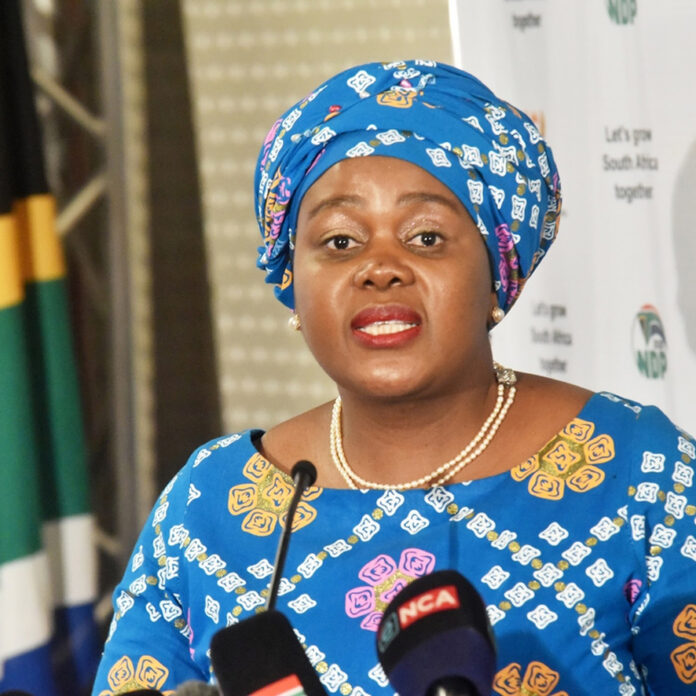
A campaign to force the disbandment of the National Prosecuting Authority’s (NPA’s) anti-corruption unit has reached the desk of Justice Minister Mmamoloko Kubayi, whose office recently received a report on the work of the specialised directorate established to pursue some of the country’s most sensitive corruption investigations.
Government insiders said that soon after the arrest warrants for crime intelligence head Lt-Gen Dumisani Khumalo and Maj-Gen Nosipho Madondo were put on hold, there were threats of legal action against Kubayi to pressure her into shutting down the Investigating Directorate Against Corruption (Idac), the special NPA unit set up to deal with serious corruption and state capture.
According to a source, the minister’s office has for about two weeks been processing reports from the NPA and Idac relating to performance on the back of complaints that the directorate was being used to pursue factional investigations and prosecutions, especially against SAPS and its crime intelligence wing.
The insider said threats of court action, from yet-to-be-named public interest groups or individuals, had been communicated to Kubayi to force her to disband the unit.
“Government is being threatened with being taken to court. People are calling for the minister to disband Idac,” the person said.
NPA spokesperson Kaizer Kganyago told Sunday World that he was not aware of any formal lobby for Idac to be disbanded reaching Mothibi’s office.
The disclosure comes on the back of the suspension of arrest warrants for Khumalo and Madondo, who were on Thursday instructed to present themselves at the Brooklyn police station in Pretoria before their arrests were halted.
KwaZulu-Natal police commissioner Lt-Gen Nhlanhla Mkhwanazi, who was outside the police station, subsequently demanded to know who made the call that resulted in the warrants not being executed.
On Friday, Kubayi also requested an urgent report from National Director of Public Prosecutions, Andy Mothibi, in terms of Section 33 of the National Prosecuting Authority Act.
Sunday World has established that the minister has since received the report, but the contents are not available, especially with the minister facing possible litigation in court.
In a statement on Friday, Kganyago confirmed that warrants of arrest had been issued against Khumalo and Madondo.
He said Idac subsequently received information that the two officers formed part of a Justice, Crime Prevention and Security (JCPS) cluster team assigned to prepare for a national security measure linked to immigration-related developments expected on June 30.
“In the interest of ensuring efficiency in the work of that team, Idac decided to suspend the execution of the warrants of arrest until the assignment of the two officers is completed,” Kganyago said.
Kubayi said the ministerial component of the JCPS cluster had not met.
“The colleagues in NPA and Idac can explain their statement. The security cluster has technical and ministerial committees. We didn’t have a JCPS ministerial meeting, and we don’t get involved in operational matters. I saw the statement like you, still waiting for the report,” Kubayi said.
The JCPS cluster operates through ministerial, directors-general and technical structures. The National Director of Public Prosecutions sits within the cluster’s technical structures, alongside senior officials from law enforcement, intelligence and criminal justice
institutions.
Parliament insiders said Idac was established through legislation. They said any move to dissolve the directorate would require legislative changes by Parliament.
The latest developments come amid criticism of Idac following testimony before the Madlanga commission.
Senior police officials have made allegations concerning factionalism, internal sabotage and political interference within parts of the criminal justice system. The criticism has intensified since the failed arrests of Khumalo and Madondo.
- A campaign to force the disbandment of the National Prosecuting Authority’s (NPA’s) anti-corruption unit has reached the desk of Justice Minister Mmamoloko Kubayi, whose office recently received a report on the work of the specialised directorate established to pursue some of the country’s most sensitive corruption investigations.
- Government insiders said that soon after the arrest warrants for crime intelligence head Lt-Gen Dumisani Khumalo and Maj-Gen Nosipho Madondo were put on hold, there were threats of legal action against Kubayi to pressure her into shutting down the Investigating Directorate Against Corruption (Idac), the special NPA unit set up to deal with serious corruption and state capture.
- According to a source, the minister’s office has for about two weeks been processing reports from the NPA and Idac relating to performance on the back of complaints that the directorate was being used to pursue factional investigations and prosecutions, especially against SAPS and its crime intelligence wing.
- The insider said threats of court action, from yet-to-be-named public interest groups or individuals, had been communicated to Kubayi to force her to disband the unit.


