


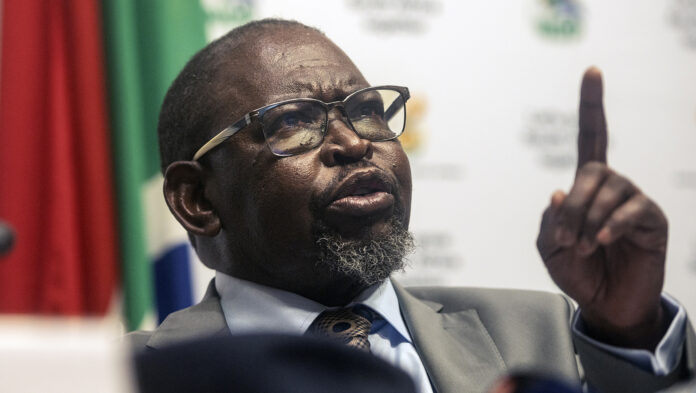
Municipalities across South Africa have failed to pay R1.7-billion deducted from workers’ salaries into their pension funds, Finance Minister Enoch Godongwana revealed on Friday, laying bare one of the most troubling reasons behind the National Treasury’s decision to freeze billions in funding to struggling councils.
The disclosure shifts the spotlight from the controversial withholding of R13.5-billion in equitable share allocations to 69 municipalities to the municipal employees whose retirement savings may not be where they are supposed to be.
The minister’s explanation comes against the backdrop of mounting criticism from opposition parties, labour unions and some government of national unity partners, who have accused Treasury of pursuing austerity, placing fiscal discipline ahead of economic growth and punishing ordinary South Africans for failures by politicians and municipal administrators.
Others argued that freezing municipal allocations would ultimately hurt communities by disrupting already fragile service delivery rather than holding those responsible for financial mismanagement to account.
‘Aim not to punish municipalities’
Godongwana, who had just landed from Gambia, used Friday’s briefing to answer those criticisms head-on.
“People must understand that we are not out there to punish municipalities. We have no intention to punish municipalities. We are doing what is constitutionally required of us,” he said.
He said the affected municipalities were not blindsided by Treasury’s decision. Instead, they had been given repeated opportunities to correct their finances before the unprecedented intervention.
“We don’t simply jump up and say, ‘Today we are withholding.’ We give you some time, send you letters, tell you, ‘Please comply.’ It’s only after then that we take decisive action,” he said.
Warning letters
According to the minister, more than 100 municipalities initially received warning letters, but many responded adequately, leaving 69 that failed to satisfy Treasury’s concerns.
“Others responded satisfactorily. We ended up having 69 municipalities that had not responded to the questions of the Treasury officials and me,” he said.
Godongwana said the affected municipalities fell into several categories, including those that repeatedly tabled unfunded budgets by approving spending plans without the revenue to support them.
But it was the second category that he described as particularly alarming.
“The second category is those that do not want to pay creditors. These municipalities owed R1.7-billion to pension funds as of February,” he said.
“In other words, they deduct money from employees of the municipality but do not transfer that money to the pension fund. When the worker goes to pension, there is a problem in paying his or her pension.”
The minister then turned directly to those who had criticised Treasury’s intervention, asking whether they were prepared to defend such conduct.
“R1.7 billion of pension funds have been deducted from members but have not been transferred into their pension. It is this kind of behaviour that we are trying to deal with. We are not interested in punishing, but are interested in supporting municipalities,” Godongwana said.
Protecting public money
He maintained that Treasury’s constitutional obligation is to protect public money while ensuring municipalities become financially sustainable.
“We’ve got to do both. We’ve got to strengthen accountability so that every rand collected works for residents.”
Municipalities hoping to regain access to the withheld funds will have to convince Treasury that they are restoring financial discipline by submitting credible repayment plans to creditors, committing to stop tabling unfunded budgets and demonstrating measurable improvements in financial governance.
For thousands of municipal employees, however, Friday’s revelations leave a more immediate question than the debate over austerity or fiscal discipline: whether deductions reflected on their monthly payslips have reached the retirement funds meant to secure their future.
- South African municipalities have failed to pay R1.7 billion deducted from employees' salaries into pension funds, revealed by Finance Minister Enoch Godongwana.
- Treasury has frozen R13.5 billion in funding to 69 municipalities due to financial mismanagement, including unpaid pension contributions and unfunded budgets.
- Opposition parties and unions criticized Treasury’s austerity measures, arguing they harm communities and penalize ordinary workers for political failures.
- Godongwana emphasized the Treasury's constitutional duty to enforce financial discipline, stating municipalities were warned repeatedly before funds were withheld.
- To regain funding, municipalities must submit credible repayment plans, stop approving unfunded budgets, and show improvements in financial governance.


