


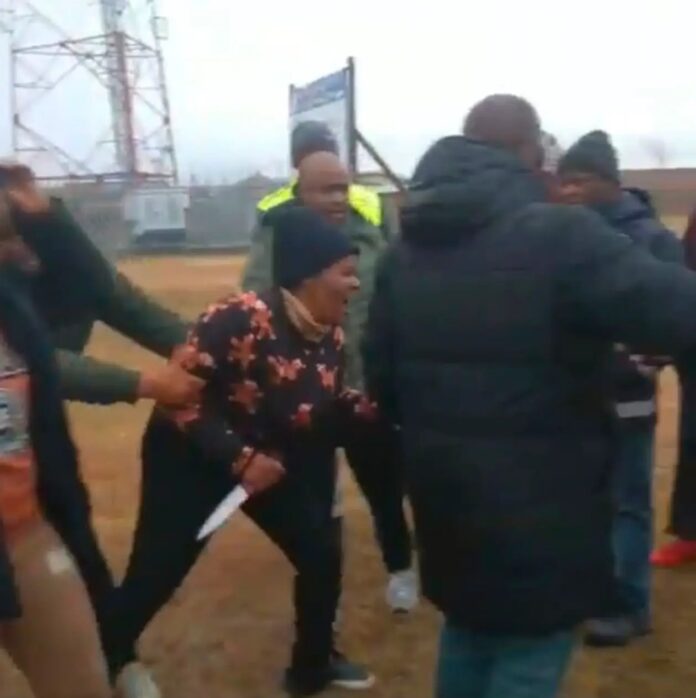
A photograph circulating on social media captures a moment of chaos at what is described as an ANC councillor selection meeting in King Sabata Dalindyebo Municipality’s Ward 4 in Mthatha, Eastern Cape.
A woman appears to be holding a butcher knife. Several individuals are physically restraining or moving towards that person. The body positions suggest a chaotic moment where people are attempting to prevent escalation or separate individuals.
The image does not independently establish what led to the confrontation, but it captures the level of tension surrounding some internal candidate selection battles as parties prepare for the 2026 local government elections.
Trust in candidate selection process at stake
The ANC’s greatest challenge before the November polls may be something other than persuading voters to return. It may be convincing its members that the candidates carrying its banner were chosen through a process they trust.
That single image does reveal several important things about the atmosphere surrounding such processes.
The power of the image is not only the apparent weapon. It is the breakdown of the boundary between a political meeting and physical confrontation.
A councillor selection meeting is supposed to be an internal democratic process where competing interests are resolved through debate, voting and rules. This image communicates the opposite.
Persuasion vs physical intervention
It captures a moment where political competition appears to have moved from persuasion to physical intervention. The visual message is one of a process under strain.
For an analysis of the ANC candidate selection process, the significance of such an image is that it illustrates the stakes attached to internal nominations.
In many municipalities, a councillor position represents access to political influence, public resources, visibility and a pathway into local government power.
That transforms branch-level candidate selection from a routine organisational exercise into a high-stakes political contest.
Three possible fault lines
The image therefore speaks to three possible fault lines, including the collapse of trust in internal processes, fear as a political instrument and the symbolism of grassroots political competition.
The presence of a butcher knife suggests that at least some participants did not believe ordinary political mechanisms were sufficient to resolve the dispute.
The question becomes: Why did a disagreement inside a political organisation reach a point where physical force appeared necessary?
That question goes directly to legitimacy. When factions believe meetings, voter rolls, candidate lists or officials are biased, disputes stop being about outcomes and become battles over the credibility of the process itself.
When fear enters the room
The image conveys fear. A democratic process depends on participants feeling safe enough to express disagreement and vote freely. When fear enters the room, the quality of the process is affected even before any vote takes place.
The image is powerful because it is not a picture of a national political fight. It appears to capture politics at its most local level. A ward meeting. A candidate selection process. Ordinary party members. That is exactly where political power is produced.
Before voters choose councillors in an election, parties first decide internally who will represent them.
The battles over those choices can therefore determine the quality of democracy before the public even reaches the ballot box.
The common thread is not only violence. It is legitimacy.
The incidents differ:
In Mafikeng, the situation includes allegations of intimidation, criminal complaints, and an intervention for dispute resolution.
In Cape Town, it involves community protests over the alleged imposition of candidates.
An alleged physical assault during a candidate selection process is involved in the Northern Cape.
In Limpopo and Eastern Cape incidents involve alleged physical confrontations captured on social media.
The connecting issue is that sections of communities or party members believe the process is being controlled rather than contested.
The recurring allegations are candidate imposition, manipulation of voter rolls, gatekeeping of meetings, exclusion of preferred candidates, and misuse of structures.
A crisis of confidence in the process
The deeper crisis is not simply disorder. It is a crisis of confidence in the process.
The Mahikeng dispute in Ward 21 provides a forensic example. The original meeting was challenged. The PDRC intervened. The meeting was nullified and a rerun ordered. The rerun itself was then challenged.
The argument moved from who should win to whether the rules determining who votes are fair. That is the essence of many ANC candidate disputes.
The fight is often over who qualifies to participate, which structures control the process, where the vote happens and who manages the verification process. The political consequence for the ANC is serious.
The ANC enters the 2026 local government elections needing candidates who can restore voter confidence after years of municipal decline.
But disputed candidate processes create a contradiction. The party needs candidates who can unify communities. Yet those candidates often emerge from internal battles that divide communities before the campaign begins.
The risk is that internal conflict becomes an electoral weakness.
A candidate who enters the election with a section of ANC members believing they were excluded begins the campaign with an internal opposition.
- A social media photo shows chaos at an ANC councillor selection meeting in Mthatha, Eastern Cape, with a woman holding a butcher knife amid a physical confrontation.
- The image highlights fears that political competition in ANC candidate selection has shifted from debate to physical conflict, reflecting a breakdown in trust.
- Internal disputes over candidate nominations are high-stakes, tied to access to political influence and resources, causing divisions and fears among members.
- Various ANC regions report conflicts involving intimidation, candidate imposition, and manipulation accusations, undermining confidence in the selection process.
- The ANC faces a dilemma ahead of the 2026 elections: needing unifying candidates while internal conflicts risk weakening voter trust and campaign cohesion.


