


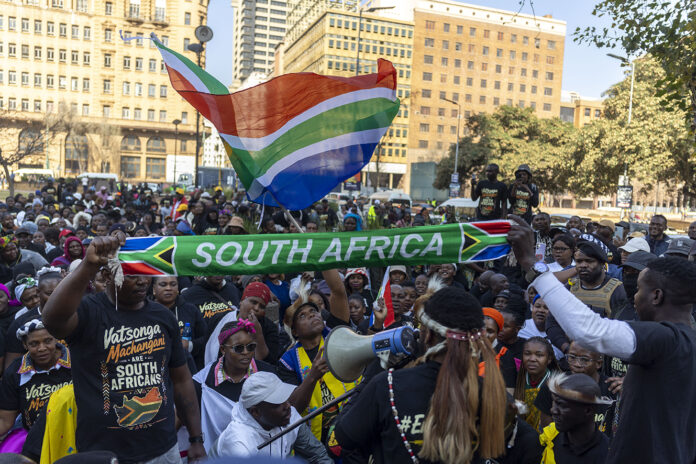
The government’s peace and security cluster has been advised to allow next week’s planned anti-illegal immigration marches to proceed under strict conditions rather than prohibit them.
Operational assessments concluded that regulated demonstrations were easier to police and less likely to descend into violence than unregulated protests.
Sunday World has learnt that the recommendation follows an intensive intelligence operation over the past two weeks, with operatives deployed across several provinces to monitor protest activity, identify organisers and influencers, assess emerging hotspots and protect critical infrastructure before the coordinated demonstrations on Tuesday.
On Friday, Justice Minister Mmamoloko Kubayi declared during an interministerial briefing that “the 30th of June is a normal day”. She stressed that the government does not recognise the day as a shutdown, warning that citizens are expected to be at work and that no one has the right to block public services or intimidate workers.
Security cluster sources said the recommendation to grant permission was based on the assessment that banning the marches would not necessarily prevent them from taking place but could instead create an unpredictable security environment.
“If you don’t give them permission, they are likely to march anyway. It then becomes much more difficult to control because there are no agreed conditions governing the event,” a security cluster source said.
Officials believe demonstrations held under agreed conditions place greater responsibility on organisers while allowing law enforcement agencies to protect participants, businesses, critical infrastructure and members of the public who are not participating.
Behind the recommendation is a nationwide intelligence operation involving continuous monitoring of protest organisers, mobilisation campaigns and potential flashpoints.
Security sources said intelligence operatives had travelled across the country, monitoring smaller demonstrations linked to illegal immigration, foreign truck drivers and unemployment to understand mobilisation patterns and identify individuals who might attempt to exploit the protests for criminal or violent purposes.
“Our responsibility is to ensure there is no sabotage of critical infrastructure, that marches remain peaceful and that they do not disrupt business activity,” a source involved in the operation said.
Officials said teams had recently monitored demonstrations in parts of Gauteng, including Soweto and the East Rand, as well as Pretoria Central and North, while similar deployments had taken place in other provinces where protest activity had intensified.
The operation also focused on identifying key organisers and influential figures behind the mobilisation.
Information gathered by intelligence operatives and seen by Sunday World illustrates the level of detail being collected to support operational planning.
Collected data included a planned march from Actonville Hostel to the industrial area near Carnival City, expected to travel along the R23, commonly known as Snake Road.
China Mall and Home Africa management in the Johannesburg CBD notified tenants that both shopping centres would close on June 30 and July 1 because of what they described as a “high-risk march and protest action”.
“In light of these security concerns and after careful consideration, management has taken the decision to temporarily close China Mall and Home Africa,” the notice states.
Traders at China Mall began closing their businesses early on Friday after receiving information that the planned marches could reach the area.
The shopping complex has instructed private security companies to increase manpower from Monday before the demonstrations.
Promotional material circulating this week advertises demonstrations in Pretoria, Johannesburg, Soweto, Germiston and Benoni, among other areas, under banners including “March and March”, “Operation Dudula”, “March Against Illegal Immigrants” and “South Africans First”.
Prominent leaders of the protests include Jacinta Ngobese-Zuma, Ngizwe Mchunu and Nkosikhona “Phakelumthakathi” Ndabandaba. One of the largest planned demonstrations is expected in Pretoria, where marchers intend to gather at Church Square before proceeding to the Sunnyside police station.
The Tshwane Metro Police Department has issued a public alert, warning motorists of extensive road closures associated with Tuesday’s march.
Acting National Commissioner Lt-Gen Puleng Dimpane said police had activated a nationwide integrated operational plan involving the SAPS, the South African National Defence Force, metro police departments, traffic law enforcement, disaster management structures and other government departments to ensure a coordinated response.
Dimpane said officers had been instructed to enforce the law “without fear or favour”, and warned that dangerous weapons and firearms would not be tolerated at public gatherings where prohibited by law or intended to intimidate others.
She urged organisers to discourage participants from carrying weapons or engaging in conduct that could provoke violence.
National Joint Operational and Intelligence Structure chairperson Lt-Gen Tebello Mosikili said the cluster had spent several weeks holding operational planning sessions and intelligence briefings to assess the security environment and ensure contingency measures were in place.
The Border Management Authority confirmed it would be fully deployed at the Beitbridge Port of Entry on Monday after successfully processing and repatriating 8 230 foreign nationals between June 12 and 24.
The operation included 6 709 Malawians and 1 521 Zimbabweans.
- The government’s peace and security cluster recommends allowing next week’s anti-illegal immigration marches to proceed under strict conditions, as regulated protests are easier to manage and less likely to become violent than banned ones.
- An intensive two-week intelligence operation monitored protest activity nationwide, identifying organisers, influencers, and potential hotspots to ensure readiness and the protection of critical infrastructure.
- Justice Minister Mmamoloko Kubayi stated June 30 is a normal workday, emphasizing no shutdown recognition and warning against blocking public services or intimidating workers.
- Security preparations include a nationwide integrated operational plan with police, military, and local agencies, aiming to enforce the law firmly, prohibit weapons, and maintain peace during the marches.
- Businesses like China Mall and Home Africa plan temporary closures due to security concerns, and major demonstrations are planned across Johannesburg, Pretoria, and other areas with road closures and heightened security measures announced.


