


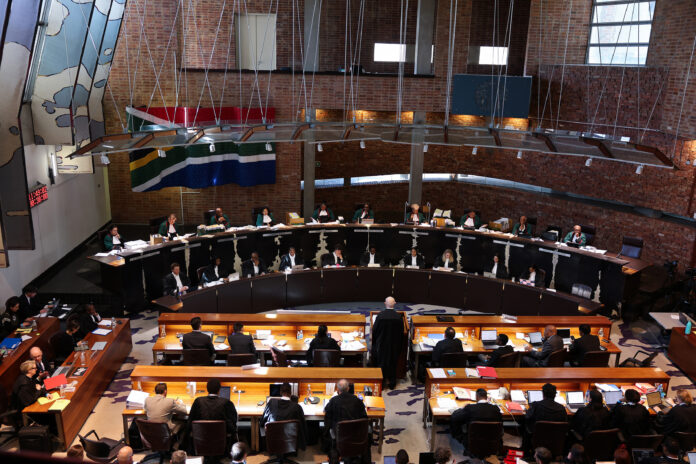
South Africa cannot build a judiciary that reflects the country’s racial and gender demographics while major law firms remain structurally untransformed, Adv Zinzile Matebese argued on Wednesday in defence of the Legal Sector Code.
Appearing for Justice Minister Mmamoloko Kubayi, Matebese told the Pretoria High Court that transformation in the legal profession was central to the constitutional project and could not be reduced to “tick-box” B-BBEE compliance.
‘Constitution backs transformation cause’
Addressing the ongoing legal challenge against the Legal Sector Code, Matebese said the Constitution explicitly places transformation at the centre of post-apartheid South Africa’s democratic order.
“That is clear from the Constitution,” he argued. “The express language of the Constitution of the Republic of South Africa puts transformation at the centre of the constitutional project.”
He linked the Legal Sector Code directly to Section 174 of the Constitution, which requires that the judiciary broadly reflect the racial and gender composition of South Africa when judges are appointed.
Matebese argued that law firms play a critical role in producing future judges and senior legal practitioners, making transformation within the profession essential to achieving constitutional goals.
“How do we achieve this? ” he asked the court.
“Do we achieve this by incentivising people who have 7% women and 25% Black people in their structures?”
Code critics slammed
He criticised some of the large firms challenging the code, arguing that high B-BBEE ratings meant little if Black professionals and women remained excluded from meaningful leadership positions.
“The object of the Constitution”, Matebese argued, “is that from those law firms we must have women of high quality and Black professionals of high quality who will preside over the affairs of South Africans.”
He told the court that South Africans needed judges and legal institutions that reflected their lived experiences, particularly given the country’s apartheid history.
“The colour of the person presiding matters to the people of South Africa,” Matebese said.
“It matters because we are coming from a traumatic past as South Africans.”
He argued that black litigants from rural areas should be able to appear before judges who understand the social and economic realities they come from.
“When a black person from Elliotdale comes before a judge, he must be able to see a judge that he resonates with,” Matebese submitted.
“He must become confident and comfortable that the person presiding over his matter understands the living conditions that he comes from in the rural area.”
According to Matebese, this was one of the reasons the Legal Sector Code sought to push large firms to recruit, train and promote Black professionals from historically disadvantaged communities.
‘Not about rands and cents’
He repeatedly stressed that the code was not primarily about procurement benefits or tender access.
“It is never about rands and cents,” he argued.
“It is never about Level 1 B-BBEE compliance and tenders. That is not the purpose that we want to achieve.”
Instead, he said, the code was intended to ensure “meaningful participation” of Black South Africans within the legal profession and broader economy.
Matebese described the Broad-Based Black Economic Empowerment Act as the legislative foundation for the Legal Sector Code, arguing that both flowed directly from constitutional obligations to address inequality and exclusion created under apartheid.
“The Legal Sector Code is a child of the B-BBEE Act,” he said. “The B-BBEE Act is a child of the Constitution.”
Meaningful inclusion
He argued that the B-BBEE Act specifically calls for “meaningful participation” of Black South Africans in the economy and not token representation designed merely to satisfy compliance targets.
“What the Act envisages is meaningful participation,” Matebese said.
“It does not envisage a situation where a person is hired solely for the purpose of ticking a box.”
He told the court the law rejects situations where Black professionals appear in structures formally but remain excluded from substantive decision-making.
According to Matebese, the Legal Sector Code was specifically designed to monitor whether transformation within firms was genuine and whether there was a “substantial change in the racial composition of ownership and management structures”.
The challenge against the Legal Sector Code has been brought by several law firms and legal bodies, which argue that aspects of the code are unconstitutional and unlawful.
But Matebese insisted the code serves a broader constitutional purpose tied to equality, redress and rebuilding institutions historically dominated by white professionals.
- Adv Zinzile Matebese argued in Pretoria High Court that South Africa's judiciary cannot reflect the country's racial and gender demographics without structural transformation in major law firms, defending the Legal Sector Code.
- He linked the Legal Sector Code to Section 174 of the Constitution, which mandates the judiciary to broadly represent South Africa’s racial and gender composition, emphasizing the role of law firms in producing future judges.
- Matebese criticized law firms challenging the code for limited inclusion of Black professionals and women in leadership, underscoring the need for judiciary members who understand the lived realities of all South Africans, especially from disadvantaged backgrounds.
- He stressed the code’s purpose is not about procurement benefits or B-BBEE compliance tick-boxes but about ensuring meaningful participation and genuine transformation within the legal profession.
- The Legal Sector Code is rooted in the Broad-Based Black Economic Empowerment Act and the Constitution, aiming to address apartheid-era inequalities through substantial changes in law firm ownership and management structures.


