


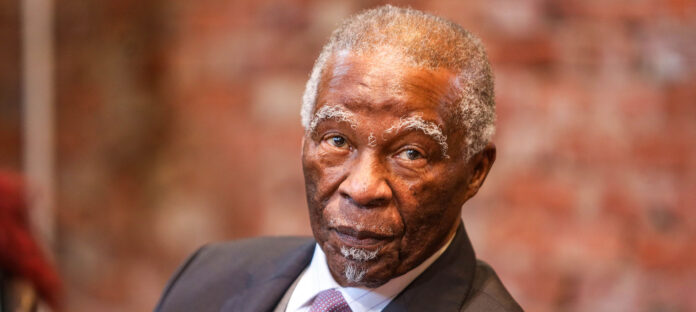
Former president Thabo Mbeki has challenged African leaders to match their calls for continental unity with investment in the infrastructure needed to make that unity practical, questioning what must be done to ensure the African Union (AU) leads member states towards projects that can connect the continent.
Mbeki, speaking recently on the future of Africa’s development agenda at the Africa Mindset Reset Forum said the continent needed to move beyond political commitments and focus on practical measures that would advance the goal of African unity.
He asked how Africa could ensure that the African Union, “from its assembly to its commission”, could “actually lead its member states” towards measures such as infrastructure investment.
“How do we ensure that leaders understand infrastructure investment well enough to direct it?” Mbeki asked.
His intervention placed infrastructure at the centre of the challenge facing the continent’s unity project.
READ: Thabo Mbeki’s inconvenient truth: When intellectuals fail to deliver on plans
For Mbeki, the question is not whether African leaders have expressed support for integration, but whether that commitment is translated into decisions that physically connect African economies and societies.
He said Africa needed leadership capable of driving the practical steps required to realise the vision that “Africa must unite”.
Mbeki also questioned what was needed to “provide the leadership that both government and society at large need”, placing emphasis on the role of political leadership in mobilising action around continental priorities.
The former president’s comments return to a central argument of his African Renaissance vision: that political unity requires practical foundations.
Infrastructure investment, he argued, was one of those foundations.
The challenge facing African governments, according to Mbeki’s intervention, is how to ensure that commitments made at the continental level translate into actual projects.
He asked what could be done to ensure that the AU’s structures were able to lead member states towards those objectives.
The former president singled out the AU Assembly and Commission, saying the continental body needed to play an active role in guiding governments towards common priorities.
His remarks come as African leaders continue to promote continental integration through initiatives aimed at increasing trade, connectivity and cooperation between countries.
ALSO READ: ‘Mbeki not an ANC super leader’ – NEC meeting told
But Mbeki’s focus was on implementation.
His argument was that unity requires practical interventions, including investment in the systems that allow countries to work together.
The former president has long associated Africa’s renewal with Africans taking responsibility for shaping the continent’s future.
In this intervention, he returned to the question of whether African institutions and governments have the leadership required to turn that ambition into reality.
The message was directed at the continent’s political leadership: if African unity remains the objective, then leaders must demonstrate that commitment through the decisions and investments required to build it.
For Mbeki, infrastructure is not simply an economic issue.
It is part of the mechanism through which Africa can become more connected, more integrated and closer to the goal of unity.
- Former president Thabo Mbeki emphasized the need for African leaders to invest in infrastructure to make continental unity practical.
- Mbeki questioned how the African Union (AU), particularly its Assembly and Commission, could lead member states towards infrastructure investment and unity.
- He highlighted that African unity requires leadership capable of transforming political commitments into tangible projects that connect economies and societies.
- Mbeki asserted that infrastructure investment is a foundational component of the African Renaissance and essential for practical unity.
- His remarks underscored the challenge of ensuring AU structures guide governments in implementing continental integration initiatives.


