


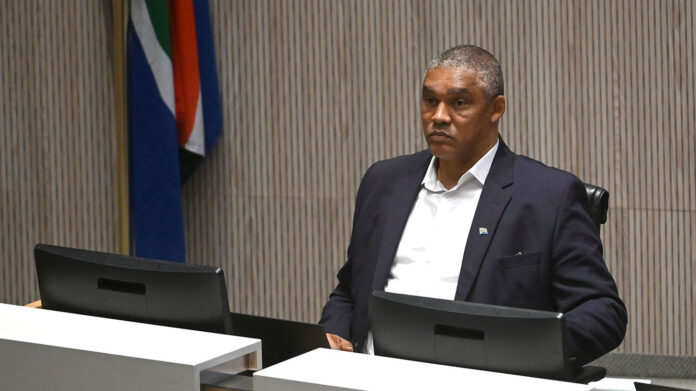
A confidential forensic report on Tshwane city manager Johann Mettler has been revealed after being discussed in a private council meeting.
It shows that the municipality has governance problems but raises doubts about whether political leaders correctly identified the wrongdoing or unfairly blamed one person for bigger issues in the organisation.
The report, intended for private consideration by councillors, was leaked after the in-committee council meeting where the city manager’s disciplinary process was discussed.
The investigation, which allegedly cost the city about R5-million and was dubbed as fruitless and wasteful expenditure, began when the office of executive mayor Nasiphi Moya received allegations concerning his conduct.
Council then resolved that an independent investigation should be conducted to determine whether there was a basis for the claims.
The Motsoeneng Bill Incorporated report does not find that Moya or Tshwane’s political leadership acted improperly. Instead, it tests whether the accountability process correctly separated failures requiring institutional reform from conduct requiring individual sanction.
“Remedial institutional action and individual disciplinary culpability are separate questions and must be determined on their respective evidential and legal foundations,” the investigators concluded.
The report found that while Tshwane faced serious administrative, governance, procurement and operational problems, the evidence did not establish that most of the failures amounted to misconduct by Mettler.
“The existence of an irregularity, governance failure, adverse finding or operational deficiency does not, without more, establish misconduct on the part of the city manager.
“The investigation did not establish a sufficient evidentiary basis to substantiate the majority of the allegations of serious misconduct against Mr Mettler.”
The findings do not deny that Tshwane has institutional problems. Investigators acknowledged “administrative, governance, procurement or operational concerns”. But, they said, the problems did not automatically translate into the city manager’s misconduct.
One of the most politically significant issues examined was the Hammanskraal water crisis and the problems at the Rooiwal Wastewater Treatment Works. The problems had developed over along time. They pointed to underinvestment, inadequate treatment capacity, maintenance backlogs and the failure to implement the wastewater master plan as contributing factors.
The report found that after his appointment, Mettler had taken steps, including securing funding, engaging national stakeholders, implementing Public Protector remedial action and involving the Development Bank of Southern Africa.
The allegation that he committed gross dereliction of duty was found to be unsubstantiated.
A similar finding applied to the allegation that Tshwane incurred fruitless and wasteful expenditure of about R37-million paid to suspended officials.
Investigators said the allegations were unsubstantiated. Suspensions on full pay were legally required and involved disciplinary processes.
They also found no evidence of deliberate delay or wilful or grossly negligent conduct.
On procurement deviations amounting to R284.78m, the report acknowledged weaknesses in procurement planning, contract management and the municipality’s reliance on Regulation 36 deviations.
But the evidence did not establish that all deviations were illegal or that Mettler deliberately breached procurement rules.
The report challenges the idea that Tshwane’s problems could be attributed to the city manager alone. Many of the matters raised either predated Mettler’s tenure, arose from systemic or institutional weaknesses, involved the responsibilities of other officials or lacked evidence connecting them to him.
The investigation did, however, identify a significant adverse finding against Mettler. After information concerning an allegation against senior manager Ashraf Adam came to his attention, Mettler had failed to table the matter before council.
Mayoral spokesperson Samkelo Mgobozi said yesterday the forensic report was tabled and considered by council in committee and any decision on releasing it must be referred to council through the speaker.
Mgobozi said Moya had communicated the decision not to institute disciplinary proceedings against Mettler.
“The City rejects the claim that the probe was fruitless and wasteful, saying council had grounds to commission it,” adding that, “the fact that no disciplinary action followed does not make the process unnecessary.”
Mgobozi also said the alleged R5-million cost of the investigation was speculative and could not be confirmed.
- A confidential forensic report on Tshwane city manager Johann Mettler revealed governance issues but found insufficient evidence to substantiate most misconduct allegations against him.
- The investigation, costing about R5-million, was initiated following allegations received by executive mayor Nasiphi Moya and aimed to distinguish institutional failures from individual culpability.
- The report found Tshwane faced administrative, governance, procurement, and operational problems, but these issues did not directly translate to misconduct by Mettler.
- A significant adverse finding was made against Mettler for failing to present an allegation against senior manager Ashraf Adam to council.
- Mayoral spokesperson Samkelo Mgobozi stated the council considered the report in committee, decided against disciplinary action for Mettler, and denied the investigation was fruitless or wasteful.


