


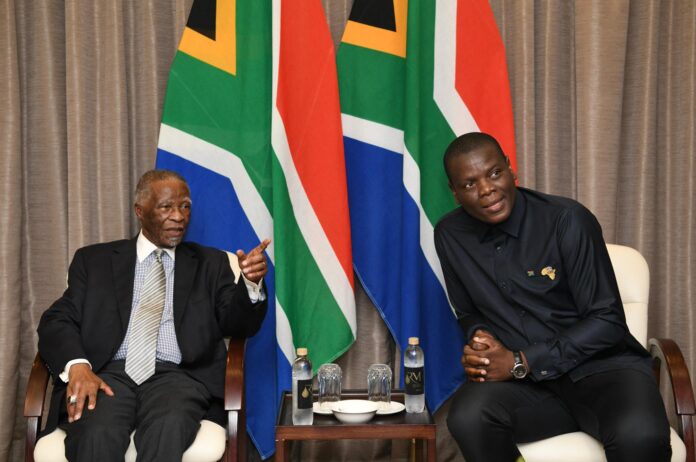
The Thabo Mbeki Foundation has exposed selective amnesia and double standards embedded in US President Donald Trump’s hostile stance towards South Africa’s redress laws and policies when he is implementing the same in his own country to address effects of slavery and colonialism.
This is contained in the foundation’s detailed monograph titled The United States of America and the Future of the Afrikaners in South Africa, which was summarised in video form in the Africa Renaissance Podcast by chief executive of the foundation, Max Boqwana, this week.
READ: Moegoe from the USA: Bozell needs to back off
According to the document, which Boqwana says can be used by anyone interested in resolving the diplomatic fallout between Washington and Pretoria, the US has been engaged in enforcing redress policies for as far back as 1865 before the assassination of then US President Abraham Lincoln, who was allegedly eliminated for pushing for the balancing of the scales for all races in the US.
But the document says even Trump himself, who has fingered South Africa for pushing for “reverse racism” laws, fed by the so-called AfriSol movement of AfriForum and Solidarity lobby groups for the Afrikaner community, has been implementing BEE in the US since his first stint as head of state and is doing so even now.
Boqwana said Trump, as recent as the 2026 UN General Assembly last month, was boasting about how his presidency has benefitted the African American community in increasing their meaningful participation in the US economy.
Trump the champion of BEE in US
“If you watched Trump’s presentation in the UN General Assembly, he was talking about US successes, and one of those was the improvement of lives of black and hispanic people, saying that their lives had improved under his leadership,” said Boqwana in a conversation with Dr Mbuyiseni Ndlozi, unpacking the foundation’s document.
The document itself goes to town about Trump’s belief in redress policies and how he practically implemented those in both stints as US head of state.
“In September 2020, at a rally in Atlanta, Georgia, shortly before that year’s US Presidential Election, Donald Trump launched what he called his ‘Black Economic Empowerment Platinum Plan’,” reads the Mbeki Foundation document, which has been met with vitriol from sections of the Afrikaner community scholars.
“Speaking again in Atlanta, Georgia, on 25 September 2024, President Trump said:’…I’m here today to announce a brand new plan to deliver more opportunity, more security, more fairness, and more prosperity to Black communities. We call it the Platinum Plan. Platinum Plan. And that’s a contract with Black Americans, and it’s going to be something that people talk about for a long time to come.
“‘If you vote Republican over the next four years, we will create 3-million new jobs for the Black community, open 500 000 new Black owned businesses, increase access to capital in Black communities by $500-billion. This includes investing
in community development, financial institutions, and minority depository institutions’.”
Boqwana said the document emphasises how America has always believed in redress policies since the time of Lincoln and again a century after his passing during the tenure of President Lyndon Johnson.
BEE, a long-standing US policy
The document argues that as early as 1863, Lincoln had started publicly agitating for redress in the aftermath of the years of slavery.
It adds that Lincoln’s public agitation for redress at the time affirmed that people described as settler colonialists in the US, the white population of European extraction, saw it as their duty to live up to the founding principle of the US that “all men are created equal”.
READ: US Pressure on South African Sovereignty: Why Retaliatory Measures will benefit the governing party?
The foundation further argues that history records that Johnson took over the baton from Lincoln’s pro-redress orientation when he, in 1964, proclaimed publicly that “it was more than a hundred years ago that Abraham Lincoln, a great president of another party, signed the Emancipation Proclamation, but emancipation is a proclamation and not a fact.
“A century has passed – more than a hundred years – since equality was promised. And yet the Negro is not equal. A century has passed since the day of promise. And the promise is unkept. The time of justice has now come … All Americans must have the
privileges of citizenship regardless of race.”
During his time, Johnson was pushing for the adoption of the 1964 Civil Rights Act, another form of redress that has been practised by the US for more than 150 years.
Boqwana said even in the 1980, then US President Ronald Reagan was also forced to implement redress-policies with pressure from Johnson’s stance, which was influenced by the the riots of the American Civil Rights Movement during the 1950s and 1960s.
“They (Johnson and Reagan) understood that having not attended to this redress 100 years earlier, they were postponing conflict and strife, and that is the strife they began to see around the civil rights movement riots, so these matters had to be sorted out once and for all,” said Boqwana.
“That is the warning for a country like South Africa, we cannot keep on postponing this issue of poverty and we cannot not be serious about redress because at some point people will not want to listen to anything, they will just say things must burn.
“In the US, President Reagan eventually issued an Executive Order saying there must be an annual minority business development plan so that there country at all times must see what is the progress what in the employment of black people. This is the essence of equality.”
Warning against ‘white genocide’ narratives
The Mbeki Foundation document warns against sections of the Afrikaner community in South Africa exploiting the ignorance of the likes of Trump to drive false narratives such as “white genocide” to force ill-informed punitive action against the county and isolation from the global community.
The foundation is not merely complaining or lamenting the problem but has taken active steps to play a part, which includes meeting US ambassador to South Africa, Leo Bozell, who they believe needs a lot of convincing as he currently appears to have drank a lot from the AfriSol propaganda.
Boqwana said the foundation will have another engagement with Bozell as part of its role in seeking to ease the tensions between the two countries, saying neither of the two can afford to divorce the other from decades of mutually-beneficial bilateral trade and relations.
“South Africa needs the USA and the USA needs South Africa,” said Boqwana.
- The Thabo Mbeki Foundation released a monograph exposing alleged double standards in US President Donald Trump's criticism of South Africa's redress laws, highlighting Trump's implementation of similar policies in the US.
- The document details that the US has enforced redress policies since 1865, starting with President Abraham Lincoln and continuing through leaders like Lyndon Johnson and Ronald Reagan.
- Trump introduced the "Black Economic Empowerment Platinum Plan" in 2020 to create jobs, open businesses, and increase capital access for Black Americans.
- The foundation warns against Afrikaner groups promoting narratives like "white genocide" to justify punitive measures against South Africa.
- The Mbeki Foundation has engaged and plans further talks with US Ambassador Leo Bozell to ease diplomatic tensions and emphasize the mutual benefits of US-South Africa relations.


