


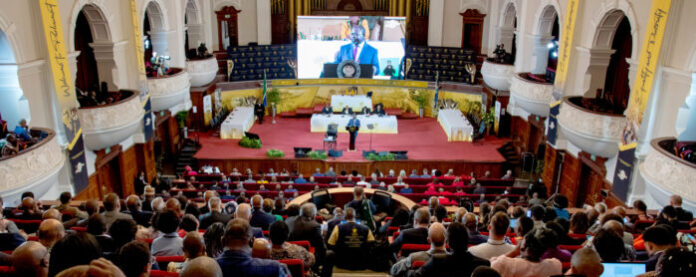
In that December sitting of 2022, parliamentarians spoke as if the judges were already en route to Phala Phala to clear up one or two confusing questions around the Section 89 panel report and would be back in a jiffy.
So the House was urged to breathe slowly. The country was urged to slow down impeachment proceedings and wait.
This will now become a strong point in limine against Ramaphosa because it attacks the credibility, good faith and procedural integrity of the review before the court even reaches the merits.
Consistency and honesty
In simple terms, the argument says: Before the court asks whether Ramaphosa is legally right, it must first ask whether this review process is being used consistently and honestly.
That is critical because the courts are not only concerned with legal technicalities. They are also guardians of the integrity of constitutional processes.
And here, the chronology creates a serious problem.
The message drifting through the National Assembly chamber that day in December 2022 was unmistakable: do not rush; do not escalate. The judges will give guidance.
GOOD Party MP Brett Herron rose and warned that it would be “unfair and unreasonable” to place a sitting president before an impeachment committee while “these legal questions remain unanswered”.
Then he proposed what sounded like a constitutional raincheck.
“Parliament should today resolve, in principle, that the section 89 process must proceed, but the commencement of the impeachment committee should be deferred, pending the outcome of the president’s review.”
All eyes on the review
And then came the promise that framed the entire debate.
“If the president’s review fails, the impeachment committee process must proceed. If his review is upheld, the need for an impeachment committee falls away.”
NFP leader Ahmed Shaik Emam followed the same script.
“We, at the same time, cannot overlook the fact that there’s an application before ConCourt to review the findings of this particular panel.”
Then he tightened the brakes further.
“What we will not agree with, however, I want to reiterate, is the impeachment process until that review application is finalised before a court of law.”
And again: “…we don’t believe that this process should continue until the review application is finalised before a court of law.”
ANC’s review crutch
The ANC itself leaned heavily on the pending review.
Then Chief Whip Pemmy Majodina stood before Parliament and declared: “Silithathela ingqalelo inyathelo likaMongameli lokusa ingxelo yeGqiza eliZimeleyo kwiNkundla noMgaqo-Siseko ukuze iyokuphononongwa…” (“We take into account the step taken by the President to take the Independent Panel report for constitutional review before the courts… ”)
Then she added: “I-ANC ayiyixhasi le ngxelo kude kubekho ubungqina obubambekayo…” (“The ANC does not support this report until there is concrete evidence… ”)
Then Justice Minister Ronald Lamola reinforced the same message.
“The president has exercised his rights to take the report on review.”
Then: “The president, like any South African, has a right to exercise his rights.”
And further: “But the president just took the matter on review to show that he has got grounds; he does not agree with the report.”
The atmosphere inside Parliament that day mattered because the review stopped being Cyril Ramaphosa’s private legal affair the moment MPs began using it as reason to cool impeachment momentum.
Once Parliament formally relied on the pending review as justification for restraint, the process acquired constitutional significance beyond Ramaphosa’s personal litigation rights.
That is what makes this such a powerful point in limine before anyone even gets to the legal merits of Ramaphosa’s latest application.
Review as a shield
The issue is no longer simply whether Ramaphosa has legal arguments against the Section 89 panel. The issue is whether the review process itself was used consistently and in constitutional good faith.
Because the earlier review materially changed Parliament’s conduct.
MPs did not merely acknowledge that Ramaphosa had gone to court. They used the pending review as part of the reason Parliament should hold back from escalating impeachment proceedings.
In effect, Parliament – acting in the name of the people of South Africa – was told: Wait for judicial clarity.
And once that happened, the review entered the constitutional bloodstream.
It stopped being something Ramaphosa could casually switch on and off depending on political circumstances.
Awkward review withdrawal
That is why the withdrawal matters so much.
If the review had remained irrelevant to Parliament’s conduct, withdrawing it later would have been politically awkward but constitutionally insignificant.
But that is not what happened here.
The review became part of the machinery that slowed impeachment momentum. It became part of the political shield around the presidency.
Then the ANC used its majority. Ramaphosa survived the impeachment vote. And after the danger passed, the review quietly disappeared before the judges could pronounce on anything at all.
No judgment.
No constitutional clarity.
There was no final ruling on whether the Section 89 panel had acted lawfully or unlawfully.
The judges Parliament had been told to wait for never arrived.
And that sequence creates the appearance that the review may have served a tactical purpose beyond constitutional principle: launch review, create uncertainty, cool impeachment momentum, survive politically, then withdraw the process once it has served its purpose.
Legally, Ramaphosa had every right to withdraw the review.
But constitutionally, that is where the discomfort begins.
Because Parliament does not sit for itself. It sits for the people of South Africa.
And once Parliament was persuaded to slow down accountability partly because judicial clarification was supposedly coming, abandoning the review created a direct contradiction between what Parliament was led to expect and what ultimately happened.
Now Ramaphosa is back before court raising many of the same constitutional objections again in a fresh review application filed in the Western Cape High Court.
And hanging over the new application is a question that refuses to die: If the judges were so important in December 2022, why were they suddenly unnecessary once the president was politically safe?
- In December 2022, South African Parliament urged slowing impeachment proceedings against President Ramaphosa pending judicial review of the Section 89 panel report.
- Multiple MPs, including those from GOOD Party, NFP, and ANC, supported deferring the impeachment process until court rulings on Ramaphosa’s legal review were finalized.
- Parliament’s reliance on the pending judicial review as reason to hold back impeachment gave the review constitutional significance beyond just Ramaphosa’s personal legal rights.
- The review was later withdrawn by Ramaphosa after he survived impeachment, raising concerns it was used tactically to delay proceedings and create political cover without judicial clarity.
- Ramaphosa has since filed a new constitutional challenge in the Western Cape High Court, with critics questioning why the initial promised judicial guidance was abandoned once politically convenient.


