


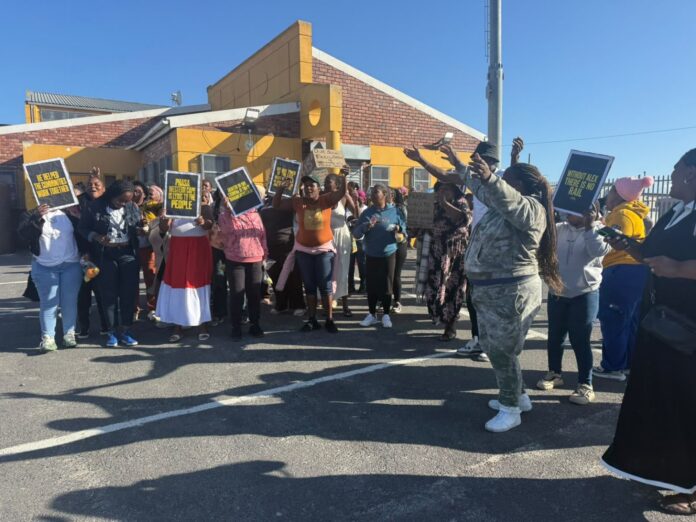
About 200 residents living along Cape Town’s Central Line have given the City of Cape Town, Western Cape government and Prasa 14 days to produce a written plan showing when they will fix dangerous living conditions in informal settlements along the railway.
The warning followed a march through Brown’s Farm on Wednesday before residents packed Ruth First Community Hall in Sinqolamthi Street for a community meeting over safety, sanitation, electricity, roads, refuse collection and crime.
Their message was blunt. “We are tired of promises. We want delivery.”
Residents say trains are passing dangerously close to homes while children move around settlements without adequate fencing, barriers or safe railway crossings.
“The trains are passing very close to our homes. There is no fence, no barrier, no safe crossing. Our children’s lives are in danger every day,” their memorandum reads.
READ MORE: Murder on the Tracks: The drama behind PRASA’s Central Line recovery
The communities want safety fencing and walkways installed along the Central Line as a matter of urgency.
But the railway is only one part of their complaint.
Residents say they are living without adequate toilets, clean running water, proper roads, electricity and regular refuse removal.
“We are living in dangerous and inhumane conditions. We have been promised services many times, but there is no delivery,” they said.
Their memorandum was directed at the city, provincial government, Prasa, ward councillors and the Human Settlements Department.
It demands a meeting within 14 days and a written plan setting out dates for addressing each grievance.
Roads, rubbish and emergency access
Residents say rubbish is piling up in some settlements because there is no regular cleaning or refuse collection.
They want weekly waste removal, chemical toilets and clean water taps while authorities work on permanent infrastructure.
Access roads are another flashpoint.
Residents say some settlements have no proper streets or roads, leaving ambulances, fire engines and other emergency vehicles struggling to reach people when disaster strikes.
“We do not have proper roads or streets. Emergency vehicles, ambulances and fire trucks cannot enter when there is an emergency,” they said.
They want roads graded and proper access routes constructed.
The march also exposed tensions between residents and Prasa over a man referred to in the memorandum only as “Alex”.
Several protesters carried placards reading: “WE WANT ALEX BACK”, “WITHOUT ALEX THERE IS NO RAIL” and “HE HELPED THE COMMUNITIES WORK TOGETHER”.
Sunday World understands the reference to “Alex” to be to former Prasa security chief Alex Papadupolo.
READ MORE: The paper trail behind the R60m Prasa security probe
Residents claim he worked closely with communities during efforts to reopen the Central Line and helped build cooperation between settlements and Prasa security.
“Alex is the one who worked with us to open the Central Line,” the memorandum states.
“He knows our communities, and we trust him.”
The memorandum describes what happened to him as his “removal/persecution” but does not explain the circumstances around his departure from duties linked to the Central Line.
Sunday World reported last month that police are examining allegations that Papadopulo improperly influenced subcontracting linked to Prasa’s Central Line security programme.
Papadopulo denies wrongdoing and says the social compact grew from meetings involving Prasa, government departments, the Housing Development Agency, the city and communities and was “signed by all the role players, including the community”.
Crime, darkness and electricity
Crime and darkness are also fuelling anger.
Residents demanded high-mast lighting, visible policing and community safety patrols, saying women and children were particularly vulnerable at night.
Electricity has become another source of frustration.
The memorandum accuses authorities of failing to fulfil promises to electrify informal settlements, leaving residents dependent on illegal connections which they say increase the danger of shack fires.
“You promised us electricity but you have not delivered. We are living in darkness and using dangerous illegal connections that cause fires,” residents said.
READ MORE: The sensitive state secrets on Papadopulo’s devices
The dispute is complicated by where some of the settlements are situated.
Residents say they have been told services cannot be provided because some communities are occupying privately owned land.
They want government to negotiate with landowners instead of allowing the ownership dispute to leave residents without basic services.
“But we are people and we need services where we are living now,” the memorandum states.
“Government must engage the landowner and find a solution.”
Authorities put on the clock
One placard carried during Wednesday’s march captured the broader anger: “PRASA WESTERN CAPE IS LYING TO THE PEOPLE.”
Residents’ wider ultimatum, however, goes beyond their dispute with PRASA.
They want fences, toilets, water, electricity, roads, lighting, refuse collection and security, backed by a written timetable.
“We do not want politics, we want action,” they said.
The City, provincial government and PRASA now have 14 days to meet the communities and tell them when delivery will begin.
- Around 200 residents along Cape Town's Central Line demanded a written plan within 14 days from the City of Cape Town, Western Cape government, and Prasa to fix dangerous conditions in informal settlements.
- Residents raised safety concerns about trains passing dangerously close to homes without fencing, barriers, or safe railway crossings, and called for urgent installation of safety fencing and walkways.
- They also complained about inadequate toilets, clean water, proper roads, electricity, and regular refuse removal, emphasizing emergency vehicles' difficulty accessing settlements due to poor roads.
- The memorandum referenced former Prasa security chief Alex Papadupolo, who residents credit for helping reopen the Central Line and building cooperation, but he faces allegations of improper influence in Prasa subcontracting.
- Residents demanded high-mast lighting, visible policing, and safer electricity connections, and urged government engagement with private landowners to provide services amid land ownership disputes.


